The Big Picture
This site visit covered two of Taiwan’s key experimental carbon capture and storage (CCS) projects: Taipower’s pilot test at the Taichung Power Plant, and CPC Corporation’s CO₂ geological storage test site at Tiechenshan. The takeaway? Taiwan’s CCS/CCUS efforts have moved beyond policy discussions and desktop studies into the experimental phase—running field trials, drilling test wells, preparing regulations, and exploring business models in parallel.
To be clear: these are small-scale experiments, not commercial operations. But they mark an important shift from theory to practice.
Three themes stood out.
1. The technology is being tested in the field
Taipower is planning an integrated capture-and-storage pilot experiment at the Taichung Power Plant, targeting 2,000 tonnes of CO₂ per year—a tiny fraction of the plant’s emissions, but enough to test whether local geological formations can accept CO₂ and whether it can be monitored and managed safely. Injection and monitoring test wells are set to be drilled.
Meanwhile, CPC’s Tiechenshan site has completed its initial trial injection runs. Backed by decades of oil and gas exploration data, existing well infrastructure, and monitoring systems, it is Taiwan’s first government-approved CO₂ geological storage test site.
2. The policy and regulatory timeline is coming into focus
Taiwan’s Ministry of Environment is advancing regulations for CO₂ capture and storage management, along with a strategic environmental assessment and low-carbon electricity standards. In parallel, the Ministry of Economic Affairs is studying low-carbon electricity certificates, carbon reduction methodologies, and relevant electricity and energy regulations—groundwork for making CCS a recognized part of a future low-carbon power supply.
3. CCS is emerging as a piece of Taiwan’s net-zero and energy security puzzle
Taiwan faces simultaneous pressures: a 2050 net-zero commitment, growing electricity demand, and the appetite of semiconductor fabs and AI data centers for low-carbon power. With renewables constrained by limited land, contested marine space, and grid conditions, natural gas plants paired with CCS could become an option worth testing for reliable low-carbon electricity—which is exactly what these experiments are designed to find out.
Highlights: Taipower’s Taichung Power Plant
Taipower began geological surveys and capture technology R&D back in 2008, including a 3,000-meter exploration well in the Changbin Industrial Park that confirmed promising caprock and sandstone formations for storage.
The utility is now in the pre-commercial experimental phase, focusing on:
A 2,000-tonne-per-year integrated capture and storage pilot test
Exploring Carbon Capture Ready (CCR) concepts for future gas-fired units
Evaluating potential long-term storage sites and conducting feasibility studies at other locations
A planned “Taichung Carbon Reduction Technology Park” will include a small-scale capture test facility, an education and exhibition center, and CO₂ utilization demonstrations—building on micro-scale testing units that have already been completed and put through their trials. The storage experiment will place injection and monitoring wells near the plant, drilled to roughly 3,000 meters—a critical proof-of-concept for Taiwan’s power sector.
Highlights: The Taichung Storage Well Site
The small-scale injection experiment targets 2,000 tonnes per year, 4,000 tonnes in total, to verify injectivity, monitoring systems, and risk assessment. Both test wells will reach about 3,000 meters deep, using acid-resistant casing and cement, core sampling, seismic sensors, and fiber-optic monitoring.
The CO₂ will move through storage, feeding, pressurization, heating, pressure control, and injection. Once underground, high temperature and pressure will push it into a supercritical state. Monitoring covers the full experimental lifecycle: baseline measurements before injection, surface monitoring and geochemical sampling during injection, and long-term monitoring afterward to confirm the CO₂ stays put.
Highlights: CPC’s Tiechenshan Test Site
Located in Tongxiao, Miaoli, Tiechenshan is Taiwan’s first government-approved CO₂ geological storage test site—and its backstory matters. The site was originally one of Taiwan’s major onshore natural gas fields, developed by CPC decades ago. After production declined, CPC converted the depleted reservoir into an underground natural gas storage facility, injecting gas into the formation during periods of low demand and withdrawing it when needed.
This history gives the site two big advantages for CO₂ storage experiments. First, decades of drilling, production, and injection operations have generated an exceptionally detailed picture of the subsurface geology. Second, the reservoir has already proven it can hold gas: the same anticline structure that trapped natural gas for millions of years—and safely stored injected gas for years of storage operations—offers strong evidence that it can contain CO₂ as well.
The storage layer is a sandstone formation about 1,400–1,500 meters underground, sealed by a thick mudstone caprock, with no active faults nearby—favorable containment conditions. The site is designed for an annual injection capacity of 100,000 tonnes of CO₂, and is equipped with CO₂ storage tanks, an unloading area, pressurization and heating equipment, injection wells, monitoring wells, observation wells, and environmental monitoring systems.
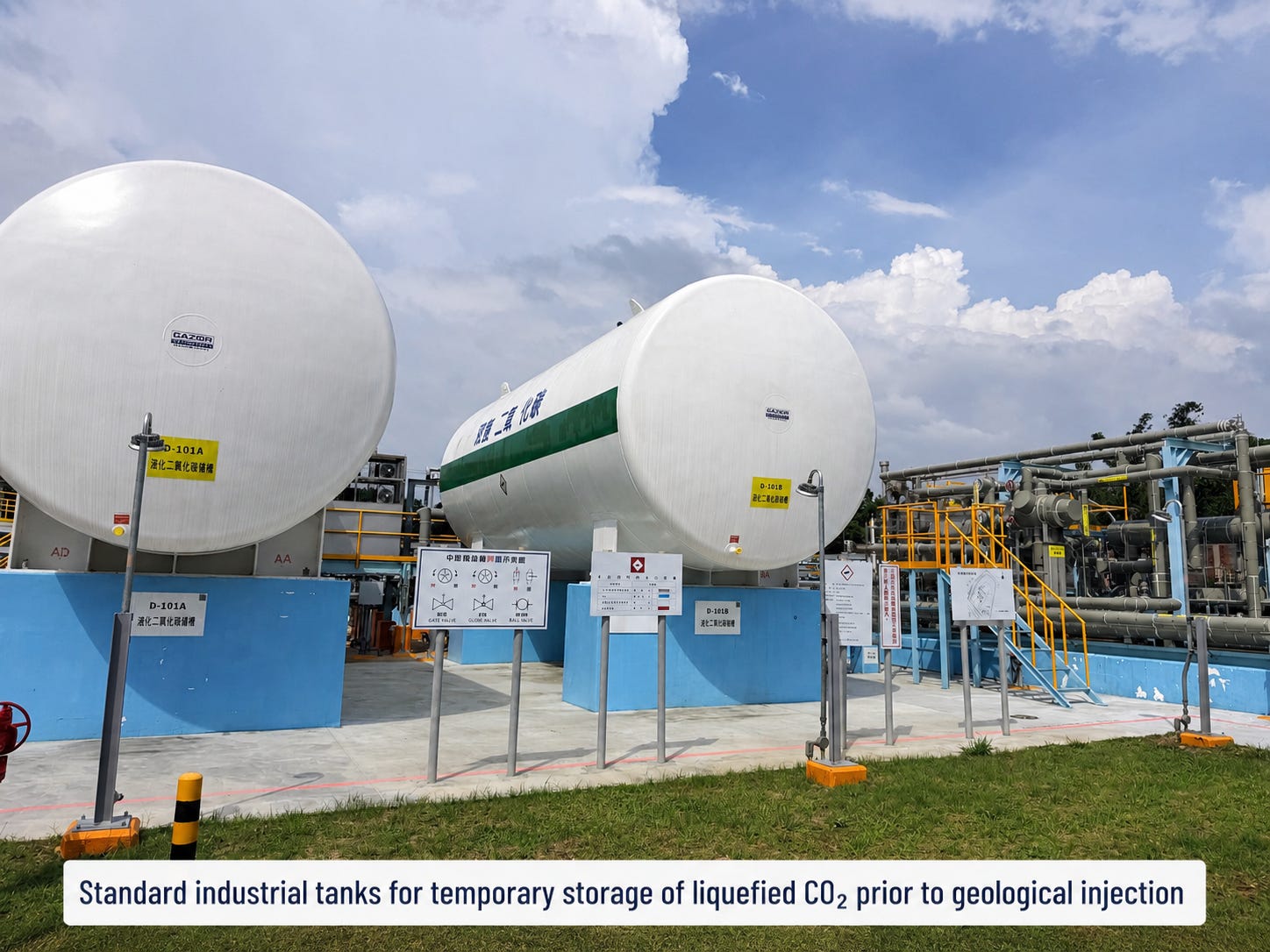
During trial runs, more than 100 tonnes of CO₂ have been injected—a deliberately small volume compared with the site’s 100,000-tonne annual design capacity—with all indicators meeting contract specifications. Acceptance testing and formal injection trials come next. Notably, the site also features public information displays and an online environmental data portal, publishing injection volumes and monitoring data—a foundation for public communication and building social trust.
Shared Challenges
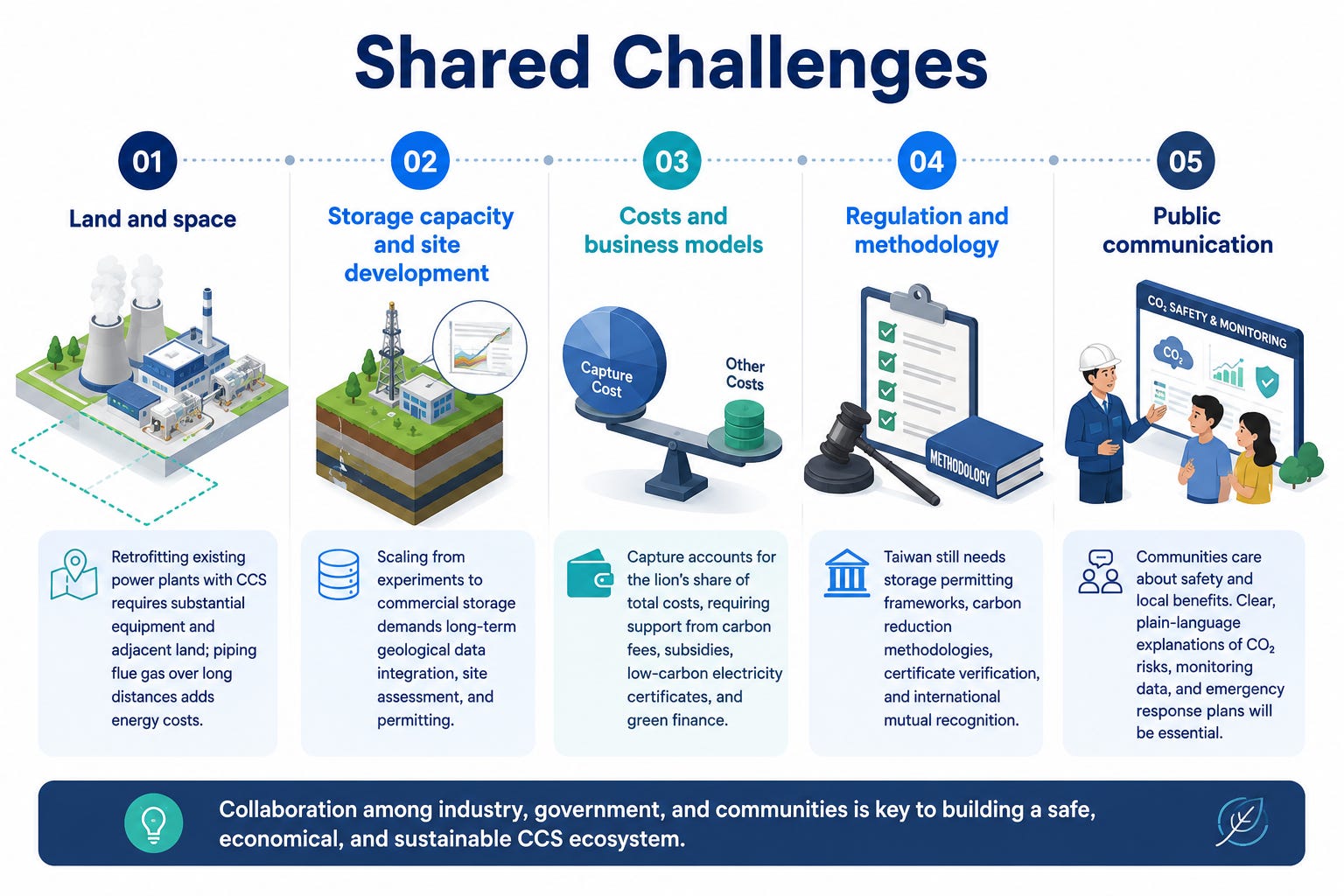
Land and space: Retrofitting existing power plants with CCS requires substantial equipment and adjacent land; piping flue gas over long distances adds energy costs.
Storage capacity and site development: Scaling from experiments to commercial storage demands long-term geological data integration, site assessment, and permitting.
Costs and business models: Capture accounts for the lion’s share of total costs, requiring support from carbon fees, subsidies, low-carbon electricity certificates, and green finance.
Regulation and methodology: Taiwan still needs storage permitting frameworks, carbon reduction methodologies, certificate verification, and international mutual recognition.
Public communication: Communities care about safety and local benefits. Clear, plain-language explanations of CO₂ risks, monitoring data, and emergency response plans will be essential.
The Road Ahead
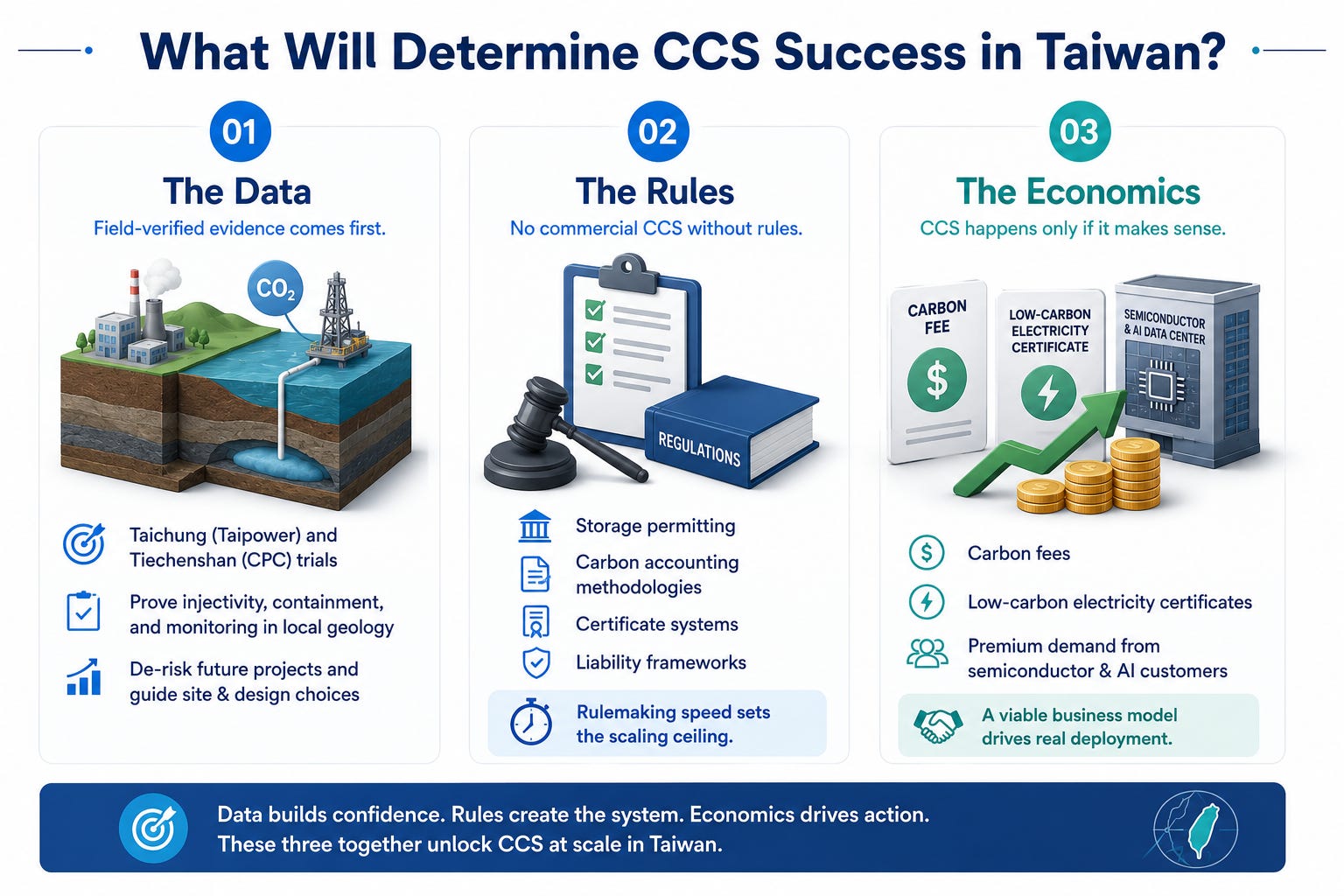
What happens next will determine whether these experiments become the foundation of something bigger. Over the coming years, watch for three signals.
First, the data. Taipower’s injection wells at Taichung and CPC’s formal injection trials at Tiechenshan will generate Taiwan’s first systematic, field-verified evidence on injectivity, containment, and monitoring performance in local geology. Good results would de-risk every subsequent project; surprises would force a rethink of site selection and design assumptions. Either way, the data matters far beyond these two sites.
Second, the rules. Experiments can run on special approvals, but commercial CCS cannot exist without a regulatory home—storage permitting, carbon accounting methodologies, certificate systems, and liability frameworks. The pace at which the Ministry of Environment and Ministry of Economic Affairs translate ongoing studies into binding rules will effectively set the ceiling on how fast CCS can scale.
Third, the economics. Even with proven technology and clear rules, CCS only happens if someone pays for it. The interplay of carbon fees, low-carbon electricity certificates, and demand from semiconductor and AI data center customers willing to pay a premium for clean, reliable power will decide whether a viable business model emerges.
None of this will move fast—geology, regulation, and infrastructure never do. But the direction is unmistakable. Taiwan has stopped asking whether to test CCS and started asking how well it works here. For an island economy with world-leading chip fabs, surging power demand, and hard limits on renewable expansion, that is a question worth answering with real wells, real CO₂, and real data.