How big is the gap?
CORSIA is the International Civil Aviation Organization’s (ICAO) global market-based measure for emissions from international aviation. Its first phase covers 2024 to 2026, and airlines must cancel CORSIA Eligible Emissions Units (EEUs) between December 2027 and January 2028.
IATA’s June 2026 estimate puts first-phase demand at 213 million tonnes of CO2 in its central scenario, against an eligible supply of only about 38 million tonnes, a gap of roughly 175 million tonnes. ICAO’s CORSIA Eligible Emissions Unit Supply Project estimates demand at 170 to 236 million tonnes, while the consultancy Sylvera, using a “partial implementation” scenario that excludes routes within the European Economic Area among other factors, estimates demand at about 163 million. The methods differ, but the conclusion is the same: supply covers only a small fraction of demand.
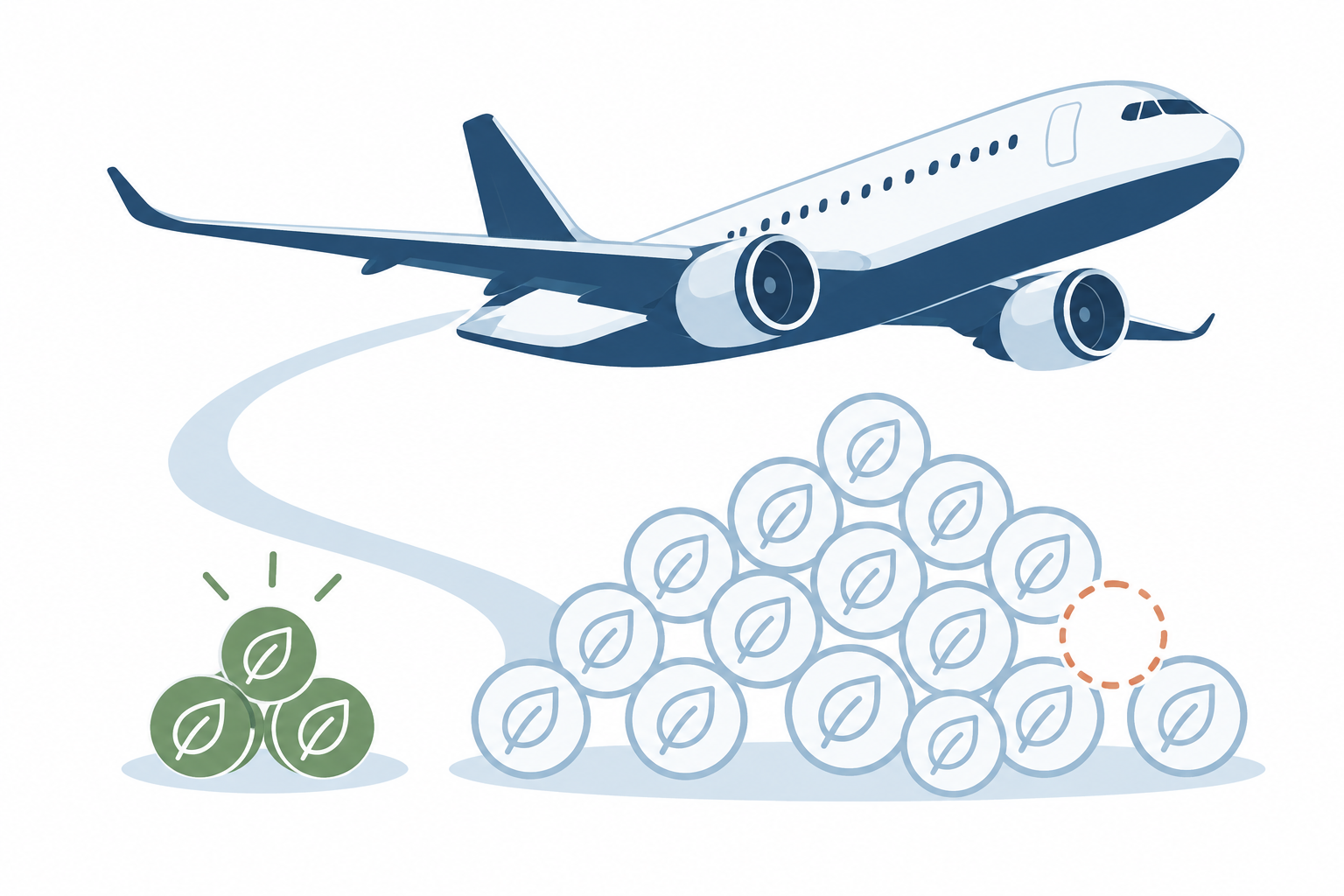
The gap is narrowing, but not fast enough. IATA’s 18 September update says that as of August 2026, about 72 million units were backed by 42 CORSIA-compatible Letters of Authorization (LoAs), leaving a gap of about 150 million units that must be closed within 15 months.
Why are eligible credits so scarce?
The first phase of CORSIA accepts only eight programmes approved by ICAO, and not every project type or vintage qualifies. Credits generated from 2021 onward may also need a Letter of Authorization from the host country confirming that the reductions will not also be counted toward its own Nationally Determined Contribution. Sylvera estimates that of the roughly 300 million tonnes of issued credits that “may” qualify, only about 13% have actually become EEUs.

The “eligible” label is becoming an asset
Issue 86 of the Carbon Market Journal reports that on 28 September, Canada-based Base Carbon’s cookstove project in Rwanda received Verra’s CORSIA Phase 1 eligibility label for another 639,609 units, bringing the project’s eligible total to 1,959,812 units. In July, Base Carbon also said that ICE’s December 2026 CORSIA Phase 1 futures had risen about 39% since 30 June. As CarbonCredits.com put it, the question used to be “does this credit represent a credible reduction?”; increasingly it is “where can it legally be used?”

The second phase begins in 2027 and runs to 2035. On ICAO’s current list, 134 States are participating, so the pool of demand will only grow.

What it means for Taiwan
Taiwan is not an ICAO member, but since 2019 its Civil Aeronautics Administration (CAA) has required Taiwanese airlines to monitor, report and verify emissions from international flights in line with CORSIA rules, designated the Taiwan Accreditation Foundation (TAF) as the national accreditation body, and in 2023 completed the legal framework for aviation emissions reduction. CAA figures put the 2019 international-flight emissions of China Airlines, Mandarin Airlines, Tigerair Taiwan, EVA Air and UNI Air at about 12.8 million tonnes, and CAA officials said in 2023 that from 2024 airlines falling short of their targets would have to buy carbon credits.
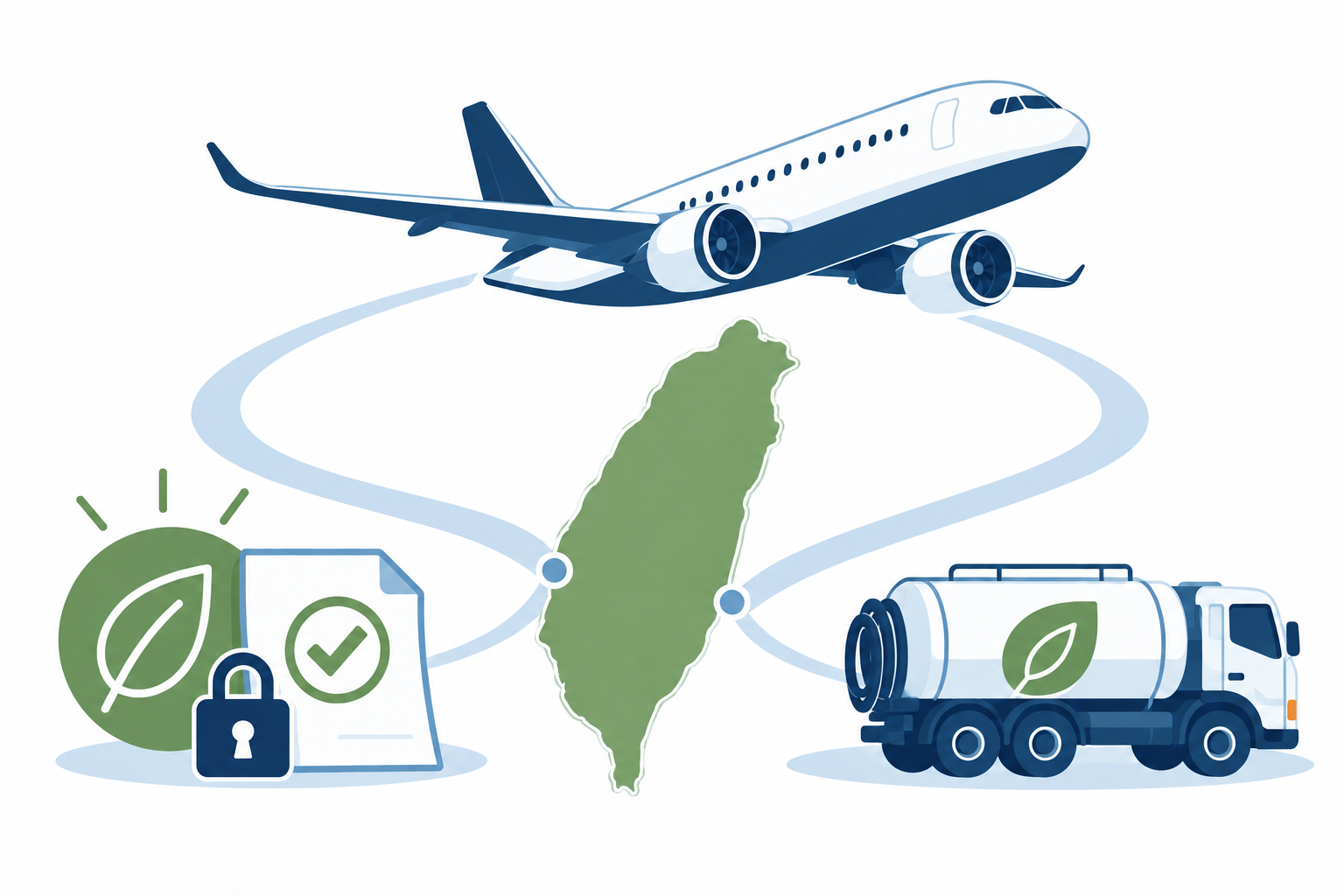
With eligible credits in short supply worldwide and prices likely to rise, Taiwanese airlines are unlikely to wait until just before settlement to enter the market. Two prudent paths stand out. The first is to lock in eligible units early through long-term contracts, checking each project’s Letter of Authorization and eligibility label. The second is to keep advancing sustainable aviation fuel (SAF): in April 2025, China Airlines, EVA Air and STARLUX flew with SAF for the first time from Taoyuan, Songshan and Kaohsiung. For policymakers, the bigger question is whether Taiwan’s own emission-reduction projects could one day become supply recognised by the international aviation market, rather than Taiwan being only a buyer.
Sources
Carbon Market Journal #86 | CORSIA Crunch, Clean Energy & the Race to Net Zero (CarbonCredits.com, LinkedIn newsletter, 2026-10-03): https://www.linkedin.com/pulse/carbon-market-journal-86-corsia-crunch-clean-energy-race-wjlbe
CarbonCredits.com, CORSIA Credit Crunch: Base Carbon Adds 640,000 Rwanda Credits to Aviation Market (2026-09-29): https://carboncredits.com/base-carbon-corsia-rwanda-credits-supply-gap/
Base Carbon press release (GlobeNewswire, 2026-09-28): https://www.globenewswire.com/news-release/2026/09/28/3369789/0/en/base-carbon-announces-corsia-eligible-tagging-of-previously-issued-carbon-credits.html
ICAO, CORSIA Eligible Emissions Unit Supply Project (CSP) presentation: https://www.icao.int/filebrowser/download/130608?fid=130608
IATA Chart of the Week, CORSIA EEU Supply is Growing but not Fast Enough (2026-09-18): https://www.iata.org/en/iata-repository/publications/economic-reports/corsia-eeu-supply-is-growing-but-not-fast-enough/
Sylvera, CORSIA Countdown (June 2026): https://info.sylvera.com/hubfs/CORSIA-Countdown-Report%5FSylvera-June2026.pdf
Ministry of Transportation and Communications press release (in Chinese), 2023-12-08: https://www.motc.gov.tw/ch/app/data/view?id=14&module=news&serno=c521a803-0b6f-47a0-8a7b-1c1bf120500e
Central News Agency (in Chinese), 2023-12-08: https://netzero.cna.com.tw/news/202312080242/
CAA SAF presentation (in Chinese), 2025-04-23: https://service.cca.gov.tw/File/Get/cca/zh-tw/Q1a1DBnybG5B34U