Over the past few years, “2050 net zero” has become almost standard kit in corporate sustainability reports.
But the real question is not whether a company has made a pledge; it is:
Can this target actually be achieved?
If a company announces net zero by 2050 but has no clear technology pathway, investment plan, governance mechanism or implementation timeline, what does that commitment actually mean?
ISO’s newly published draft of ISO 14060, Net zero aligned organizations is precisely an attempt to answer that question.
It is not another carbon accounting method, nor a new emissions-reduction formula; it aims to establish the world’s first verifiable corporate net-zero governance standard.
The point is not how to count carbon, but how to manage net zero
Many people’s first glance at ISO 14060 may lead them to think it is yet another new standard for calculating greenhouse gas emissions.
It is not.
Companies already have a number of mature tools, for example:
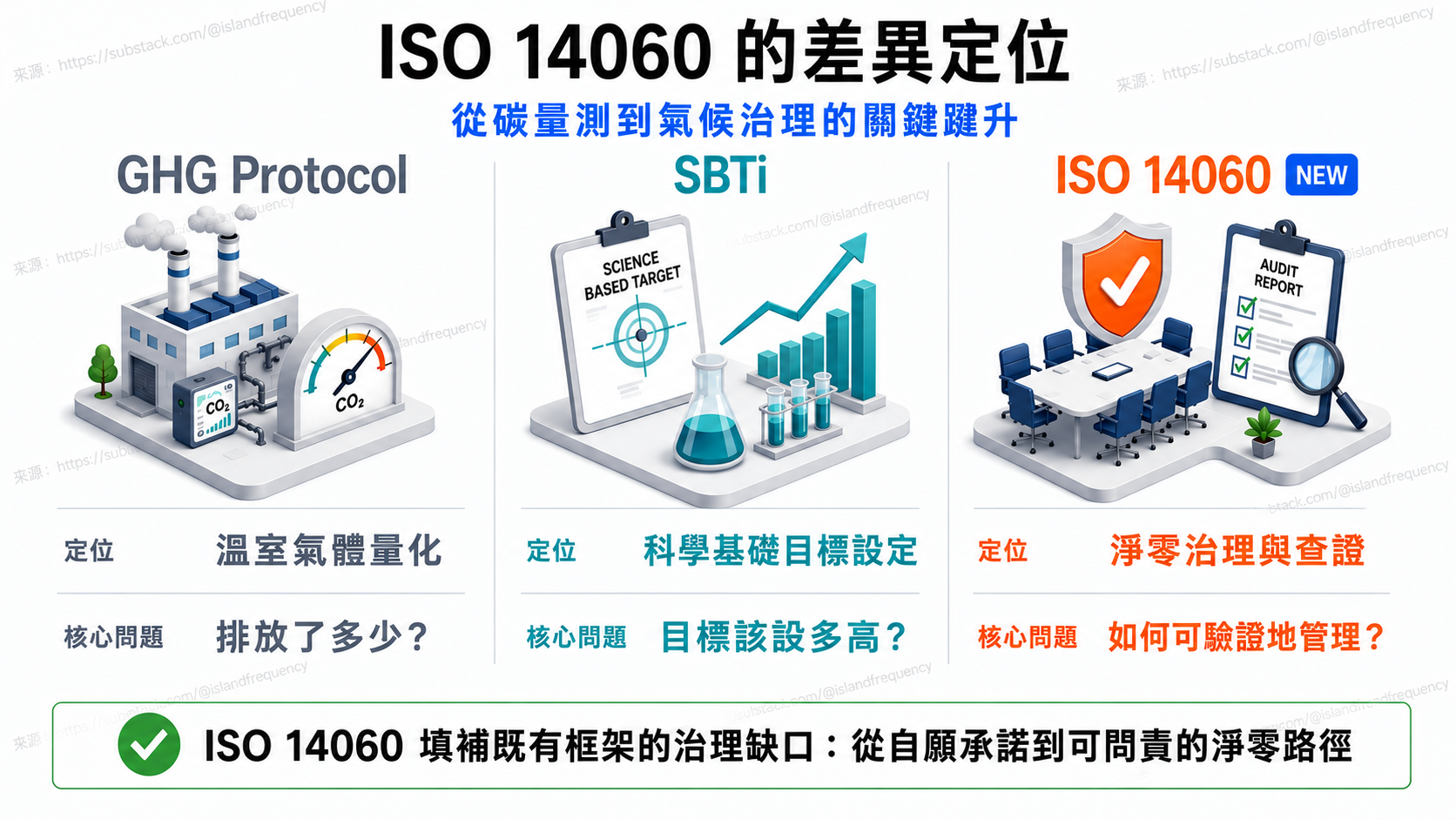
GHG Protocol sets the rules for carbon accounting
SBTi sets science-based reduction targets
ISO 14064, 14067 and related standards focus on greenhouse gas management
ISO 14060 does not intend to replace them.
What it really sets out to solve is a different problem:
Does a company have the capability to deliver net zero in practice?
In other words, ISO is shifting the focus from “carbon emissions management” to “corporate governance”.
In future, shouting net zero will not be enough
One of the most noteworthy requirements in the ISO draft is:
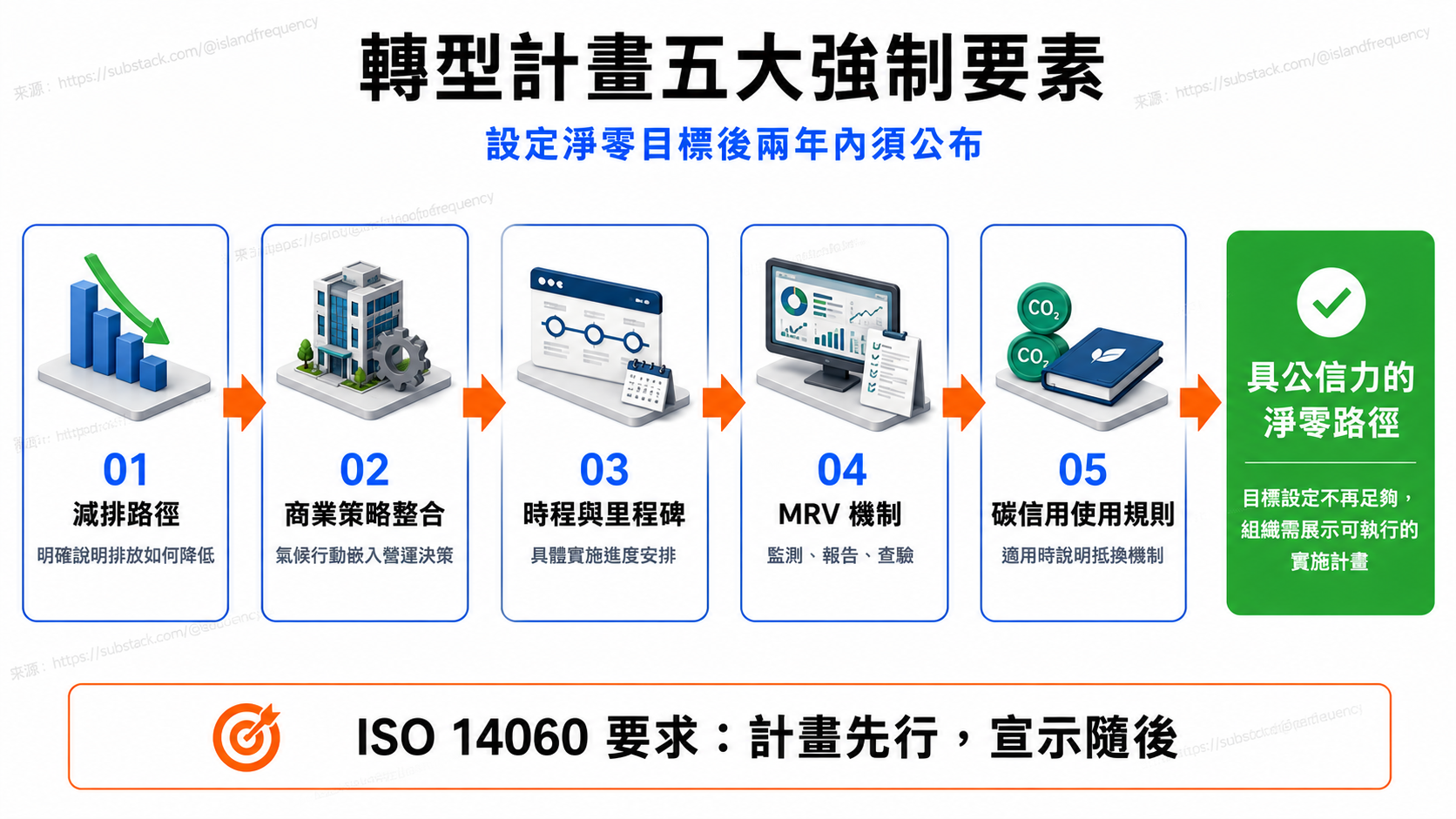
Once a company has set a net-zero target, it must publish a complete Transition Plan within two years.
The content is not just emissions-reduction targets; it includes:
- ✔ How emissions will be cut
- ✔ How the business model will be adjusted
- ✔ When each stage will be completed
- ✔ How monitoring and disclosure will work (MRV)
- ✔ Whether carbon credits will be used, and how
In other words,
in future a company cannot get by with only a “2050 Net Zero” logo.
More important is this:
You have to be able to produce a complete construction blueprint.
Third-party verification may become a new baseline
Another major change is that ISO stresses:
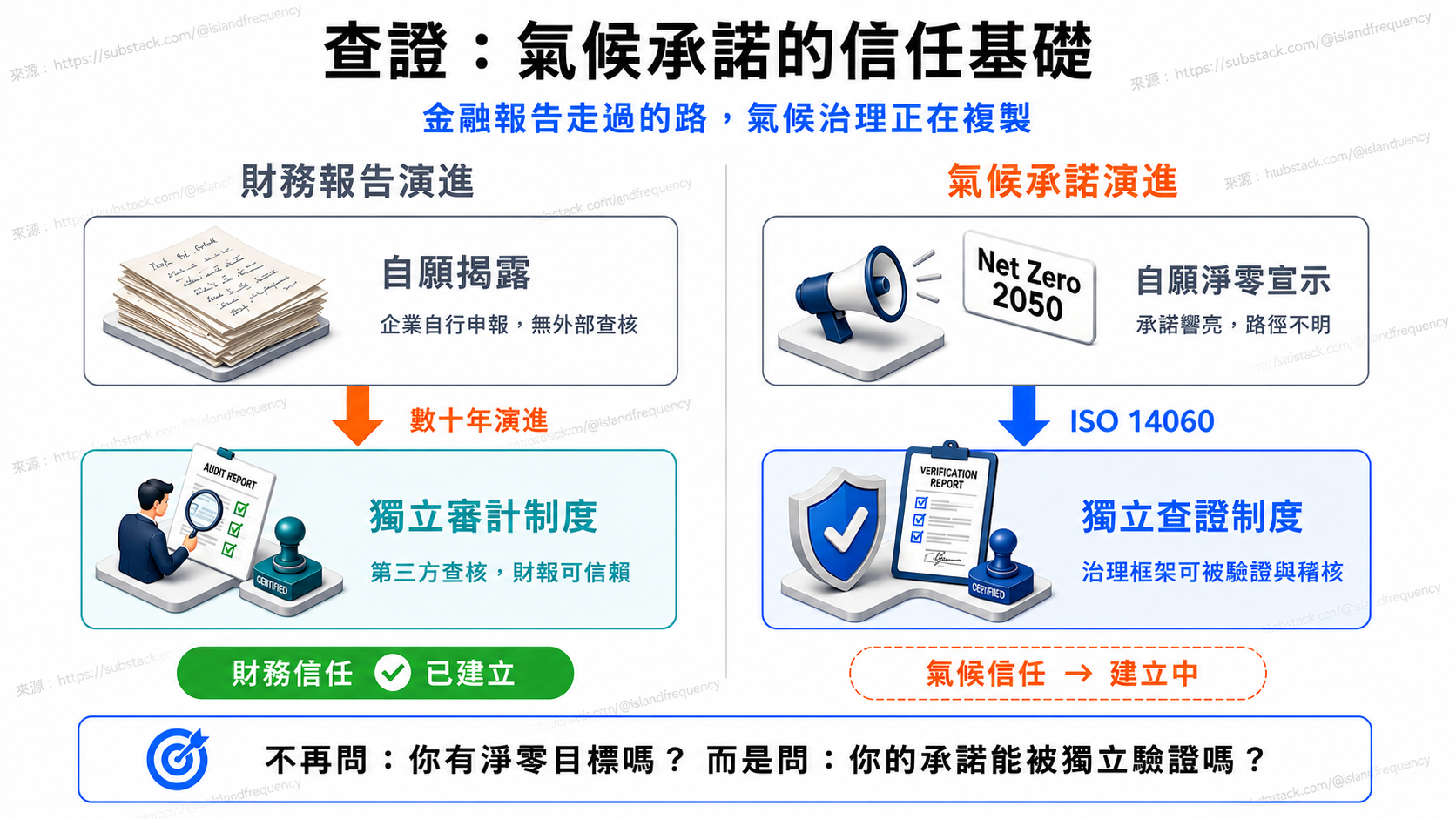
All net-zero commitments should undergo independent third-party verification.
That means what companies will be measured on in future is not only emissions cuts, but credibility.
In fact this is much like financial statements.
A company’s financial reports carry public trust not because the company itself says how much it earned, but because they have been audited by accountants.
In future, net-zero commitments may move in the same direction.
The market will no longer look only at what companies say; it will care more about:
Is there evidence?
SMEs have not been overlooked
ISO also knows that not every company has the resources of a multinational.
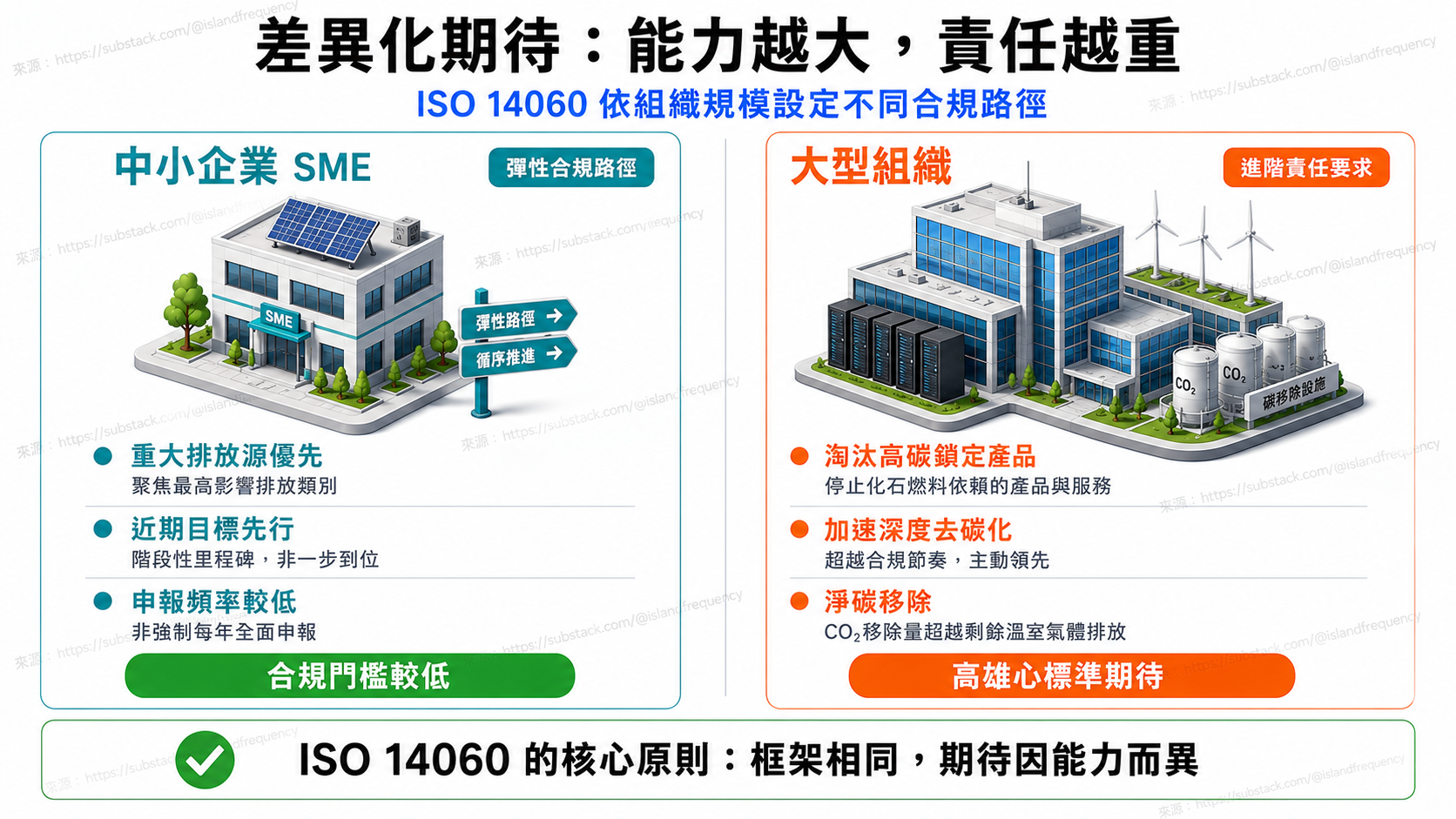
The draft therefore gives small and medium-sized enterprises (SMEs) greater flexibility, for example:
They may focus first on material emission sources
They may set medium-term targets first
Disclosure frequency may be relaxed from once a year to once every three years
By contrast,
large enterprises are expected to take on greater responsibility, for example:
Gradually phasing out high-carbon products
Avoiding new fossil-fuel lock-in
Over the long term, working towards CO₂ removals that exceed their own residual emissions
The greater the capability, the greater the responsibility.
That has also become an increasingly clear trend in international climate governance in recent years.
What does this mean for Taiwanese companies?
If your company has export markets, an international supply chain, or faces overseas customers, ISO 14060 is worth starting to watch.
Especially in semiconductors, electronics manufacturing, ICT, steel, cement, chemicals and similar industries, the future may require proof not only of product quality but also that:
Your net-zero management capability is credible.
It is also worth noting that ISO is deepening its cooperation with the GHG Protocol, and companies may gradually move towards a more consistent global carbon-management framework.
For multinationals, that can narrow the gaps between different standards; for supply chains, it also means that net-zero governance will gradually become a shared language.
My observations
In recent years, corporate discussion of net zero has mostly focused on:
Should we buy green power?
How do we buy carbon credits?
How do we calculate Scope 3?
But ISO 14060 sends another, more important signal:
What truly determines a company’s competitiveness is not only emissions-reduction technology, but governance capability.
In future, net zero will no longer be only the work of the ESG department.
It will gradually become part of the board, operating strategy, investment decisions and corporate governance.
Seen from that angle, the value of ISO 14060 is not merely adding another standard.
It represents an upgrade in how global business thinks about management—
Net zero is moving from a target to a system of governance.
If this topic is relevant to your work, feel free to get in touch.
📩 twnccs@gmail.com