
Industrial software company IFS held its annual IFS Unleashed conference in Orlando on 13 October, releasing the IFS Industrial Index 2026 survey and presenting customer deployments of industrial AI.[1][2] Industrial AI here means AI used directly in factories, asset maintenance and field service, for tasks such as scheduling, material supply and reading equipment status.
1. How the survey was done
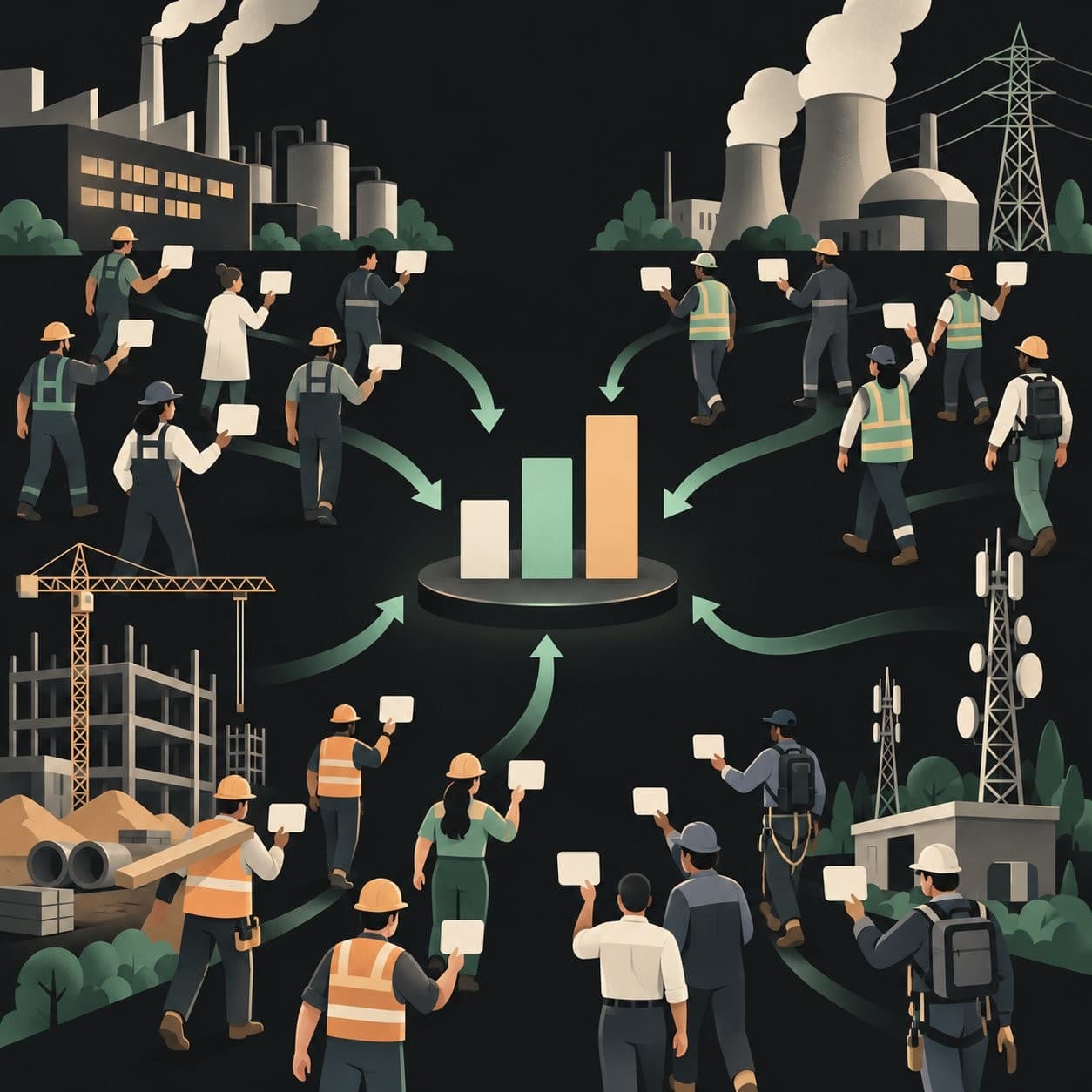
Censuswide ran the survey online from 17 August to 3 September among 2,275 executives and frontline workers at companies with more than 500 employees and annual revenue above $250 million, in manufacturing, aerospace and defence, energy and utilities, construction and engineering, transportation and telecoms.[1]
2. Findings

Key figures from the IFS press release:[1]
- Over 90% of organisations report significant gains in reliability and performance: 93% for first-time-right performance, 90% for asset availability and 88% for on-time delivery.
- Over 50% of employee time is saved in workflows such as production throughput and quality assurance. Of the freed capacity, 36% of companies prioritise safety, training and compliance, and 35% asset performance and reliability.
- In the past 12 months, 43% have trained and introduced agentic digital workers, and 37% have trained peers to use industrial AI tools.
The survey also tracks governance: 11% have validated AI outputs in safety-, quality- or mission-critical processes, 4% require human approval for AI-supported decisions, and 20% use industrial AI in supply chain management or maintenance planning.[1] At the same event IFS introduced the Industrial AI Harness, which runs AI within users' existing permissions, approvals and audit records.[3]
3. Customer cases

PHS Group, UK: technician scheduling
PHS provides workplace hygiene services, with more than 5 million field visits a year. After replacing manual planning with IFS's AI scheduling system (PSO):[4]
- Average jobs per technician per day rose from 18.5 to over 26, a 40% productivity gain, with top performers above 35.
- 95% of jobs are scheduled automatically, and next-day manual route planning is no longer needed.
- On-the-day delivery rose by more than 40 percentage points, and over 100 new hires were avoided.
- Travel time and emissions fell.

Kodiak Gas Services, US: replenishment agent
Kodiak runs one of the largest gas compression fleets in the US, with 4.5 million horsepower, 800 field technicians and 150 warehouses. Kodiak and IFS identified more than 25 use cases for AI agents. The first in production is the Material Replenisher agent, which lets technicians check stock and locations and place orders directly.[5] Kodiak estimates that if half its technicians use it on a given day, it will bring $3 million in annual value and return more than 90,000 hours a year to maintenance work.[5]
4. Directions Taiwan can consider
- Start with clear processes such as scheduling and materials: PHS and Kodiak both began with one daily, easily measured process before expanding.
- Include energy in the metrics: optimising routes, schedules and equipment operation affects working hours, fuel and electricity together, so these can be tracked side by side.
- Set governance rules early: output validation and human approval for critical processes can be built in from the start.
Related reading: CoreWeave on training data for physical AI and Paper2Agent and knowledge management.
References
- IFS, IFS Industrial Index 2026 reveals the factory floor is surging ahead in AI usage (2026-10-13). https://www.ifs.com/en/insights/news/ifs-industrial-index-2026-reveals-the-factory-floor-is-surging-ahead-in-ai-usage
- Energy Tech, Scaling Industrial AI: Leadership Insights and Future Trends from IFS Unleashed 2026 (2026-10-13). https://www.energytech.com/energy-efficiency/news/55411348/scaling-industrial-ai-leadership-insights-and-future-trends-from-ifs-unleashed-2026
- IFS, IFS brings the Industrial AI Harness to the world's most critical and complex industries (2026-10-13). https://www.ifs.com/en/insights/news/ifs-brings-the-industrial-ai-harness-to-the-worlds-most-critical-and-complex-industries
- IFS, PHS Group customer story. https://www.ifs.com/en/insights/customer-stories/phs-group
- IFS, Kodiak customer story. https://www.ifs.com/en/insights/customer-stories/kodiak
Leave a comment
Comments are reviewed before publication. Email is private and used only when contact is necessary. Privacy notice