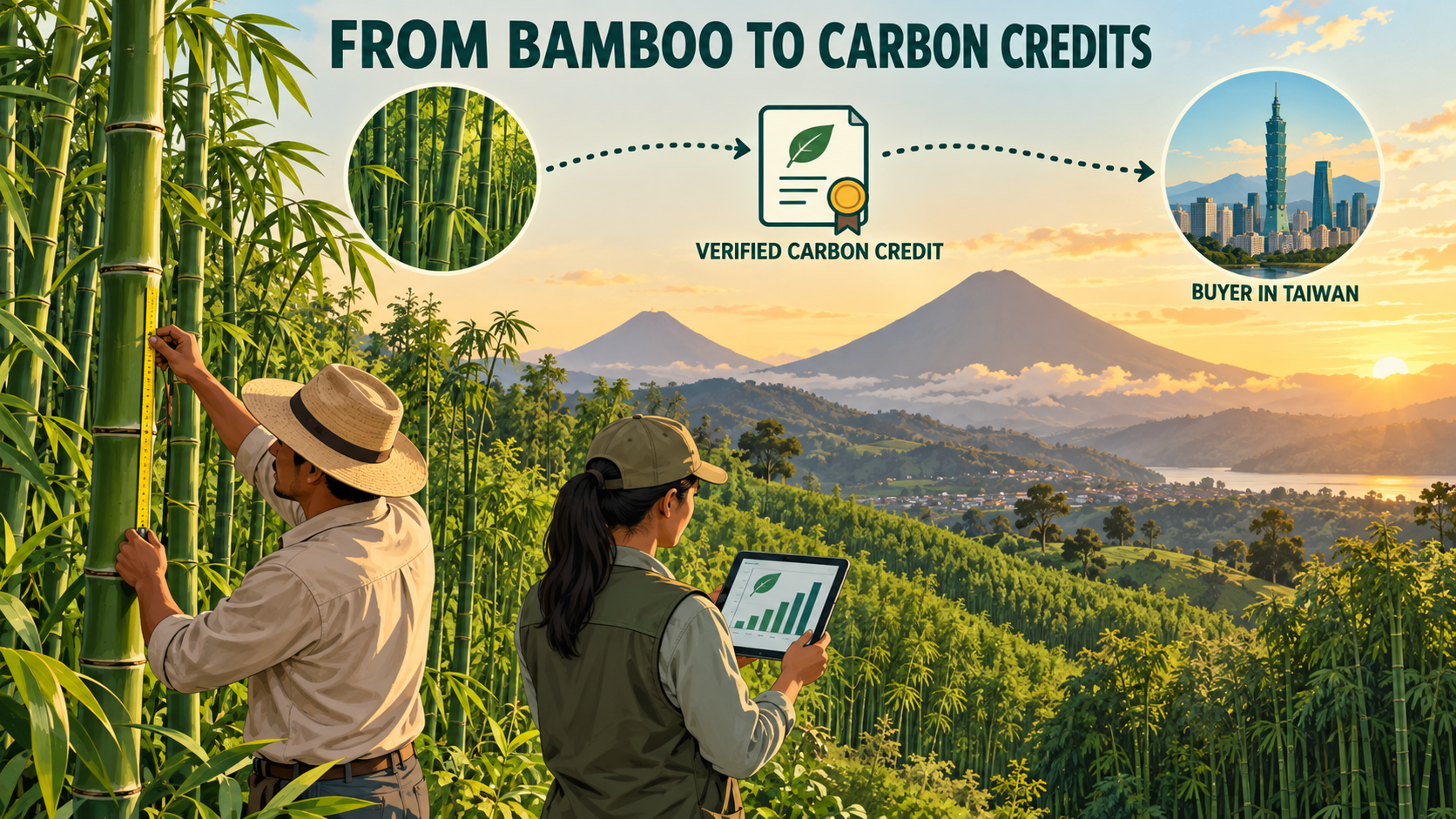
Foreign Minister Lin Chia-lung led a delegation to Guatemala in early October, and among the documents signed during the trip was one that drew little attention but deserves a close look from the carbon market: Taiwanese company Cupola360 signed a letter of intent with a Guatemalan agribusiness on bamboo carbon credits, stating its intention to have first right to buy future credits at US$30 per tonne of CO2 equivalent. The project, supported by the Taiwan Technical Mission in Guatemala of the International Cooperation and Development Fund (TaiwanICDF), plans to plant about 115 hectares of new bamboo and to seek certification under the Verified Carbon Standard (VCS), an international carbon credit standard. UK carbon market outlet Carbon Pulse also covered the deal under the headline "Taiwan's international aid agency backs bamboo project in Guatemala". It is a new attempt to link Taiwan's foreign aid expertise, Taiwanese companies' demand for carbon credits and international certification — but what has been signed is only a letter of intent, and several steps remain before any actual credits exist.
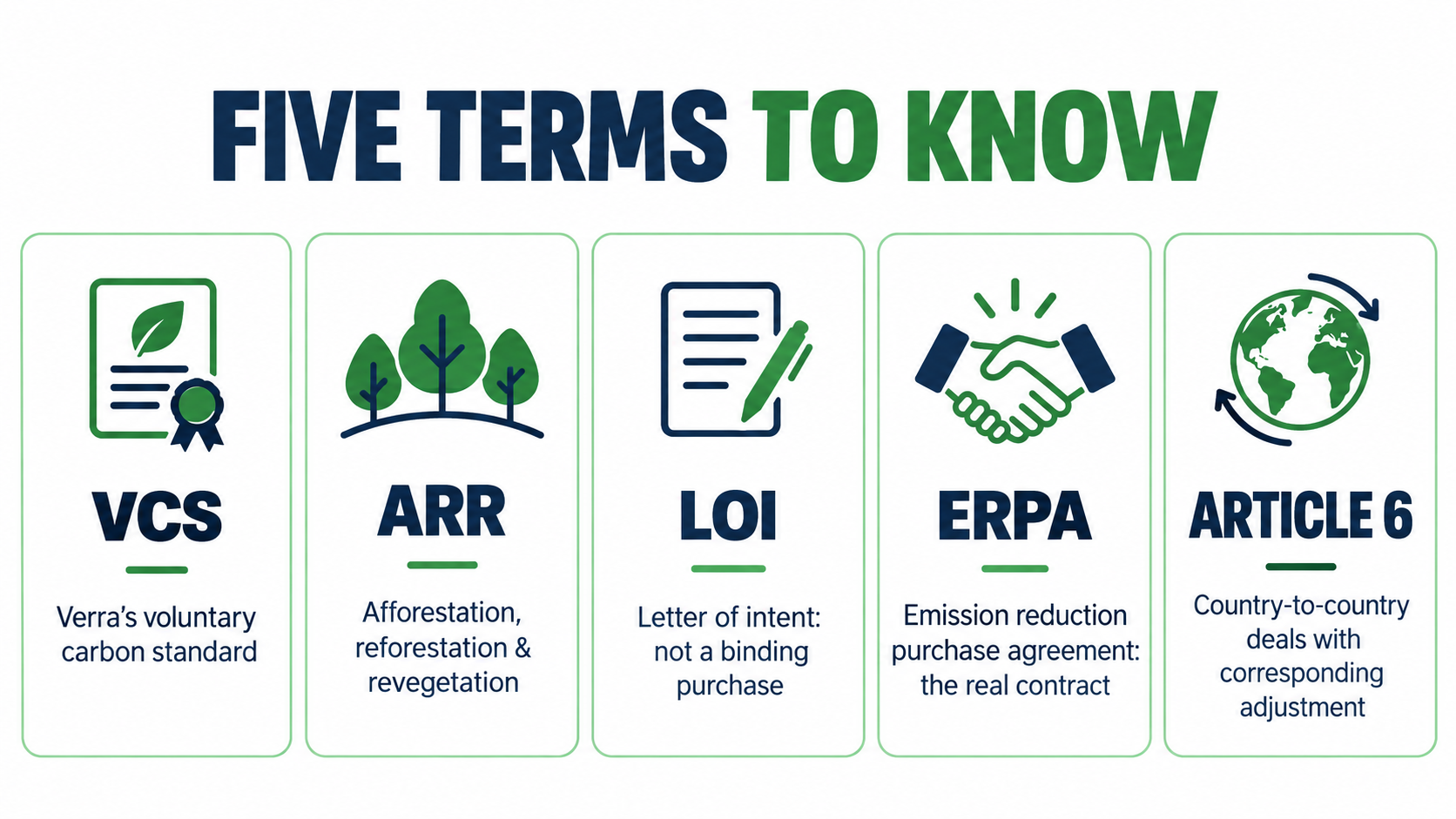
Primer: VCS, ARR, letters of intent and ERPAs
VCS (Verified Carbon Standard): a voluntary carbon credit standard run by the US non-profit Verra and one of the world's largest carbon credit registries. A project must be designed under an approved methodology, validated by a third party and registered; after that, each monitoring period has to be verified by a third party before credits are issued.
ARR (afforestation, reforestation and revegetation): planting trees (or bamboo) on land that had no forest or has been degraded so that they absorb CO2 — a "carbon removal" type of credit. Because the carbon is stored in plants and soil, it is at risk of being "reversed" by logging, fire, pests or disease, so projects usually set aside a share of their credits in a buffer pool as insurance.
Letter of intent (LOI): a document expressing a willingness to cooperate, usually not binding as a sale and purchase. The press release on this deal also makes clear that purchase tranches, volumes, delivery and payment terms are still to be negotiated.
ERPA (Emission Reduction Purchase Agreement): the formal contract that actually fixes how much is bought, at what price and when it is delivered. According to the press release, one will be signed separately once conditions are ripe.
Voluntary market vs. Article 6 of the Paris Agreement: VCS credits belong to the voluntary market and are mainly used by companies for voluntary offsetting or claims. Article 6, by contrast, covers emission reduction cooperation between countries and involves host-country authorization and a "corresponding adjustment" so that the same reduction is not counted by two countries. The two have different rules and uses.
What happened
According to the TaiwanICDF press release distributed through the Central News Agency (CNA) press release platform (2026-10-06):
When and where it was signed: on October 1, during the Taiwan–Guatemala Joint Economic Cooperation Conference and Investment Forum, witnessed by Foreign Minister Lin Chia-lung and Guatemala's Vice Minister of Foreign Affairs Julio Eduardo Orozco Pérez.
The signatories: the Guatemalan agribusiness Verdes de Centroamérica, S.A., and CJ Hsieh, general manager of Taiwan's Cupola360 Inc.
Price: Cupola360 expressed its willingness to have first right to buy the credits the project generates in the future, at an intended purchase price of US$30 per tonne, which the press release says is above the current market reference price for ARR projects in the voluntary market.
Project size: about 115 hectares of newly planted Dendrocalamus asper (a giant tropical bamboo), developed as an ARR carbon sink project.
Certification route: design, registration, monitoring and third-party verification are planned to follow the relevant VCS methodologies.
Timeframe: an initial collaboration vision of 15 years; the number of credits that can actually be issued will be confirmed step by step based on implementation and third-party verification results.
TaiwanICDF's role: the Taiwan Technical Mission's "Project for Strengthening the Sustainable Development of the Bamboo Industry in Guatemala" provides technical guidance on bamboo cultivation, management, carbon sink surveys and carbon credit methodologies.
The project did not come out of nowhere. According to a United Daily News report from COP30 in November 2025, TaiwanICDF said at the time that it was working with the Guatemalan government and hoped to turn its bamboo industry project into the world's first bamboo VCS carbon credit project, with TaiwanICDF mainly providing technical and financial support and completion expected within four years. Guatemala's Ministry of Agriculture, Livestock and Food (MAGA), with support from the Taiwanese embassy, has also launched a National Bamboo Carbon Sink Initiative, inviting cooperatives, community organisations and companies to apply. Those selected receive bamboo seedlings, technical assistance and support with international certification, and the credits generated belong to the participants.
Who is the buyer: a tech company that makes 360-degree cameras
Cupola360 is a wholly owned subsidiary of IC design company ASPEED Technology, mainly making "reality remote management" products such as 360-degree panoramic inspection cameras and audio-video extension; ASPEED announced in November 2025 that it would spin off the related business into Cupola360. A tech company pre-ordering bamboo carbon credits from overseas reflects how demand among Taiwanese companies for high-quality nature-based carbon removals is starting to emerge. Public information does not, however, say what Cupola360 plans to use the credits for (voluntary offsetting, carbon-neutral product claims or something else).
Bamboo carbon credits: the opportunity and the hard questions
Bamboo grows fast and regenerates readily — cut it and new culms sprout again from the underground rhizomes — and TaiwanICDF positions it as a solution that combines carbon sequestration, land restoration and rural livelihoods. But turning it into carbon credits still means answering several technical questions:
Which methodology applies: the press release only refers to "relevant" VCS methodologies; it does not say which ARR methodology will be used or how the carbon in harvested bamboo will be counted.
Harvesting and permanence: bamboo stands are usually harvested regularly, so credit calculations tend to rely on long-term average carbon stocks rather than carbon that keeps accumulating. Harvesting practices and the risk of fire or land-use change all affect how many credits are eventually issued and how much has to go into the buffer.
Volumes are still unknown: the press release gives no estimate of how many credits 115 hectares can produce, saying only that this will be confirmed by verification results. This article does not estimate a volume.
What "world first" means: if it really becomes the first bamboo VCS project, it will have to go through a validation process with no precedent, and the time and cost may well be higher than for an ordinary afforestation project.
Article 6 cooperation with Paraguay is a different road
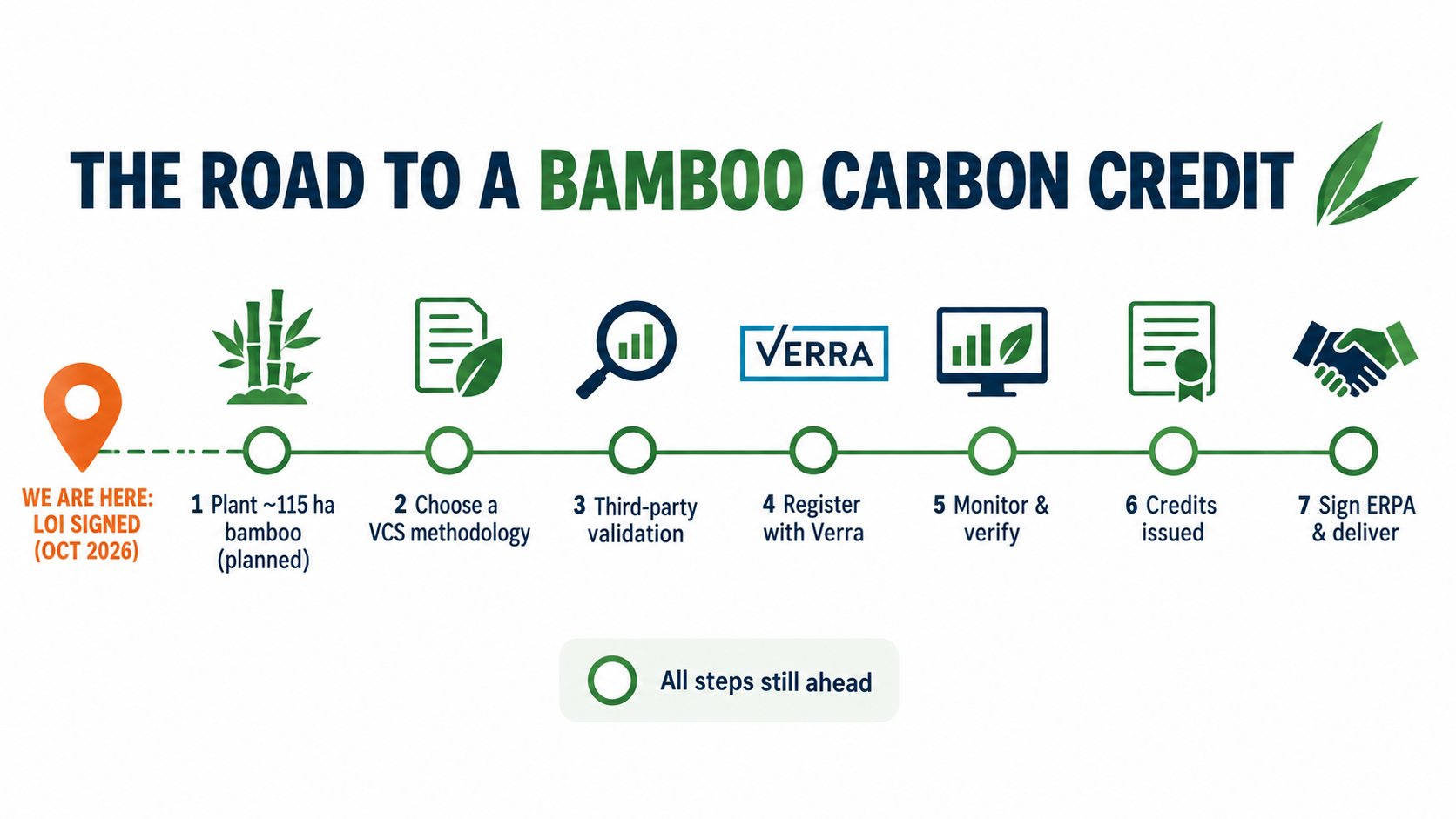
Carbon Pulse's report set the deal alongside Taiwan's cooperation with Paraguay and noted that TaiwanICDF did not specify whether it would pursue similar projects under the Paris Agreement. The distinction matters:
Paraguay: Taiwan's Ministry of Environment signed a memorandum of understanding under the Paris Agreement with Paraguay on October 1, 2025. In May 2026, Minister of Environment Peng Chi-ming said Taiwan was discussing an implementation agreement with Paraguay that would require internationally transferred mitigation outcomes (ITMOs) to be generated under Article 6 with corresponding adjustments, on which basis they would be recognised for offsetting up to 5% of emissions subject to the carbon fee. In September 2026, the Industrial Technology Research Institute (ITRI) and a Paraguayan company also launched an "Article 6 pilot" of a small-scale ARR project in the Chaco region.
Guatemala: public information so far points to a voluntary-market route through VCS, with a company signalling its intention to buy through a letter of intent; there is no mention of host-country authorization or corresponding adjustments.
In other words, whether the Guatemalan bamboo credits could one day be used to offset Taiwan's domestic carbon fee has no answer at this stage. Under Taiwan's Regulations Governing the Collection of Carbon Fees, foreign emission reduction credits can only be used as offsets once recognised by the Ministry of Environment, and the ministry's current public position is that the system is being designed around Article 6. Carbon Pulse also reported that Taiwan and Paraguay are negotiating a floor of at least 5 million Paraguayan carbon credits for international transfer; Taiwan's Ministry of Environment has not publicly confirmed that figure.
What is settled and what is still planned
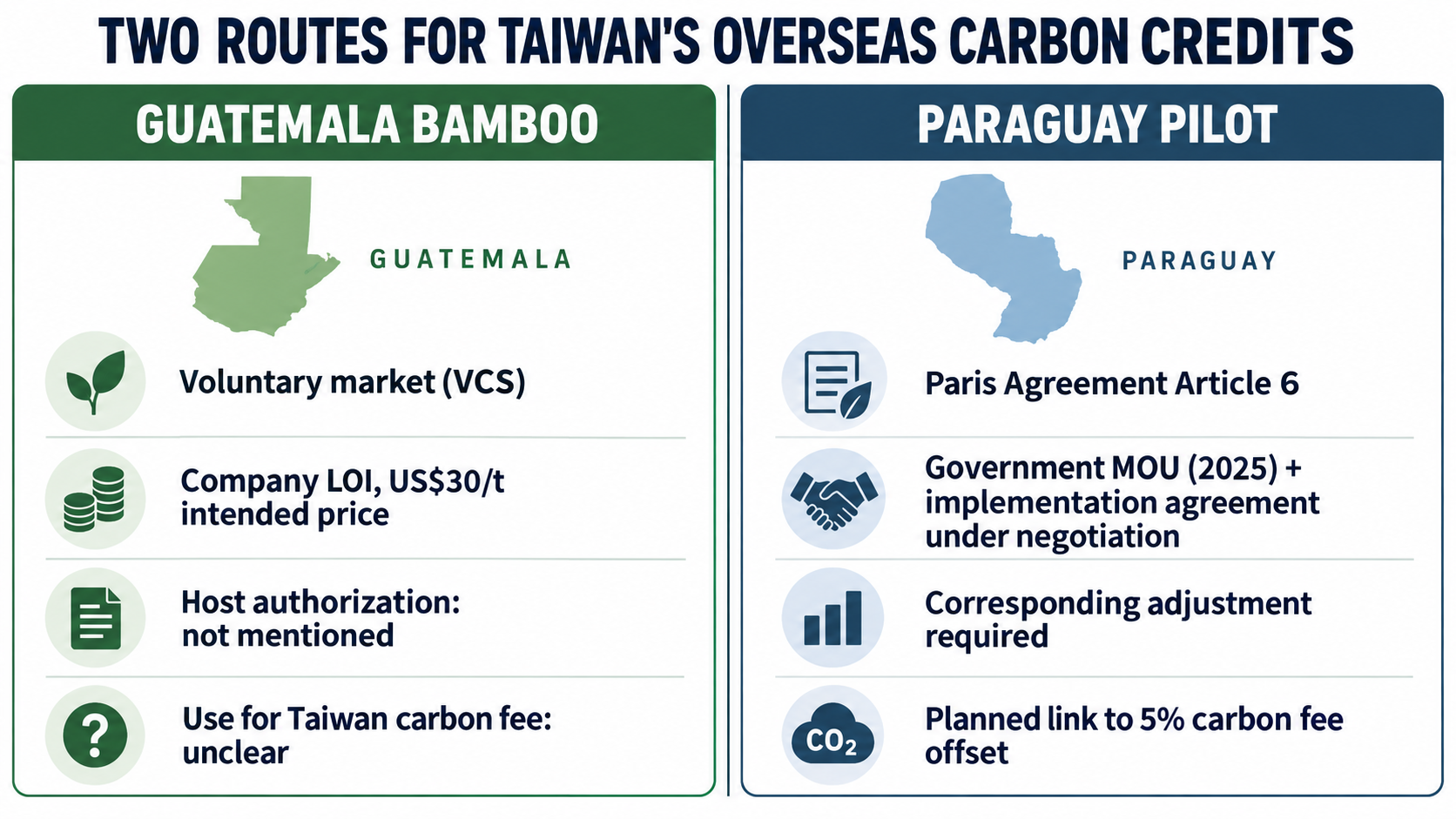
Settled: the bamboo carbon credit letter of intent signed on October 1; an intended purchase price of US$30 per tonne; plans for about 115 hectares, a 15-year collaboration vision, and design and verification under VCS; technical guidance from TaiwanICDF's technical mission.
Not yet settled: the methodology to be used, the timeline for validation and registration, the number of credits that can be issued, the formal purchase contract (ERPA), delivery tranches and payment terms.
Not addressed in public information: whether the project will seek Article 6 authorization from the Guatemalan government; what Cupola360 will use the credits for; how credit revenue will be shared with local farmers and communities.
Our view: turning an aid project into a carbon credit supply chain means getting three things right first
What follows is our own reading, not the position of TaiwanICDF or the companies involved.
What is new about this deal is that it links "foreign aid technical mission → local agribusiness → international certification → Taiwanese corporate buyer" into a single chain. TaiwanICDF's long-running bamboo industry project was originally about livelihoods and industry; adding carbon credits finds a new source of income for an ally's natural resources, and a traceable source of carbon credits for Taiwanese companies.
But for this chain to hold up, at least three things need to be done properly:
Quality before price: an indicative price of US$30 a tonne only means something if the credits can genuinely withstand scrutiny. The biggest concerns about ARR credits in recent years have been whether baselines, permanence and buffer contributions are set conservatively. Bamboo is a new case, which makes transparent, public methodology and monitoring data all the more necessary.
Be clear about the use up front: if companies want to use the credits against Taiwan's carbon fee, or later in compliance markets such as international aviation, they need to consider whether host-country authorization and corresponding adjustments are required; if the credits are only for voluntary offsetting, they still need to avoid double claiming against Guatemala's national emission reduction targets.
Write local rights into the contract: MAGA's initiative stresses that the credits belong to the participants. When an ERPA is eventually signed, how revenue is shared with the farmers and communities who plant the bamboo will be key to whether projects like this can last.
Taiwan is not a party to the United Nations Framework Convention on Climate Change, so its path into international carbon markets is narrower than most. That is precisely why every carbon credit project brokered by Taiwan should hold itself to the highest standards of quality and transparency — which matters far more than being the first to claim a "world first".