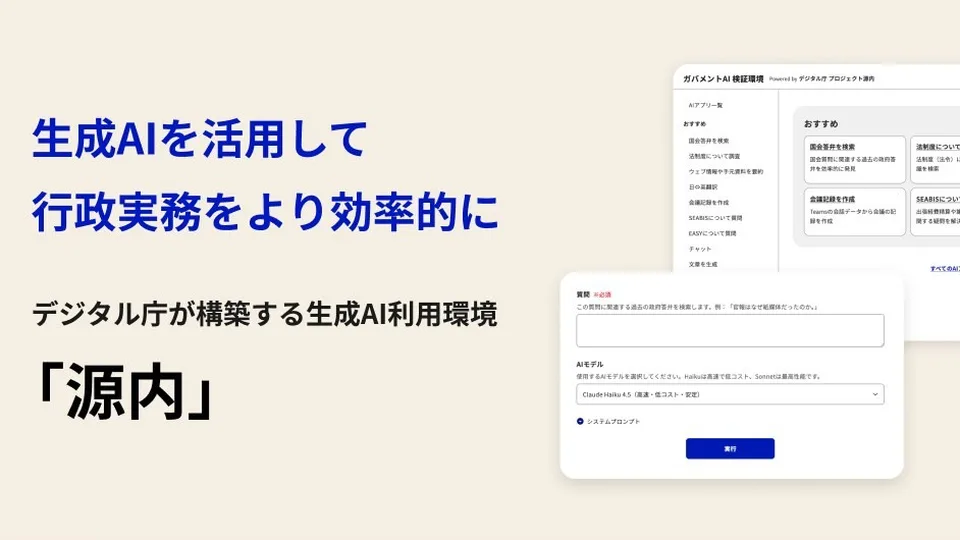
A civil servant finishes a meeting and is left with one audio recording. Japan hands the follow-up work of organizing and translating to an AI agent. On October 26, 2026, Jiji Press reported through nippon.com that Japan's Digital Agency has made an AI agent environment available on "Government AI Gennai," the government's dedicated generative AI platform. It targets about 180,000 government employees.
One Instruction, Several Steps
In a chat interface, generative AI usually needs a separate instruction for each step. With an AI agent, the user states a direction in natural language and the agent carries on. The Digital Agency says users can hand over several tasks at once.

- Read the meeting audio
- Organize the content
- Output a document
The report's example is a meeting recording. An employee uploads the audio file, and the agent prepares the meeting minutes and translates them.
The Digital Agency says that providing an advanced AI agent environment on a shared government foundation, at a scale of about 180,000 people and usable by ordinary employees in daily work, is a world first.
About 40 Government Applications on the Platform
The Gennai platform has about 40 applications. They include chat among colleagues, drafting documents and meeting minutes, translating and summarizing documents, searching Diet answer records, legal research, and audio transcription.

The Digital Agency's introduction guide explains that staff can use natural language to arrange several work steps and save skills for later use. Work steps can be organized as reusable skills, making routine tasks easier to repeat.
Phased Rollout, With an Open-Source Release Planned Next Year
The Digital Agency's announced schedule is as follows.

- From October 20, 2026: "Agent Chat" is being introduced step by step to ministries and agencies.
- Around December 2026: The target is to introduce "Gennai Kobo" (workshop). It offers an advanced agent with code generation and correction, file operations, command execution, web Deep Research, and prototype development.
- Around February 2027: "Gennai OSS Ver. 2.0" is scheduled for release, available to local public bodies, private companies, and others.
The Gennai Standard: Employees Must Check AI-Generated Content
Also on October 20, 2026, the Digital Agency published the "Gennai Standard." It divides roles into users, administrators, and developers, and requires that users follow the rule that employees must check AI-generated content. The agent can keep working on its own, and the user still reviews what it produces.
Directions Taiwan Can Draw On
Taiwan has built a diverse foundation that can be compared with Japan's approach.

- Usage guidelines: In August 2023 the Executive Yuan issued the "Executive Yuan and Its Subordinate Agencies Reference Guidelines for the Use of Generative AI." Its principles cover responsibility, trustworthiness, security, privacy, data governance, and accountability.
- Testing environment: The Ministry of Digital Affairs (MODA) runs the "Government AI Application Lab (TryAI)," where agencies test and evaluate models and develop applications. It gathers more than 32 language models, including TAIDE, open-source, and commercial models. The variety lets each agency choose by its needs.
- Local model: The National Science and Technology Council (NSTC) promotes the Trustworthy AI Dialogue Engine (TAIDE) program. TAIDE supports everyday office tasks such as summarizing, letter writing, article writing, and English-to-Chinese translation.
- Corpus and handbook: MODA has published the "Public Sector AI Application Reference Handbook," with practical guidance on AI adoption, data governance, and outcome evaluation.
Japan's phased rollout offers a reference for planning everyday documents, advanced research, and open-source use. Taiwan can build on its diverse models, local data, and practical guidance, then expand applications according to each agency's work.
Sources
- nippon.com / Jiji Press: Japan Digital Agency Adds AI Agent to "Gennai" Govt Platform
- Japan Digital Agency: Gennai announcement and Gennai Standard
- Japan Digital Agency: Government AI Gennai Agent Chat Introduction
- Ministry of Digital Affairs: Government AI Application Lab (TryAI)
- Trustworthy AI Dialogue Engine (TAIDE)
Leave a comment
Comments are reviewed before publication. Email is private and used only when contact is necessary. Privacy notice