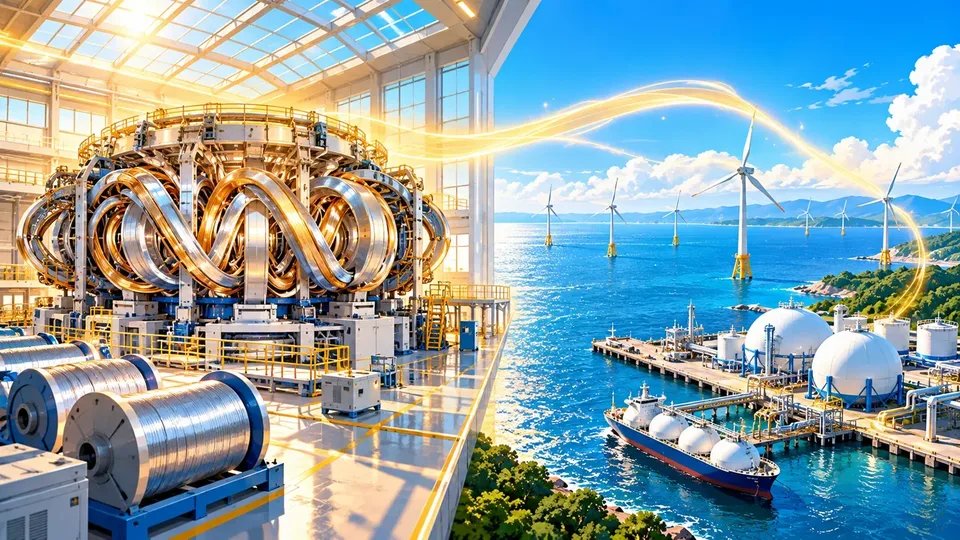
Germany and Japan Announce Deeper Public-Private Cooperation on Fusion and Hydrogen
German Chancellor Friedrich Merz visited Tokyo on 28 October 2026 and held about 30 minutes of talks with Japanese Prime Minister Sanae Takaichi. A summary from the Japanese Prime Minister's Office says the two countries issued three documents: a Japan-Germany leaders' joint statement, a joint declaration on advanced technology cooperation, and a joint declaration on economic security cooperation.

In the advanced technology declaration, the two leaders agreed to pursue concrete public-private coordination in areas including fusion energy and hydrogen. The economic security declaration covers supply chain resilience, diversification of critical mineral sources and protection of critical technologies. The Japan-Germany advanced technology declaration names fusion energy and hydrogen as fields for public-private coordination.
Proxima Fusion Signs Memoranda with Two Japanese Companies
During Merz's visit, Munich-based Proxima Fusion signed memoranda of understanding with Kyoto Fusioneering and Fujikura. Merz and Takaichi were present at the Fujikura signing. Proxima Fusion was spun out of the Max Planck Institute for Plasma Physics and develops stellarator fusion technology, which confines high-temperature plasma with strong magnetic fields.
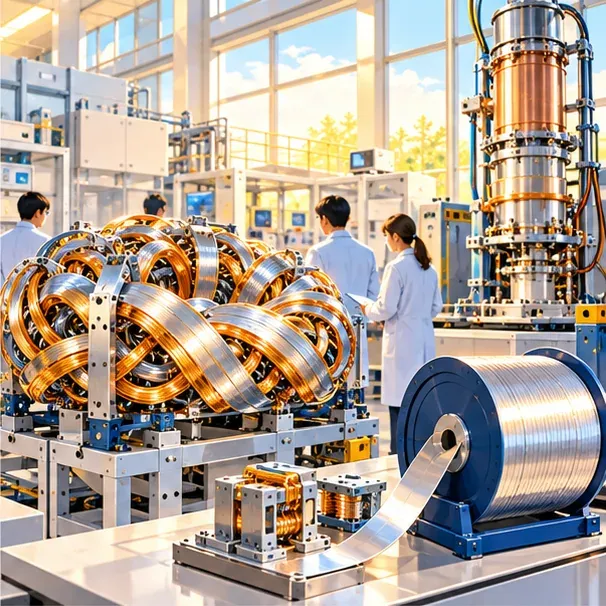
- Kyoto Fusioneering: the two companies will continue and expand joint development of next-generation gyrotrons for plasma heating and of fuel cycle technology. Kyoto Fusioneering will also take part in Germany's Fusion Hubs concept.
- Fujikura: the two companies will evaluate in stages the technical and economic feasibility of a stable supply of high-temperature superconducting (HTS) tape and of local production, with the evaluation focused mainly on Germany.
These points draw on releases from the Japanese Prime Minister's Office, Proxima Fusion, Kyoto Fusioneering and Fujikura. The memoranda cover cooperation and feasibility assessment; no factory investment has been completed.
Alpha and Stellaris Are Estimated to Need 20,000 to 40,000 km of Superconducting Tape
HTS tape is used in superconducting magnets. At very low temperatures it carries large currents and produces the strong magnetic fields that confine plasma. According to the Fujikura release, Proxima Fusion estimates that its demonstration device, Alpha, needs about 20,000 km of tape and that each commercial plant, Stellaris, needs about 40,000 km. Both figures are company estimates; they do not describe quantities already used.
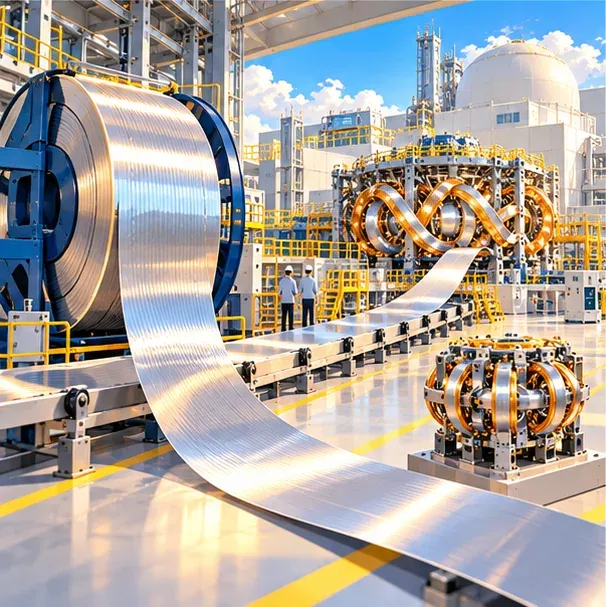
Proxima Fusion aims to complete Alpha in the early 2030s and to bring the Stellaris commercial plant online in the late 2030s. Proxima Fusion says it has raised more than €650 million and that the Alpha Alliance includes more than 50 industrial partners.
Proxima Fusion's Alpha and Stellaris Timeline and Germany's Fusion Power Plant Action Plan
Fusion joins light atomic nuclei such as hydrogen at extreme temperatures and releases energy. Taiwan's Central News Agency (CNA) reports that the technology is regarded as a promising low-carbon energy source but still faces technical and commercialization challenges. Alpha and Stellaris are a planned device and a planned power plant.
In the Fujikura release, Proxima Fusion CEO Francesco Sciortino says the supply chain must be in place several years ahead of the power plant itself. On 1 October 2025 the German cabinet adopted the action plan "Deutschland auf dem Weg zum Fusionskraftwerk", which aims to build the first fusion power plant in Germany (official wording also frames it as the world's first, located in Germany). The German government also notes that major technical challenges remain. This is a plant-location goal, not a committed commercial timeline.
Vietnam Sets Up Its Own Booth at European Hydrogen Week for the First Time
Vietnam News Agency's VOV reports that on 28 October 2026 Vietnam had its own exhibition booth for the first time at European Hydrogen Week in Brussels, held 26 to 30 October. Tran Ngoc Quan, head of the Vietnam Trade Office in Belgium, Luxembourg and the EU, said the office has taken part regularly since the event began in 2020.
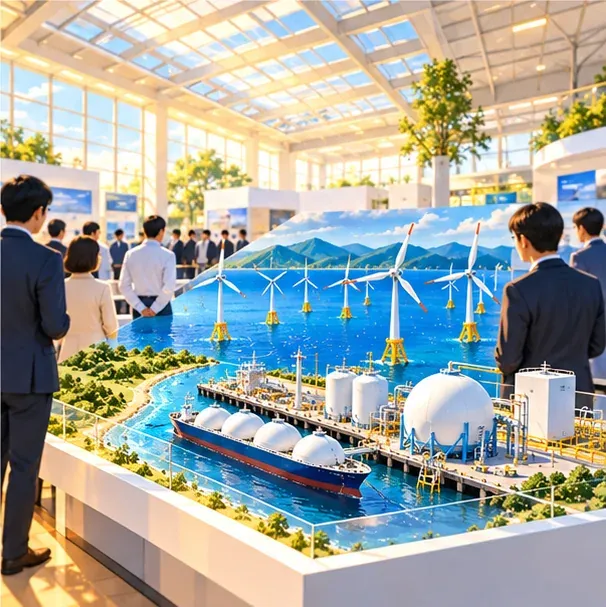
The trade office cited the following figures and targets:
- Offshore wind potential above 600 GW, among the largest in Southeast Asia, along a coastline of more than 3,000 km.
- Hydrogen output targets of 100,000 to 500,000 tonnes a year by 2030 and 10 to 20 million tonnes a year by 2050.
- VOV presents these targets as consistent with Vietnam's net-zero commitment, the European Green Deal and the Just Energy Transition Partnership (JETP).
The report adds that Vietnam still has to turn its resource potential into projects that are financially viable and backed by regulation and infrastructure.
Vietnam Lists Four Hydrogen Investment Priorities; Japanese and Korean Visitors Express Import Interest
The trade office described four investment priorities:
- Renewable hydrogen production, including electrolysis, offshore-wind-based hydrogen, green ammonia and liquid hydrogen exports.
- Infrastructure for storage, compression, pipelines, transport networks and port logistics.
- Fuel switching in heavy transport and shipping, and industrial decarbonization.
- Hydrogen applications in steel, fertilizer, chemicals, cement, power generation and heavy transport.
At the booth, some visitors from South Korea and Japan said they would be ready to become first importers if Vietnam develops a hydrogen trade. They expressed interest; no purchase commitment or contract was reported. Exion Hydrogen is owned by Polish investors and headquartered in Poland, with its research, development and business centre in Belgium. It uses alkaline and PEM electrolysis technology. Its executive Bjorn Van Thienen said hydrogen, and green hydrogen in particular, will play a clear role in the future energy mix. The trade office said its priority at this stage is to make European companies and investors aware of Vietnam's hydrogen strategy and clean energy commitments.
Directions Taiwan can draw on
The two points below come from the verified reports above. Related on this site: DNV Energy Transition Outlook 2026: Faster Electrification, Taiwan VP on AI power: new plants, grid resilience, storage.
- Materials and components for fusion: Fujikura and Proxima Fusion are evaluating stable HTS tape supply and local production in Germany, and Proxima Fusion estimates that Alpha needs about 20,000 km and each Stellaris about 40,000 km. Taiwan can keep following updates on the scale and timing of this procurement.
- Hydrogen targets in neighbouring countries: Vietnam has published hydrogen output targets for 2030 and 2050, and Japanese and Korean visitors said they would be first importers if Vietnam develops a hydrogen trade. Taiwan can keep following whether these targets turn into concrete projects and trade arrangements.
Leave a comment
Comments are reviewed before publication. Email is private and used only when contact is necessary. Privacy notice