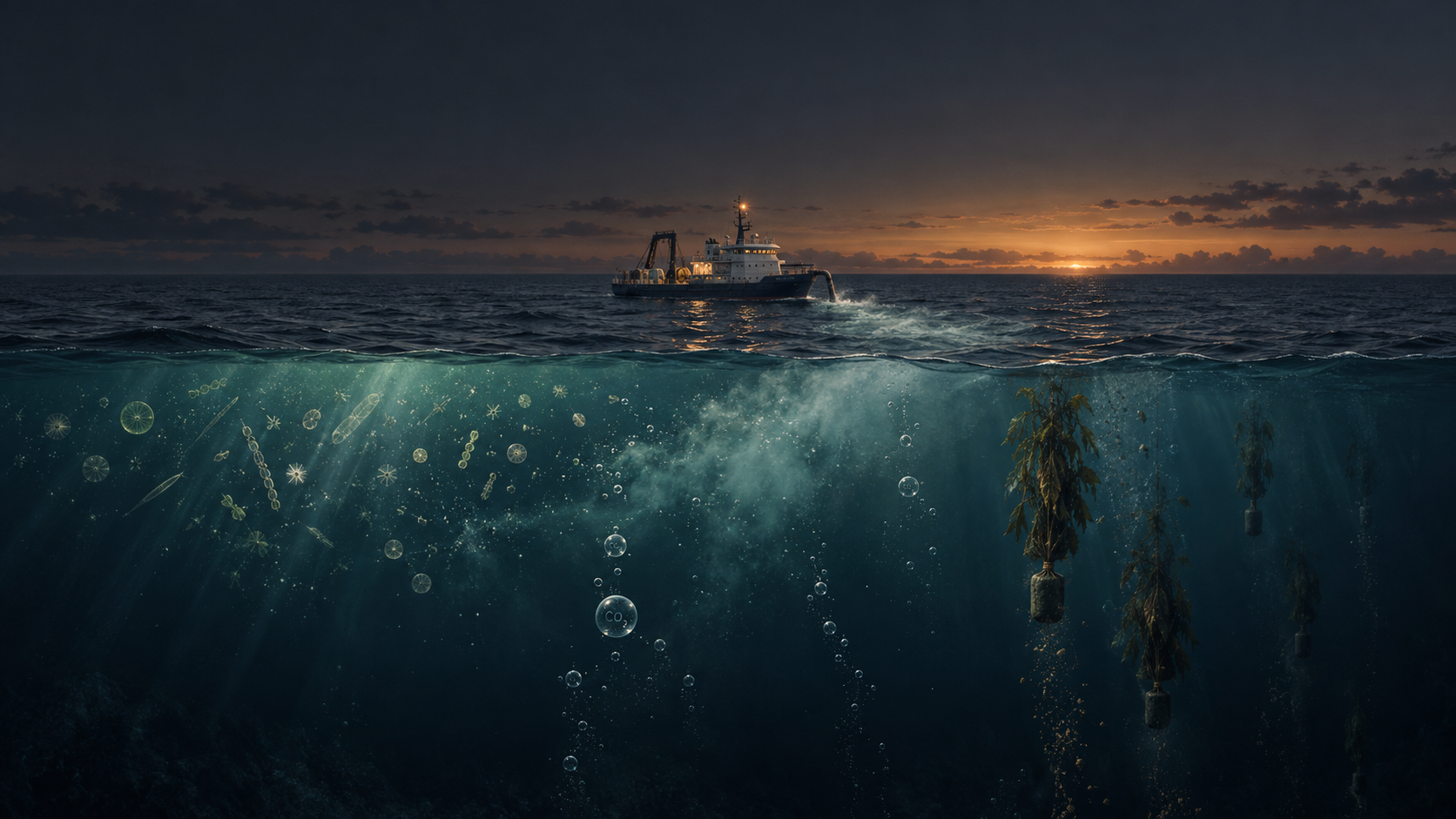
The International Maritime Organization (IMO) adopted assessment frameworks for research on three marine carbon removal techniques, and it says activities beyond research cannot be considered yet. On October 9, 2026, IMO announced that Parties to the London Convention and London Protocol adopted a resolution. The resolution sets up one assessment framework each for ocean fertilization, ocean alkalinity enhancement, and ocean sinking of biomass. Governments can use the frameworks to decide, case by case, if a proposal is "legitimate scientific research" and if it can proceed without unacceptable risks. Industry outlet Carbon Pulse reports that observers say the guidance could affect the emerging market for ocean-based carbon removal credits.
Key terms
International Maritime Organization (IMO): The UN specialized agency for shipping and marine pollution treaties, based in London. IMO administers the London Convention and London Protocol.
London Convention and London Protocol: International treaties that control the dumping of wastes and other matter at sea. The Convention dates from 1972. The Protocol dates from 1996 and entered into force in 2006. Its aim is to strengthen and eventually replace the Convention.
Marine carbon dioxide removal (marine CDR): Methods that use the ocean to absorb carbon dioxide from the atmosphere or to store carbon for long periods. IMO calls these methods "marine geoengineering." It says their possible impacts on marine ecosystems are not yet fully understood.
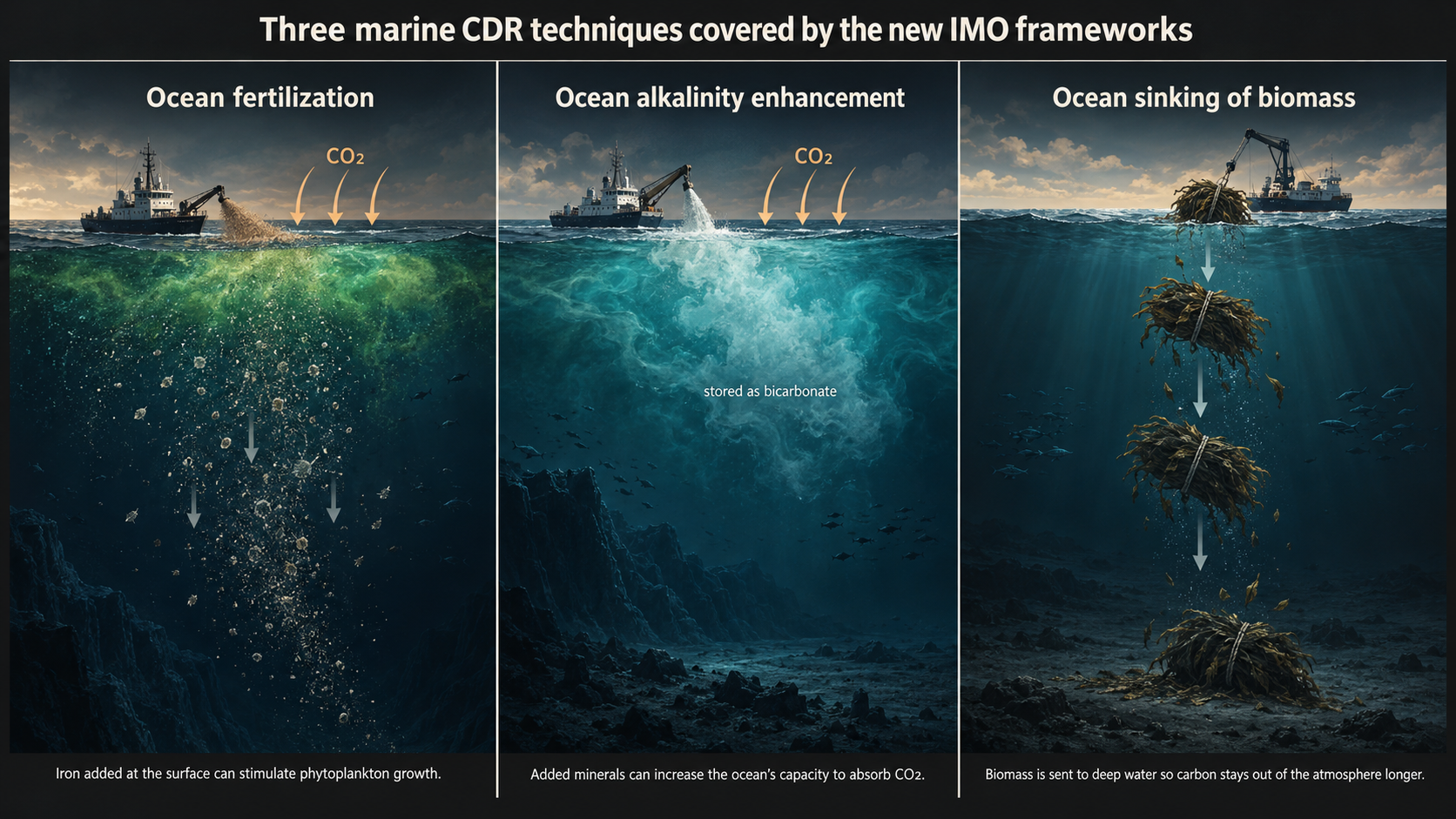
Ocean fertilization: Adding nutrients to seawater to increase phytoplankton growth, which absorbs carbon dioxide from the atmosphere.
Ocean alkalinity enhancement (OAE): Adding alkaline substances to seawater to increase the ocean's capacity to absorb atmospheric carbon dioxide and to counteract ocean acidification.
Ocean sinking of biomass: Deliberately placing biological material, such as marine or land plant matter, into the ocean to store carbon.
The Parties adopted one framework for each of the three techniques
The Parties adopted the resolution at their annual meeting from October 5 to 9, 2026. The meeting was the 48th Consultative Meeting of Contracting Parties to the London Convention and the 21st Meeting of Contracting Parties to the London Protocol (LC 48/LP 21). It took place at IMO Headquarters in London. Radia Razack of South Africa chaired it. The Center for International Environmental Law (CIEL) says the Parties adopted the resolution on Friday, October 9.
IMO Secretary-General Arsenio Dominguez said the frameworks give regulators and researchers rigorous and transparent tools. He said marine geoengineering is attracting more scientific, commercial, and public attention. He added that the frameworks help to assess proposed activities and protect the marine environment.
The ocean fertilization framework updates an older one, and the other two frameworks are new. A pre-meeting analysis by the Sabin Center for Climate Change Law at Columbia University gives the background. In 2008, the Parties adopted a non-binding decision that ocean fertilization other than legitimate scientific research should not be allowed. In 2010, they adopted an assessment framework for ocean fertilization. The Sabin Center adds that in 2023 the Parties stated that OAE and biomass sinking should be treated like ocean fertilization. This means some legitimate scientific research may be allowed, but deployment should be deferred.
The assessment runs from initial screening to post-project review
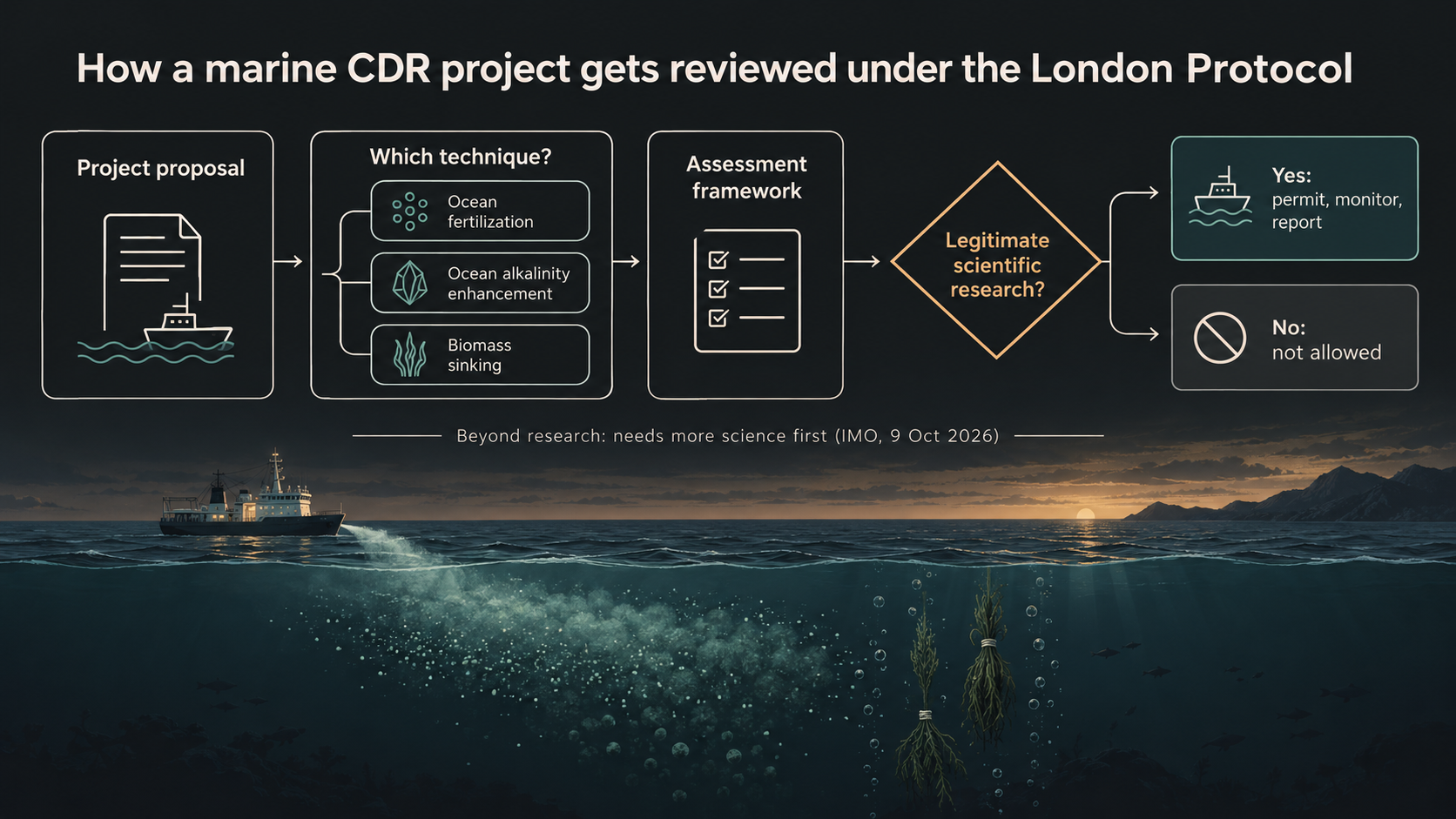
Each framework covers initial screening, environmental assessment, risk management, decision-making, and post-project review. IMO says assessments can be revisited when new information becomes available.
IMO says all proposals must meet the same basic requirements. Each proposal must show a legitimate scientific purpose and fully assess environmental risks. It must also include stakeholder consultation and peer review, plus rigorous monitoring and transparent reporting.
CIEL says all three framework documents ask States to consult Indigenous Peoples. According to CIEL, the documents ask States to consult Indigenous Peoples as international law requires. CIEL says they also ask States to consider the social, cultural, and economic impacts of these techniques.
IMO says activities beyond research cannot be considered yet
IMO says more scientific research is needed before any activities beyond the research stage can be considered. The Parties stressed that scientific knowledge is still limited. They said research should proceed with caution and that environmental protection is the top priority.
Carbon credits: observers expect an effect, but the details depend on the final text
Carbon Pulse reports that observers say the guidance could affect the emerging market for ocean-based carbon removal credits. The full Carbon Pulse article is paywalled. This article uses only its public lede.
The NGO CIEL reads the frameworks to mean that projects that generate or sell carbon credits are not legitimate scientific research. CIEL says the three frameworks include criteria so that economic interests cannot influence the design, conduct, or outcome of research. This is CIEL's interpretation. The IMO press release does not mention carbon credits.
The draft texts published before the meeting allow some types of payment. The Sabin Center says the draft updated ocean fertilization framework limits "financial and/or economic gain." It adds that this limit "should not preclude payment for services rendered in support of the experiment or future financial impacts of patented technology." According to the Sabin Center, the OAE and biomass sinking drafts use the same language. It also reports that, before the meeting, a number of Parties argued that the sale or pre-sale of carbon credits should not be allowed. The Sabin Center said this question was still open at that time.
Legal status: views on whether the frameworks are binding differed before the meeting
The binding London Protocol rules on marine geoengineering are not yet in force. In 2013, the Parties to the London Protocol adopted an amendment that sets up binding rules for marine geoengineering. CIEL says the amendment will enter into force when two-thirds of the Protocol Parties ratify it. The Sabin Center says ocean fertilization is the only activity listed in the amendment so far.
A pre-meeting working group report shows that many delegations see the assessment frameworks as best-practice guidance. The Sabin Center cites a July 2026 report of the Legal Intersessional Correspondence Group on Marine Geoengineering (LICG). According to that report, some delegations stressed that the frameworks do not create new legally binding obligations. Delegations also recognized that Parties keep discretion in their domestic permitting processes.
Other decisions at the meeting
The Parties also approved guidance on end-of-life management of fiberglass reinforced plastic (FRP) vessels. IMO says the guidance was developed with the UN Environment Programme (UNEP) and covers alternatives to disposal at sea. The Parties also agreed on intersessional work on the relationship between the London Convention and Protocol and the Agreement on Marine Biological Diversity of Areas beyond National Jurisdiction (BBNJ Agreement).
What is still unclear
Full text of the resolution: The IMO press release does not include the resolution text or number. We have not yet checked if the final text, including the clauses on economic interests and payment, matches the pre-meeting drafts.
Legal status of the frameworks: There is no public information yet on how the final resolution describes the status of the frameworks, or on how States will use them in domestic permitting.
Real effect on carbon credit markets: So far, only observers and NGOs have commented. Carbon credit standards and buyers have not yet responded in public.
What it means for Taiwan
The new frameworks apply to marine carbon removal research, not to CCS in sub-seabed geological formations. According to IMO, the London Protocol was amended in 2006 (Annex 1) to create a legal basis for permanent storage of carbon dioxide in sub-seabed geological formations. A 2009 amendment to Article 6 allows the export of carbon dioxide for this purpose. In 2019, the Parties adopted a resolution that allows provisional application of the export amendment.
Taiwan does not formally take part in these international marine treaties, but its domestic law requires a permit for ocean dumping. A 2025 study in the journal Laws says Taiwan's particular international status prevents formal participation in the related marine treaties. The study says Taiwan aligns with them through domestic law. Article 23 of Taiwan's Marine Pollution Control Act requires a permit from the central competent authority, the Ocean Affairs Council (OAC), for ocean dumping.
Taiwan already has dedicated regulations for CCS storage. The Ministry of Environment (MOENV) issued the Regulations for the Management of Carbon Dioxide Capture and Storage on August 25, 2026. The Central News Agency (CNA) reported that the regulations require 20 years of monitoring after a well is sealed.
Our view
This is our reading. It is not an official position of IMO or of the Parties to the London Convention and London Protocol.
Keep two kinds of "ocean carbon" apart. Under the London Protocol, sub-seabed storage and marine carbon removal follow different rules. When you read international coverage, it helps to check which one it covers. We think the research limits in these frameworks should not be read as limits on Taiwan's offshore storage plans.
Carbon credit buyers may want to ask more questions. A company that looks at marine carbon removal credits can ask if the project is research or deployment, which country issued the permit, and how the removals are monitored. Until the full resolution text is public, there is a gap between CIEL's reading and the draft text.
How domestic law applies is still open. If an OAE or biomass sinking trial is proposed in Taiwan's waters, it is not clear if it counts as "ocean dumping" under the Marine Pollution Control Act, or which agency would review it. We think the authorities could clarify this in advance.
Related reading: For the global CCS picture, see "Global Status of CCS 2026 Report to Launch on October 20." When the report comes out, its sections on policy, regulation, and carbon markets may be useful context.
Sources
IMO press release, IMO adopts frameworks to assess marine geoengineering research activities (Oct 9, 2026): imo.org
Carbon Pulse, IMO adopts new guidance on certain marine carbon removal techniques (Oct 9, 2026; paywalled, public lede only): carbon-pulse.com/559288
CIEL press release, Global Treaty Advances Precautionary Regime on Marine Geoengineering (Oct 9, 2026): ciel.org
Sabin Center for Climate Change Law (Columbia University), Parties to the London Convention and Protocol Debate Marine Carbon Dioxide Removal Governance (Oct 7, 2026; pre-meeting analysis): blogs.law.columbia.edu
LC 48/5/1, Draft revised Ocean Alkalinity Enhancement Assessment Framework (meeting document, 2026, pre-meeting): PDF
IMO, Carbon Capture and Sequestration (explainer page, date not stated): imo.org
IMO, Resolution LP.5(14) (Oct 11, 2019): PDF
Laws & Regulations Database of the Republic of China (Taiwan), Marine Pollution Control Act (last amended May 31, 2023): law.moj.gov.tw
Laws (MDPI), Enhancing Marine Environmental Protection Enforcement in Taiwan (2025): mdpi.com
Central News Agency (CNA), 碳封存管理辦法公告 封井後須監測20年 [Carbon storage regulations issued; 20 years of monitoring required after well closure] (Aug 25, 2026): cna.com.tw
Lead: Carbon Pulse (Oct 9, 2026). This is a selective summary. See the original sources for full content and limits.