As of July 31, 2026, there were 832 commercial carbon capture and storage (CCS) projects worldwide: 113 operating, 59 under construction and 660 in development. Operating capture capacity is 68 million tonnes a year (68 Mtpa), with another 56 Mtpa under construction. If all of it comes online, combined capacity would reach about 124 million tonnes a year.
These figures come from Global Status of CCS 2026, which the Global CCS Institute released on October 20, 2026. The report lists 266 projects dedicated to carbon dioxide (CO₂) transport or storage, about 32% of the inventory, or nearly a third. They provide transport or storage services and have no capture capacity of their own.
Pages 7–9 of the report compare against the 2025 edition. Projects rose from 734 to 832, about 13%. Operating capacity rose about 6% from 64 million tonnes a year. If everything under construction starts up, operating capacity would grow about 82%. Capacity across all stages, including projects not yet operating, totals 522 Mtpa, about 2% above the previous edition’s 513 Mtpa. More than 400 million tonnes of CO₂ have been captured and permanently stored since 1996.
Pages 9–10 put the average capture scale of new projects at about 500,000 tonnes a year. Natural-gas processing and liquefied natural gas (LNG) lead operating capture capacity at 42 million tonnes a year. Power and heat account for 160 million tonnes a year across all stages, of which about 155 million tonnes are not yet operating. The annual capture figures are facility capacities; actual annual capture has to be compiled separately from operating data.
Shared transport and storage infrastructure expands
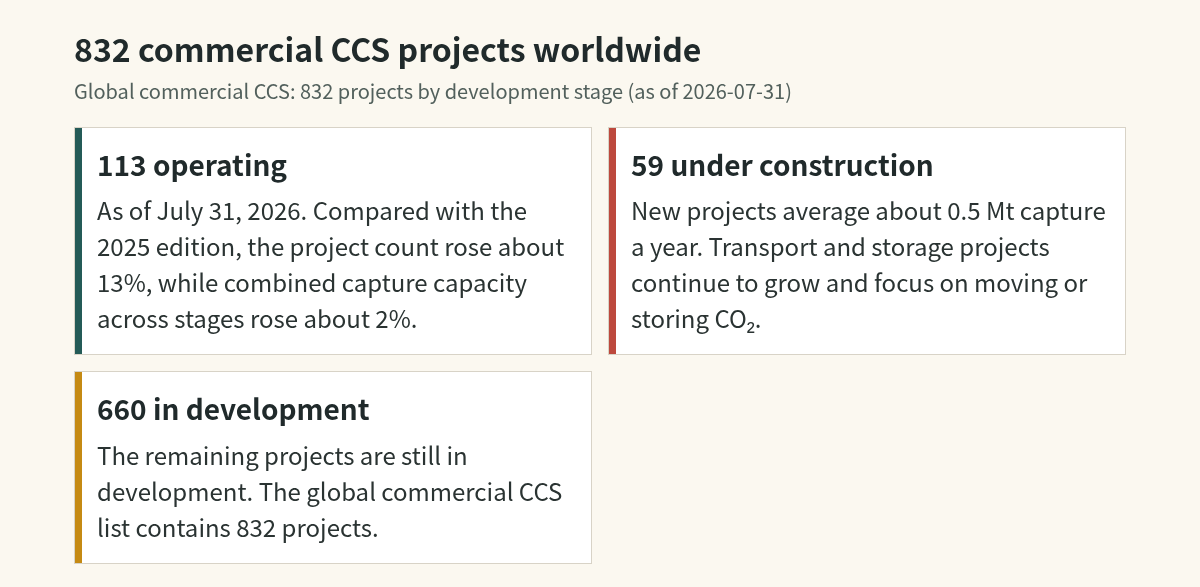
Project numbers are growing faster than capacity: the project count rose about 13%, while capture capacity across all stages grew only about 2%. Transport and storage developments keep growing in number too. They move or store CO₂ without adding capture capacity of their own.
Shared infrastructure lets several emitters plug into the same transport and storage services. Europe has 15 operating projects and another 21 under construction, and the report uses Northern Lights’ open-access services as its main example, along with CO₂ shipping and cross-border cooperation. [pp. 22–24]
A large storage development is being planned at Ras Laffan in Qatar. In February 2026, Worley announced engineering work for a project designed to support permanent storage of approximately 4.3 million tonnes of CO₂ a year once operational. [Worley, February 10, 2026]
Moving CO₂ across borders raises the question of who holds long-term responsibility and how returns are shared. The report’s Asia-Pacific and India chapter examines liability transfer, long-term stewardship, crediting and commercial risk. [p. 37]

Regional progress
The Americas have the largest number of projects. The report counts 63 operating and 18 under construction in the region, with 188 more in advanced development and 141 in early development. [p. 12] Operating capture capacity in the Americas is about 48 million tonnes a year. Based on current project announcements, it could reach 282 million tonnes a year by 2030 and beyond. [p. 10]
Europe currently operates about 3 million tonnes a year of capture capacity, which could rise to as much as 141 million tonnes a year if all projects proceed as planned. [Executive summary] Norway’s Sleipner and Snøhvit have operated for many years, and Denmark’s Greensand storage project has entered commercial operation. [p. 22] CO₂ pipelines listed as EU Projects of Common or Mutual Interest (PCI/PMI) total about 9,000 km. [p. 23] In October 2025, the European Climate, Infrastructure and Environment Executive Agency (CINEA) awarded €240 million to 10 cross-border transport and storage projects, including €120 million for the Prinos project in Greece. [p. 24]
The Middle East and Africa have 5 operating projects and 5 under construction. Saudi Arabia’s Jubail hub targets 9 million tonnes a year by 2028, Qatar is advancing the 4.3 million-tonne Ras Laffan project, and Oman plans a CO₂ network of more than 800 km. [Executive summary]
Asia-Pacific projects under construction and regulation
Three projects operate in the Asia-Pacific and India region: Gorgon and Moomba in Australia and the Ngawha geothermal facility in New Zealand. Together they store about 3 million tonnes of CO₂ a year. [p. 37] Moomba received 1,194,662 Australian Carbon Credit Units (ACCUs) over the 12 months to June 29, 2026. [p. 36]

PTTEP’s Arthit project in Thailand reached a final investment decision (FID) in September 2025, bringing the number of projects under construction in the region to four:
| Project | Country | Expected start | Capture capacity (Mtpa) | Storage type |
|---|---|---|---|---|
| PTTEP Arthit | Thailand | 2027 | 1 | Depleted oil and gas field |
| Petronas Kasawari | Malaysia | 2027 | 3.7 | Depleted oil and gas field |
| bp Tangguh | Indonesia | 2028 | 3 | Enhanced gas recovery |
| INPEX Abadi | Indonesia | 2030 | 2.8 | Not specified |
Table data are from the report’s project list. [pp. 56–57] Once all four are running, the region could add more than 10 million tonnes a year of storage by 2030, which the report estimates as a potential 350% increase in the regional storage rate. Projects before FID rose from 49 in the 2025 edition to 62. [p. 37]
On regulation, Malaysia enacted its CCUS Act 2025, which includes long-term stewardship requirements and an injection levy, and set up the MyCCUS Agency. Indonesia issued Presidential Regulation No. 110 of 2025 on the economic value of carbon. Western Australia’s state legislation came into force in May 2026, Thailand began drafting a CCS law in 2026, and New Zealand proposed an “Enabling CCUS” regime. South Korea assigned CCS to its Ministry of Climate, Energy and Environment, and Singapore established a CCS Programme Office. [p. 36]
Japan, South Korea and Singapore plan to export CO₂ for storage in Australia, Indonesia or Malaysia. Several memoranda of understanding have been signed, but no binding agreements are yet in place. Australia, Indonesia, Malaysia and Japan already permit CO₂ import and export for storage under their laws. [p. 37]
On carbon pricing, Vietnam launched a pilot emissions trading scheme in 2025 and issued a decree in January 2026 for its domestic carbon market. India committed about USD 2.2 billion (₹20,000 crore) over five years to support CCUS. [p. 36]
China’s targets, standards and projects
China’s 15th Five-Year Plan for the oil and gas sector (2026–2030) sets a target of 10 million tonnes of annual CO₂ injection by 2030. The report notes that it is the first Chinese policy document to include a quantified CCUS objective. The State Administration for Market Regulation approved 12 national CCUS standards on January 8, 2026, effective from July 2026; five of them are identical to ISO standards. [p. 43]
Huaneng’s 1.5 million-tonne-a-year coal power CCS facility was commissioned in September 2025. Sinopec is developing a 1 million-tonne coal power project at the Shengli Oil Field, with construction expected from October 2026 to October 2028, and China Resources is advancing a 500,000-tonne project in Tangshan. CNPC Xinjiang’s 1 million-tonne coal power CCUS project in Karamay is about halfway through construction. [p. 42]
Yanchang Petroleum is building a 1 million-tonne project in Shaanxi and on June 12 began construction of a 145 km CO₂ pipeline with a transport capacity of 2.8 million tonnes a year. CNOOC started a CCUS project at the Dongfang 1-1 gas field off Hainan in April 2026, planned to store more than 1 million tonnes of CO₂ a year. By January 2026, Dalian Shipbuilding Offshore had delivered the first four CO₂ carriers for Northern Lights. [pp. 42–43]
The report uses CNPC’s Jilin oilfield as a case study. The project has injected about 4.1 million tonnes of CO₂ in total, of which 3.61 million tonnes are permanently stored, and has an injection capacity of 800,000 tonnes a year. A two-phase pipeline of about 400 km is planned; the 282 km first phase is under construction and designed to carry 3.3 million tonnes a year. [p. 44]
Financing and commercialisation
Europe has the largest public funding programmes. The latest EU Innovation Fund round supports 11 CCS projects. The Netherlands, Denmark and Flanders have each awarded about €2 billion to domestic CCS projects, and France awarded €1.6 billion to seven decarbonisation projects, four of which include CCUS. [p. 12]

Private capital is starting to take part. In December 2025, the Port of Rotterdam raised €50 million through the world’s first CCS bond, for the Porthos project. In May 2026, Eni CCUS Holding secured £500 million from 13 international lenders for its CCS portfolio. [p. 25]
Commercial contracts for transport and storage are also building up. Northern Lights first stored CO₂ in the Aurora reservoir in August 2025 and began providing commercial services to industrial customers. Its second phase is under construction, with contracts for four new CO₂ carriers signed in early 2026. [p. 25] In the United States, ExxonMobil has around 9 million tonnes a year of storage under contract. [Executive summary]
The report takes these financing and contract examples to show that Europe’s CCS industry is beginning to rely less on public funding. [p. 25]
The duration and terms of policy support
Canada has extended the full-rate period for its carbon capture, utilization and storage (CCUS) investment tax credit. Full rates apply through the end of 2035, with half rates from 2036 to 2040. Eligible capture equipment other than direct air capture qualifies for a 50% rate. Transport and storage equipment qualifies for 37.5%. Direct air capture has a separate rate.
Under section 127.44 of the Income Tax Act as it stands, enhanced oil recovery (EOR) is not an eligible use for the credit. Canada’s Spring Economic Update 2026, presented on April 28, proposes adding EOR at half the normal rates: through 2035, 30% for direct air capture, 25% for other capture equipment and 18.75% for transport, storage and use equipment, falling to 15%, 12.5% and 9.375% for 2036 to 2040. The proposal would apply only in jurisdictions designated as having sufficient permanent-storage regulation, would require at least 95% of the CO₂ intended for EOR to be stored permanently over the review period (generally 20 years), and would exclude equipment used all or substantially all to produce oil. If enacted, it would take effect from April 28, 2026; the Canada Revenue Agency’s August 2026 update still describes it as a proposal. [Income Tax Act s.127.44] [Spring Economic Update 2026] [CRA, August 2026]
Japan’s CCS regulatory framework is in force, while its cost-support arrangements are still being developed. The CCS Business Act took full effect on May 22, 2026. The report describes a proposed support scheme for pipeline-based CCS with a 15-year term and advance support covering up to 75% of construction costs. Shipping projects are being considered separately. [Japanese government] [Report, p. 46]
Japan, capture technology and policy around the world
Japan launched its GX-ETS emissions trading scheme in April 2026. The contract-for-difference design described in the report would compensate for the gap between CCS costs and the GX-ETS carbon price over 15 years. [p. 46] In June 2024, the government selected nine Advanced CCS Projects through JOGMEC, with storage in Japan and overseas; three plan storage in Malaysia and one in Oceania. The target is an annual CCS volume of 6 to 12 million tonnes by the early 2030s. Japan also accepted the amendment to the London Protocol in 2026, providing a legal basis for exporting CO₂ for storage. [p. 48]
Amine-based solvents remain the most mature and widely used capture technology. The report counts about 194 million tonnes a year of capture capacity in development whose technology has not been specified, and many of those projects are still selecting a technology. [p. 11]
Over the past year, seven countries included CCS in their updated Nationally Determined Contributions (NDCs), four included it in national strategies or plans, and carbon markets in five countries now cover CCS. New CCS permits or licences were awarded in Denmark, Greece, Malaysia, the Netherlands and the United States, and Texas and Arizona received Class VI primacy. Cross-regional cooperation includes the Canada–Saudi Arabia agreement and the Sweden–Indonesia announcement. [p. 12] Across 17 US states, 33 CCS laws have been enacted. [Executive summary]
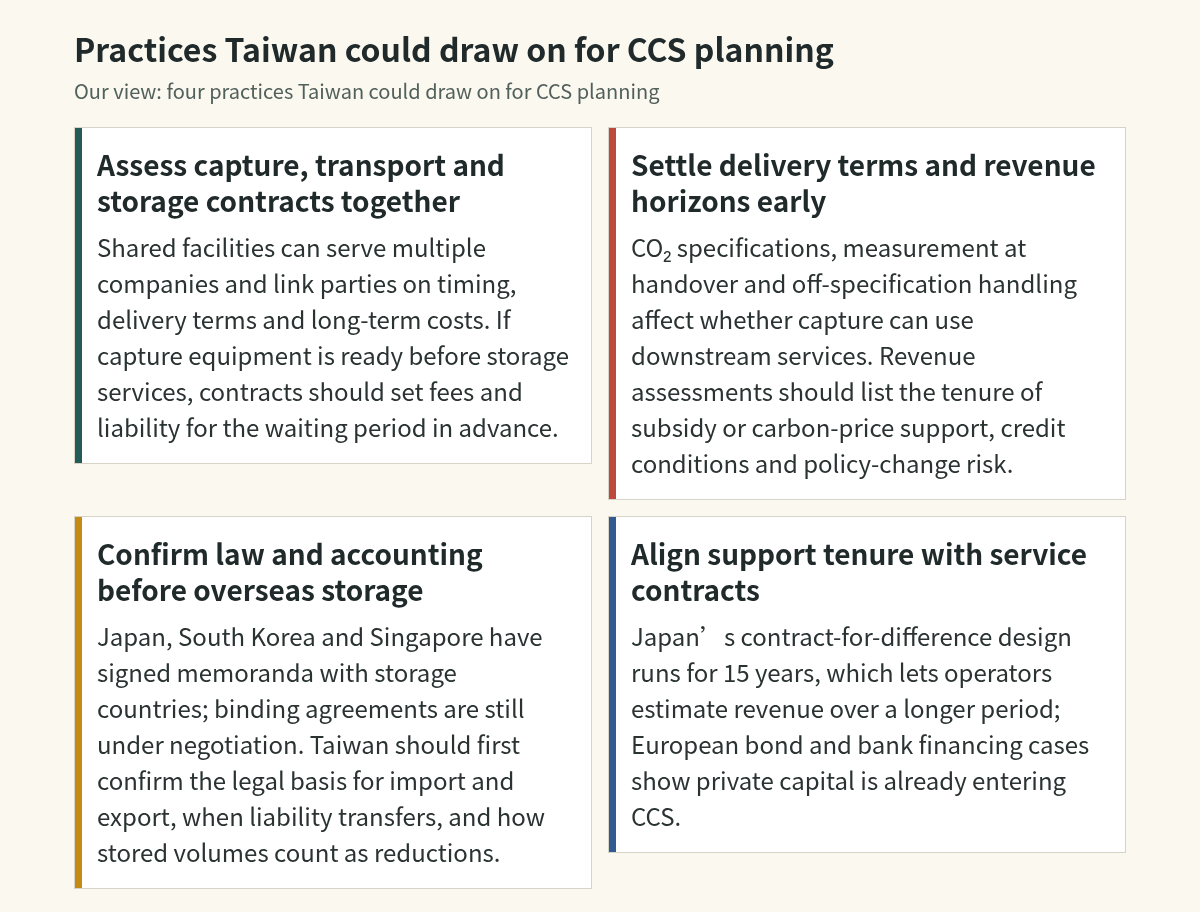
Our view: Practices Taiwan could draw on for CCS planning
The report’s regional chapters do not include project or policy data for Taiwan; Taiwan’s pilot and regulatory developments this year are in public material from the Ministry of Environment.
On April 1, 2026 the Ministry of Environment approved CPC Corporation’s carbon capture and storage pilot at Tiechenshan. The plan has three stages, with cumulative injection thresholds of 10,000, 100,000 and 300,000 tonnes. Results at each stage must be reviewed before work can continue.
The Regulations on Management of Carbon Dioxide Capture and Subsequent Storage, issued and put into force on August 25, require disclosure of information. Specified real-time monitoring data, including CO₂ concentrations and seismic readings, must be uploaded to a designated website. Monitoring after well closure is in principle required for 20 years, unless a special case is approved. Release from that duty requires review, and operators must file a report six months before monitoring is completed.
Northern Lights, the report’s main example of shared infrastructure, first stored CO₂ in the Aurora reservoir in August 2025 and now serves industrial customers commercially. In planning CCS, Taiwan can assess transport and storage services offered to several customers together with the capture equipment.
Sources (9)
Sources
- Ministry of Environment, Taiwan, approval of the Tiechenshan CCS pilot, 1 April 2026: https://enews.moenv.gov.tw/moenv-news/zh-tw/News/13985
- Ministry of Environment, Taiwan, Regulations on Management of Carbon Dioxide Capture and Subsequent Storage, 25 August 2026: https://oaout.moenv.gov.tw/law/LawContent.aspx?id=GL007972
- Global CCS Institute, Global Status of CCS 2026, full report (PDF)
- Global CCS Institute, Global Status of CCS 2026, executive summary (PDF)
- Worley, news release on the Ras Laffan CO₂ sequestration project, February 10, 2026
- Canada, Income Tax Act, section 127.44
- Department of Finance Canada, Spring Economic Update 2026, tax measures
- Canada Revenue Agency, Clean economy ITC news and updates
- Ministry of the Environment, Japan, material on the CCS Business Act
Leave a comment
Comments are reviewed before publication. Email is private and used only when contact is necessary. Privacy notice