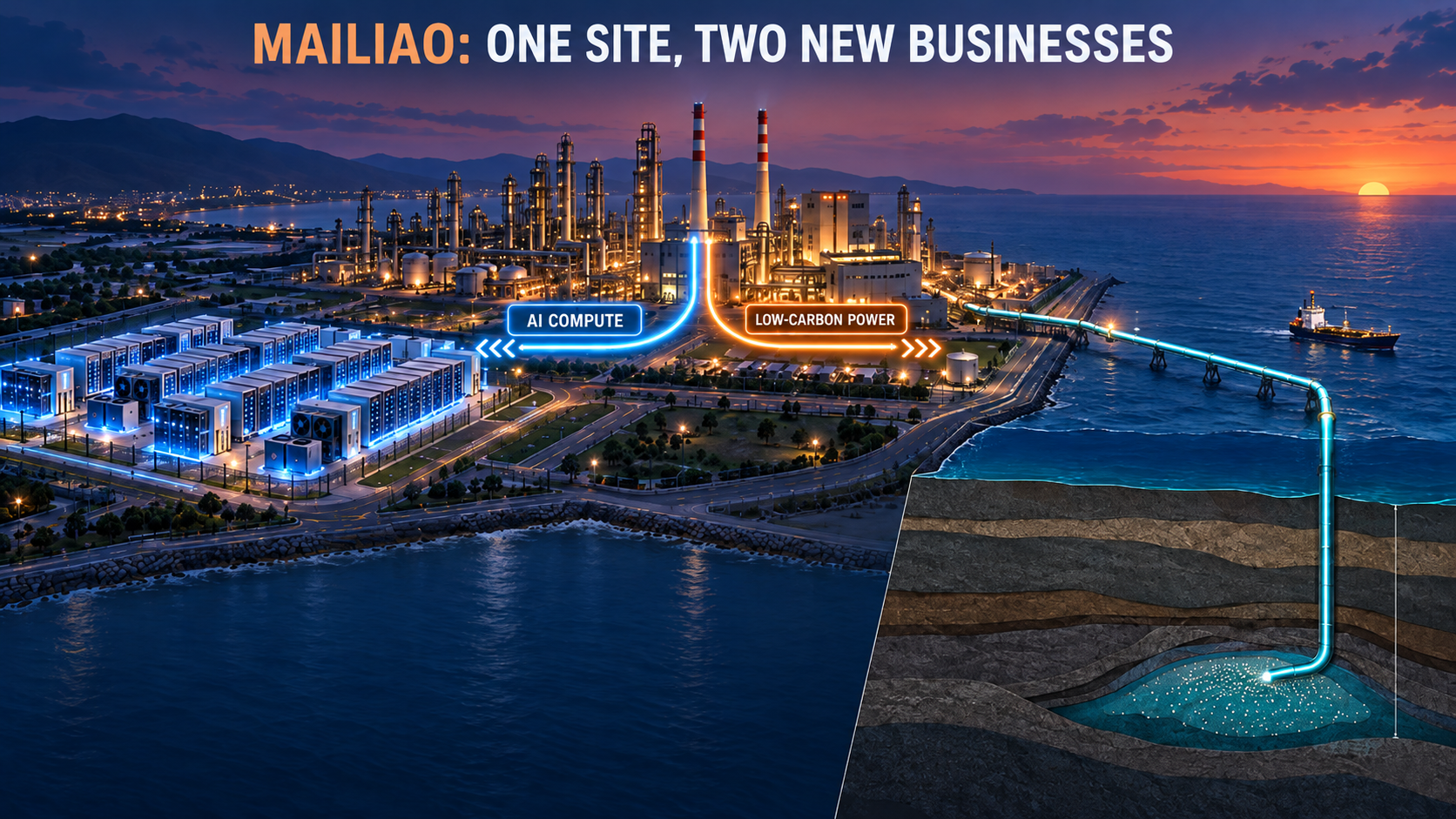
For decades, the Sixth Naphtha Cracker complex in Mailiao, Yunlin County, has been associated with petrochemical plants, smokestacks and a coal-fired power plant. Two recent developments give the site two new roles: Formosa Smart Energy Tech plans to build an AI data center here with CHUANG-XI Information and Technology, and Taiwan Semiconductor Manufacturing Co. (TSMC) has been reported to be working with Formosa Petrochemical on research into pairing Mailiao's new gas-fired power plant with carbon capture and storage, to produce low-carbon electricity it could buy. One story looks like it is about AI and the other about decarbonization, but the logic behind both is the same: turning an industrial park's existing land, power and utilities into new businesses. Both efforts are only at the starting line, though, so what is confirmed and what is merely planned need to be looked at separately.
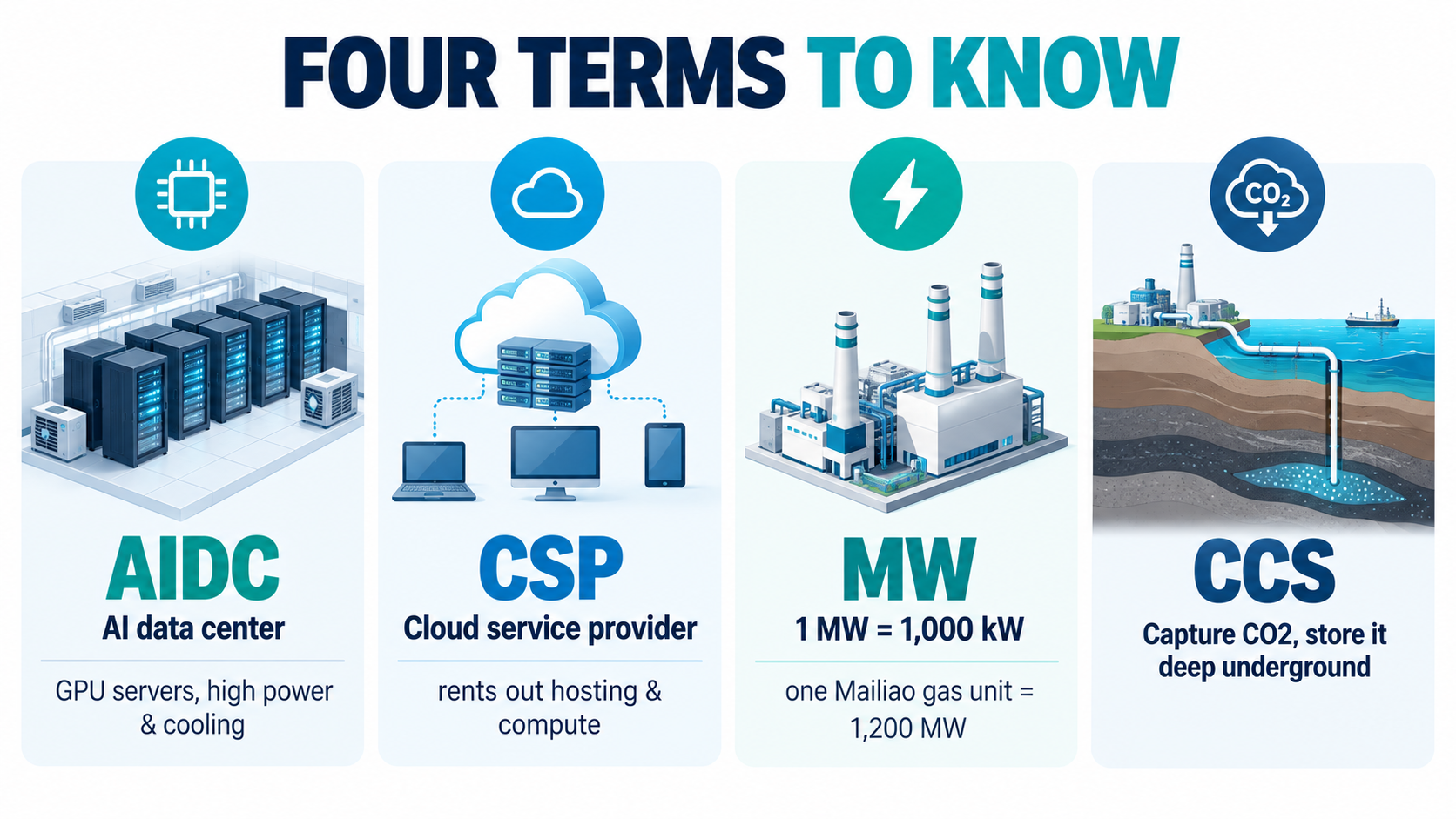
Primer: AIDC, CSP, "MW-scale" and CCS
AIDC (AI data center): a data center built specifically to house AI servers, most of them fitted with GPUs or other accelerator chips. Compared with a conventional server room, it has higher power use per unit of floor space and greater cooling needs, and it is more demanding about the stability of its power supply.
CSP (cloud service provider): a company that packages data center space, servers and networks into services it rents out, such as colocation hosting or on-demand compute. Building a data center is a one-off engineering project; being a CSP is a long-term operating business with monthly billing.
MW-scale: MW stands for megawatt (1 MW = 1,000 kW), a unit commonly used to describe a data center's power capacity. "MW-scale" only indicates an order of magnitude and gives no precise figure, so it cannot be converted directly into electricity consumption or revenue. For comparison, a single unit at Mailiao's new gas-fired power plant is 1.2 million kW, or 1,200 MW.
CCS (carbon capture and storage): capturing the carbon dioxide emitted by power plants or factories, compressing it and injecting it into suitable rock formations deep underground for long-term storage. A gas-fired plant equipped with CCS can sharply cut the emissions of the electricity it generates, and that electricity is often called "low-carbon power". But it is not renewable energy, and it is not zero-emission.
Story one: Formosa Smart Energy and CHUANG-XI build an AI data center in Mailiao
On October 7, 2026, Formosa Smart Energy, an affiliate of the Formosa Plastics Group, announced that it had signed a letter of intent with CHUANG-XI Information and Technology (CXIT) to jointly build an AI data center, with the group's Mailiao industrial park as the first site. The two companies also plan to set up a CSP joint venture to take over subsequent operations and compute services.
According to the announcement, the division of labor is roughly as follows:
Scale: the first phase is "initially planned at MW scale"; no exact capacity was disclosed.
Build approach: site conditions, power supply, utility systems and data center equipment will be integrated using a modular design to shorten initial setup time, with phased expansion later in line with customer demand.
Operations: once construction, testing and acceptance are complete and the AIDC goes live, the CSP joint venture will take over operations.
CHUANG-XI's role: bringing in smart operations, cybersecurity and global network capabilities, and later developing colocation hosting and compute rental.
Formosa Smart Energy chairwoman Sandy Wang said in the announcement that the Formosa Plastics Group has spent decades building up large industrial sites, power and utility facilities, and that the goal now is to turn these existing industrial resources into growth momentum for the AI era, extending the company's role from front-end engineering to back-end services.
One point deserves emphasis: a letter of intent is not a formal contract, and the joint venture is still at the "planned" stage. The announcement did not disclose the investment amount, exact capacity, launch date or any customer commitments, nor did it say where the data center's electricity will come from. In other words, what is certain now is the direction of the partnership; it cannot be taken as evidence that construction has started, that the facility is operating, or that the joint venture has been formed.
Story two: Mailiao's gas-fired plant plus carbon storage, and the low-carbon power TSMC wants to buy
The central player in the second story is Formosa Petrochemical. This one was not formally announced by the companies; it has come out gradually through a series of media reports, so it matters which outlet reported what.
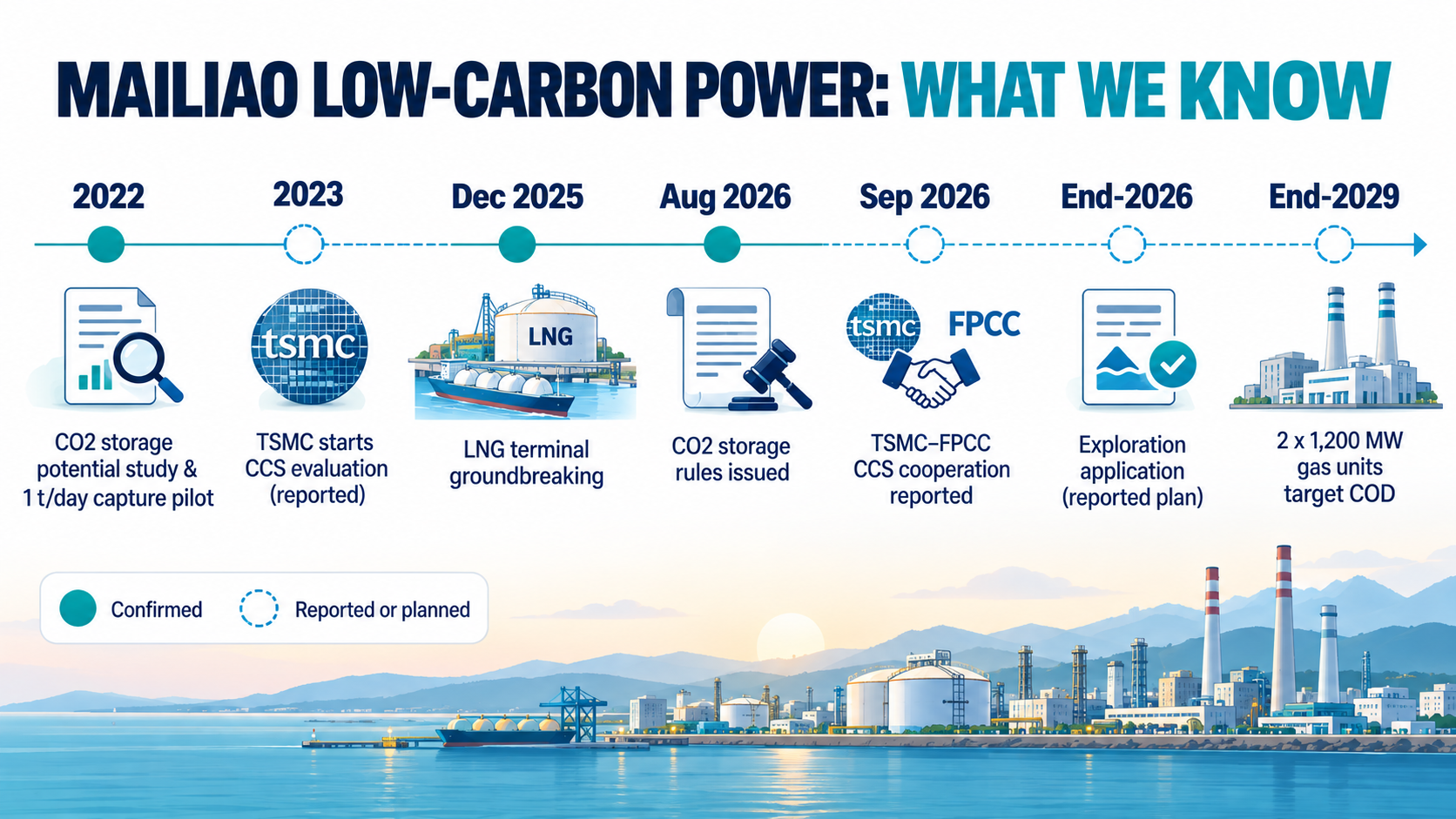
First, the part already under construction: converting the Mailiao power plant from coal to gas. Formosa Petrochemical is investing more than NT$130 billion to build two combined-cycle gas units of 1.2 million kW each at the Sixth Naphtha Cracker complex, along with its own liquefied natural gas (LNG) receiving terminal and a south utility wharf. Ground was broken on the terminal and wharf on December 19, 2025, with commercial operation targeted for December 31, 2029 under dispatch by Taiwan Power Company (Taipower). Formosa Petrochemical estimates the plant will generate 14 to 16 billion kWh a year, about 5% of Taiwan's total power generation, with carbon emissions roughly 60% lower than in its coal-fired days.
Next, the reported carbon storage partnership:
CommonWealth Magazine (2026-09-21): reported in an exclusive that TSMC and Formosa Petrochemical had "formally signed an agreement to cooperate", launching research into carbon capture and storage at natural gas power plants. However, neither the form of the agreement (memorandum, letter of intent or binding contract) nor its value has been made public.
Wealth Magazine (2026-09-24, republished by Economic Daily News and others): TSMC began evaluating carbon capture in 2023 and discussed with Formosa Petrochemical that if Mailiao's new gas units were paired with CCS, the electricity they generate might be bought by TSMC under arrangements modeled on renewable energy deals. The report described it as a joint project of TSMC, Formosa Petrochemical and ExxonMobil; Formosa Petrochemical is reportedly preparing to file an application for storage exploration by the end of the year, and Brad Crabtree, a senior executive in ExxonMobil's Low Carbon Solutions business, visited Taiwan in mid-September.
Central News Agency (CNA) (2026-09-29): Formosa Petrochemical president Keh-Yen Lin confirmed that "Formosa Petrochemical was originally doing this on its own, and now TSMC has joined", and that the first step will be a single pilot site, with any scale-up depending on how things go. He also acknowledged that an environmental impact assessment and talks with local governments and environmental groups still lie ahead: "this is not a matter of one or two years."
Business Today ESG (2026-10-07): reported that TSMC and Formosa Petrochemical are evaluating an investment of NT$5 billion to NT$10 billion in CCS, though the companies have not officially confirmed the figure.
Formosa Petrochemical is not starting from scratch here: since 2022 it has worked with National Central University to assess storage potential along the Mailiao coast, and that same year it ran a demonstration project with National Tsing Hua University in Mailiao that captured 1 tonne of carbon dioxide per day. Still, none of TSMC, Formosa Petrochemical or ExxonMobil has issued a formal press release, and ExxonMobil's involvement has so far appeared only in Wealth Magazine's reporting. The storage site, capture volume, and the quantity and price of any low-carbon power supply have not yet been disclosed.
On the policy side, the Ministry of Environment issued the Regulations for the Management of Carbon Dioxide Capture and Storage on August 25, 2026, which require operators to apply for exploration and complete an environmental impact assessment before applying for storage approval. For Mailiao to become Taiwan's first privately developed storage site, it will have to clear each of these steps in turn. For the current state of Taiwan's other carbon storage trials, see our note "Taiwan's carbon capture and storage experiments".
What is confirmed and what is still planned
Under way: construction of Mailiao's gas units, LNG terminal and wharf (ground broken at the end of 2025, commercial operation targeted for the end of 2029); the letter of intent between Formosa Smart Energy and CHUANG-XI (2026-10-07); Formosa Petrochemical's storage-potential assessment and small-scale capture demonstration (since 2022).
Reported, with no formal company announcement: the terms of the TSMC–Formosa Petrochemical CCS agreement; ExxonMobil's role; the NT$5–10 billion investment figure; an exploration application by year-end.
Still planned: formation of the CSP joint venture; the AIDC's exact capacity and launch date; the storage pilot site; whether, when and at what price TSMC can buy low-carbon power from Mailiao.
Our view: one set of energy assets, two businesses
Read together, the two stories make the Formosa Plastics Group's plans for Mailiao clearer: the land, generating capacity and utilities built up at the Sixth Naphtha Cracker complex, together with the petrochemical industry's experience in handling gases and underground engineering, are being repackaged into two products.
Selling compute: what AI data centers need most is usable land, power and cooling. Formosa Smart Energy wants to extend these assets from "engineering and construction" into "long-term operating services".
Selling low-carbon power: the semiconductor and AI supply chains need stable, low-carbon electricity, and renewable energy cannot keep up with demand for now. If power from a gas-fired plant with CCS is recognized as low-carbon, the business could move up from "selling electricity" to "selling electricity that comes with a decarbonization attribute".
What the two have in common: the real value lies not in the equipment itself but in long-term contracts. A data center recovers its costs through steady occupancy and service pricing; low-carbon power depends on buyers being willing to pay for the decarbonization attribute over the long term. Finishing construction is just one milestone; whether customers can be signed and kept is what determines future revenue.
But no public information currently shows that the two efforts are linked: Formosa Smart Energy's announcement does not say the AI data center will use power from Mailiao's new gas-fired plant, let alone mention carbon storage. Seeing them as two sides of one strategy is our interpretation, not something the companies have said.
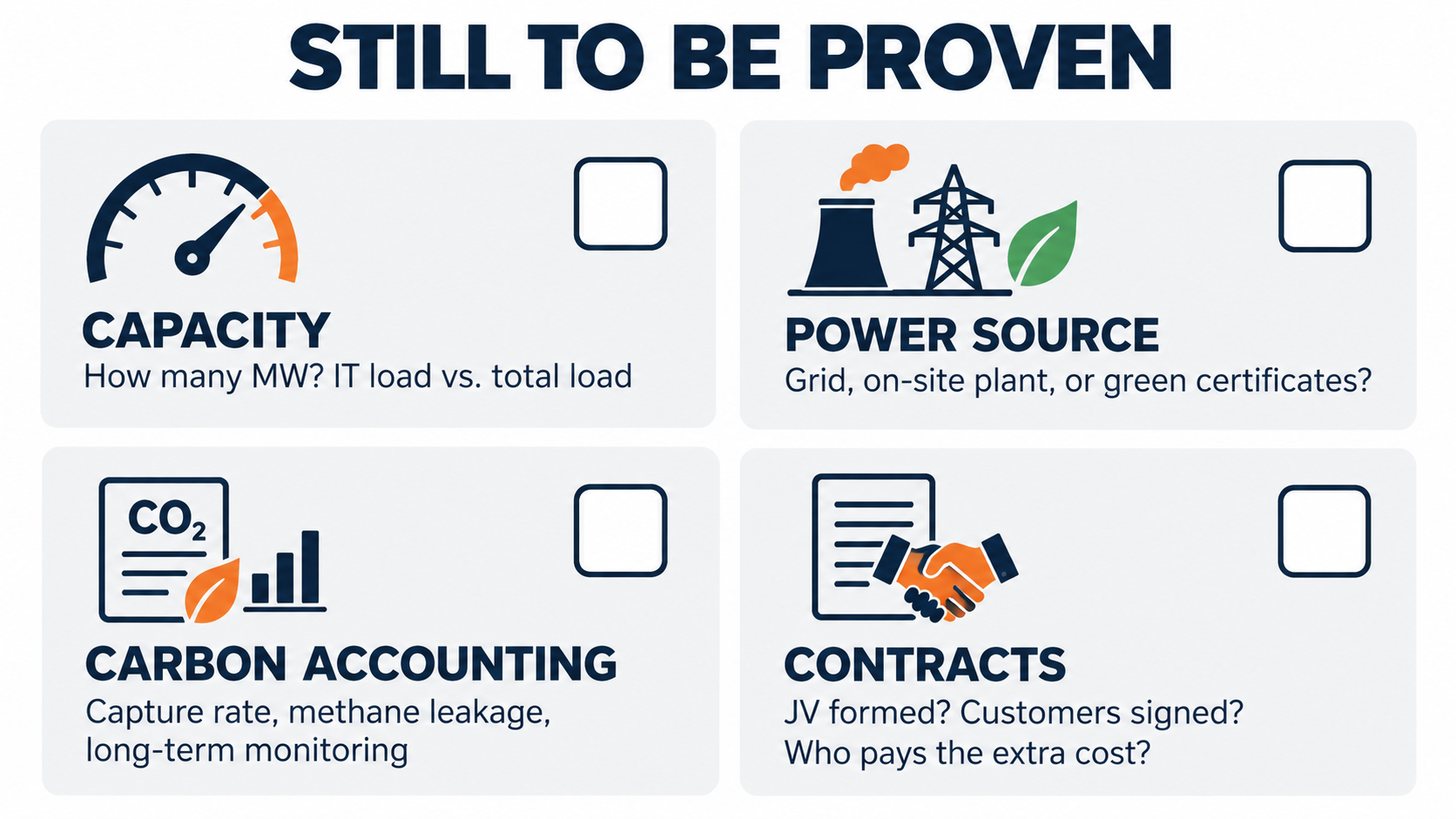
Four things still to be proven (our view)
Capacity: "MW-scale" could mean a few MW or several tens of MW. Only if the IT load, total site power use and cooling design are disclosed can outsiders judge the energy demand. The International Energy Agency (IEA) notes that data center electricity use covers not just servers but also cooling, uninterruptible power supplies and other auxiliary equipment, with cooling accounting for anywhere from about 7% in efficient large-scale facilities to more than 30% in less efficient ones. It adds that data center loads tend to be concentrated in specific locations, which can make grid integration more difficult.
Power source: will the AI data center run on the Taipower grid, the industrial park's own cogeneration plant, or separately purchased green power and certificates? Until that is spelled out, an "industrial park" should not be equated with "low-carbon compute".
Carbon accounting: whether power from a gas-fired plant with CCS is truly low-carbon depends on the actual capture rate, the energy consumed by the capture equipment itself, upstream methane leakage from natural gas, and whether long-term monitoring can prove that the carbon dioxide stays underground. Taiwan's rules for recognizing and certifying low-carbon power are also still under discussion, and they will determine whether the electricity TSMC buys can count toward its emission reductions. Boston University professor Benjamin Sovacool, on a recent visit to Taiwan, also cautioned that CCS is not a quick fix for decarbonizing electricity and should be prioritized for hard-to-abate industries such as cement and steel.
Contracts: for the AIDC, the questions are when the joint venture will be formed and whether it will win customer orders; for CCS, whether the TSMC–Formosa Petrochemical partnership moves from research to a power purchase agreement, and at what price. CommonWealth Magazine's headline already flagged "NT$1.5 more per kWh". Who bears that extra cost will be the most critical commercial question.
Mailiao offers a case worth watching: how a traditional heavy-industry park can turn its energy assets into new products for the AI era. But most of what is visible so far consists of letters of intent, media reports and plans. Real competitiveness will have to be proven through reliable delivery, stable customers, and capacity, power and emissions figures that can withstand scrutiny.