
In October 2026, the US energy outlet Microgrid Knowledge reported on a new book that collects first-hand accounts from utilities, academics, Indigenous communities and advocates. The accounts describe how Alaska connects hydropower, wind, solar and battery storage into small grids in remote, cold places where fuel is expensive. This article summarizes three examples from the coverage (Kodiak Island, Kotzebue north of the Arctic Circle, and Igiugig) and compares them with power supply and storage on Taiwan's Penghu, Kinmen and Lanyu islands.
Further reading: for more on the reliability of lithium battery storage systems, see our article "EPRI: Lithium Battery Storage Failure Rate Down 98% in Seven Years".
About 100 Alaskan utilities serve fewer than 800,000 people
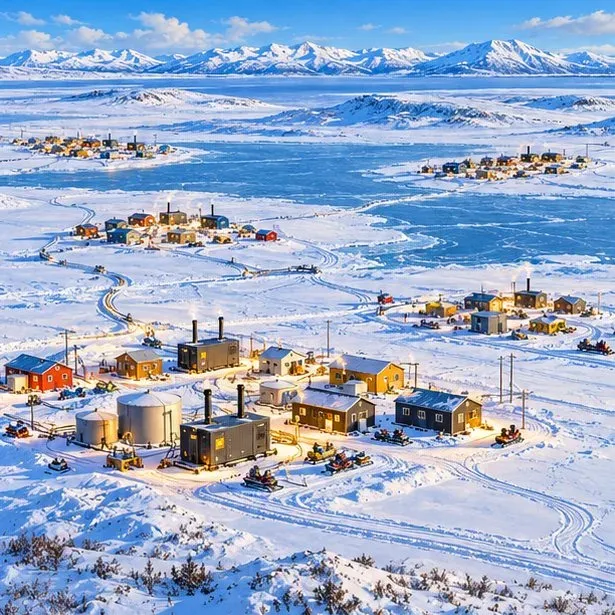
The book is titled "Alaska's Microgrid Innovators: How Communities Are Responding to Today's Energy Challenges" and was edited by Peter Asmus, a microgrid advocate and president of Pathfinder Communications. The report says Alaska has about 100 utilities serving fewer than 800,000 people, and some serve fewer than 100 customers. Asmus argues that this fragmented structure has produced clean energy innovation, driven by renewables being economical.
Cost is the main motive. The US Department of Energy (DOE) states that 250 remote Alaskan communities depend on isolated diesel microgrids. In Igiugig, a community of about 70 people, No. 1 diesel cost US$10.10 per gallon in 2023–24 and electricity cost US$0.91 per kWh. Alaska's Power Cost Equalization (PCE) program subsidizes US$0.72 per kWh for up to 750 kWh of use per month.
Kodiak Island uses hydropower as base load, with wind and batteries covering dry years
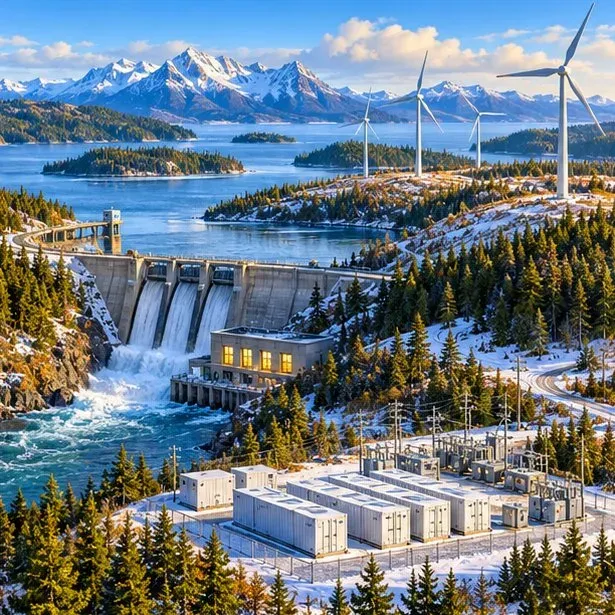
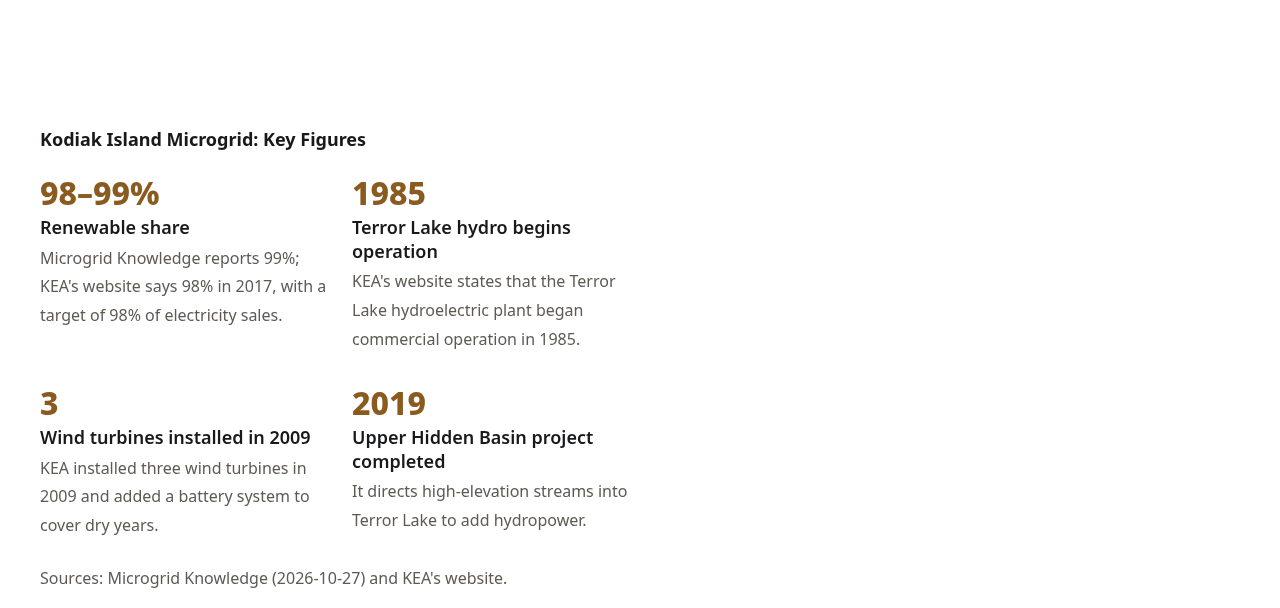
Kodiak Island is the second-largest island in the United States. According to Microgrid Knowledge, the island's microgrid runs on 99% renewable energy; KEA's website, however, says the renewable share of generation held at 98% in 2017, and the current target is also to keep 98% of electricity sales from renewables. It is operated by Kodiak Electric Association (KEA), a not-for-profit cooperative founded in 1941 and owned by its members. KEA's website states that the Terror Lake hydroelectric plant began commercial operation in 1985.
In a dry year, a hydro-based system produces less, diesel generation rises, and prices become hard to predict. The report says KEA installed three wind turbines in 2009 and added a battery system. KEA's website records that renewables supplied more than 95% of generation in 2013 and held at 98% in 2017. The Upper Hidden Basin diversion project, completed in 2019, directs high-elevation streams into Terror Lake to add hydropower. KEA's current goal is to keep 98% of energy sales from renewable sources.
Kotzebue Electric Association lies north of the Arctic Circle, where river ice and mud limit wind turbine delivery and installation
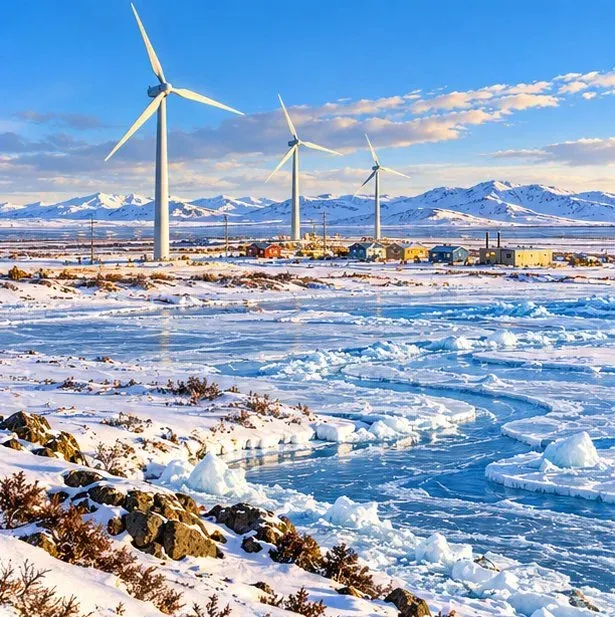
Kotzebue Electric Association is located north of the Arctic Circle. Asmus explains that the timing of delivery and installation is constrained there: when the river is frozen, turbines cannot be brought in by boat; after the ice melts, the ground is too muddy for construction, so installation waits until the ground freezes in winter.
The microgrid began with small turbines and grew to larger modern turbines, combined with solar and a utility-scale battery. One chapter of the book was written by Brad Reeve, manager of Kotzebue Electric Association in the 1990s, and describes how he pursued wind power in an environment where some doubted that commercial wind was viable.
Igiugig placed an underwater turbine in a river used by sockeye salmon
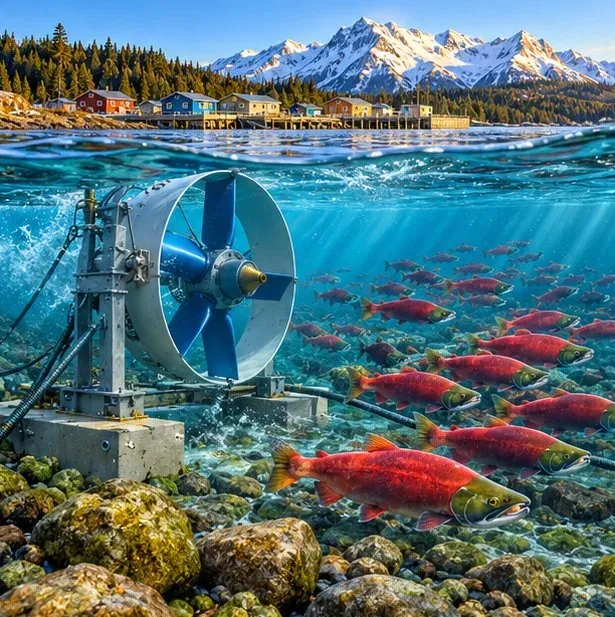
Igiugig lies in southwestern Alaska at the outlet of Lake Iliamna, at the head of the Kvichak River. DOE describes the Lake Iliamna outlet as a nursery for the largest red salmon run on Earth. The community partnered with Ocean Renewable Power Company (ORPC) to use the RivGen underwater turbine.
The first RivGen was deployed in July 2019. DOE presentation materials show that RivGen 2.0 went through two Alaskan winters (about −40 °C) and two frazil ice events. The Igiugig Village Council was the first tribal entity to receive a Federal Energy Regulatory Commission (FERC) hydrokinetic pilot license, according to DOE. Fish monitoring was carried out by the Village Council, the Alaska Department of Fish and Game, the University of Alaska Fairbanks and the Pacific Northwest National Laboratory. The DOE presentation records tens of millions of sockeye salmon passing the turbine location with no observed injuries or mortalities. The report quotes Asmus as saying the community used its long-standing knowledge of salmon to track when and where the fish appear, and that the turbine is moved up and down with the seasons to reduce the risk of harming fish.
RivGen is planned to replace diesel as base load, with a battery and controller for stability
Igiugig's original power plant had three diesel generators of 0.065 MW each, producing 325 MWh a year and burning 24,789 gallons of diesel. A 2020 DOE article says diesel still made up nearly 60% of the energy mix, the plant cost US$250,000 a year to run, and electricity cost about 10 times as much as in the lower 48 states (the contiguous United States). In 2005 the community set a goal of taking its diesel generators offline by 2025.
The second phase added a second RivGen (version 2.1), a Schneider Electric microgrid control system and battery storage. The battery was installed in autumn 2021 with a capacity of 253 kWh and a 0.125 MW inverter that can operate as grid-following or grid-forming; commissioning began in spring 2022. According to the presentation's design, diesel units become backup and RivGen provides predictable base load. The presentation also records problems during commissioning: a millisecond-scale anomaly during one grid connection caused a blackout, and the team reviewed its safety protocols and moved forward. It lists "interconnection and commissioning will never go as planned" as one lesson.
Taiwan's islands offer storage, undersea cable and microgrid cases for comparison
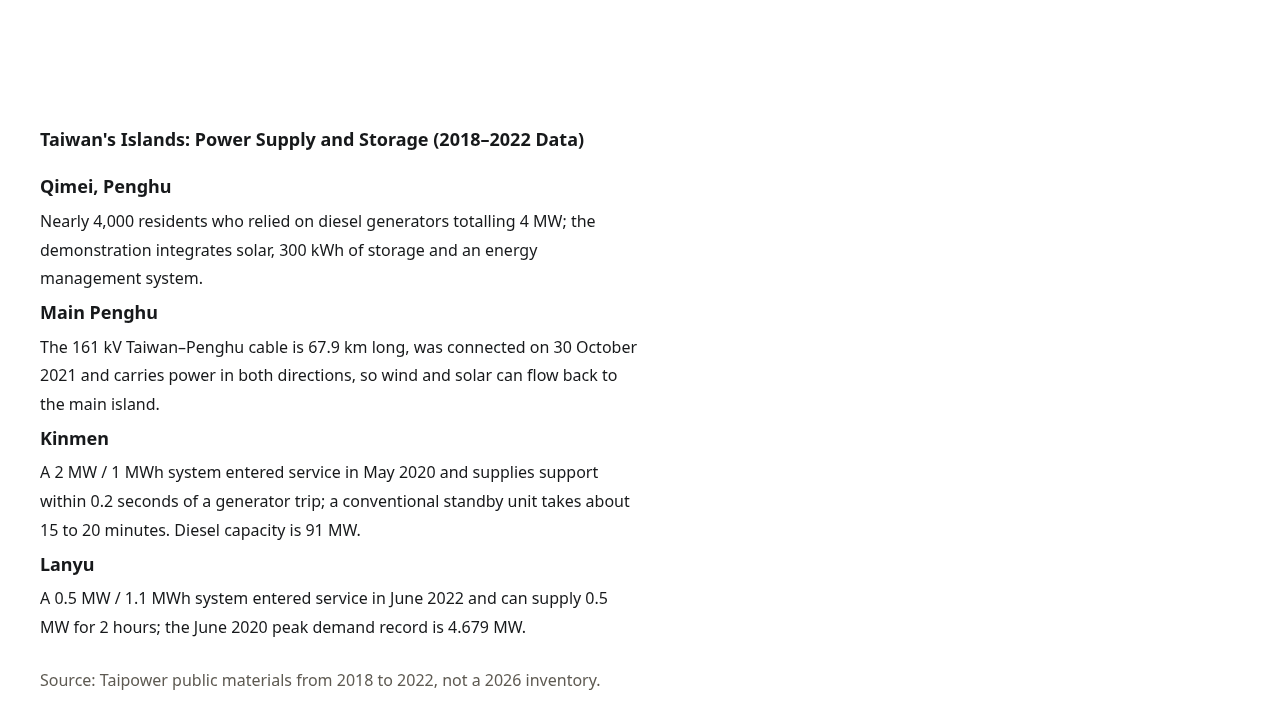
The figures below for Penghu, Kinmen and Lanyu come from public materials dated 2018 to 2022; they are not a 2026 inventory.
A 2018 press release from Taiwan Power Company (Taipower) described Qimei on Penghu as the first large island microgrid in Taiwan. Qimei has nearly 4,000 residents and relied on diesel generators with a total installed capacity of 4 MW. The demonstration system integrates solar (0.155 MWp in phase one and 0.2 MWp added in phase two; MWp means megawatt-peak), 300 kWh of storage and an energy management system. Taipower's planned targets at the time were 0.6 MW of wind, 1.2 MWp of solar and 2,000 kWh of storage.
Main Penghu took the route of interconnection by undersea cable. The 161 kV Taiwan–Penghu cable is 67.9 km long (58.8 km submarine and 9.1 km underground) with a total budget of about NT$15.73 billion. It was connected to the system at 4 a.m. on 30 October 2021, linking Penghu's grid to the main island; Taipower says it carries power in both directions, so wind and solar power can flow back to the main island.
On Kinmen and Lanyu, the focus is the response speed of storage. The Kinmen Xiaxing power plant put a 2 MW / 1 MWh lithium battery system into service in May 2020. Taipower says that when a generator trips, the system can supply support within 0.2 seconds, while a conventional standby unit takes about 15 to 20 minutes to start. At the time, Kinmen had 91 MW of diesel capacity, more than 9 MW of solar and 4 MW of wind, with renewables above 30% in some periods. The Lanyu power plant put a 0.5 MW / 1.1 MWh system into service in June 2022, made of 160 lithium battery modules, able to supply 0.5 MW for 2 hours. Lanyu set a peak demand record of 4.679 MW in June 2020, and its six diesel units can generate about 4.8 MW at most. As of the 2022 press release, 13.4 km of the 38.8 km island-circling power line had been put underground.
Sources
- Kodiak Electric Association, About Us: https://kodiakelectric.com/about-us
- Microgrid Knowledge, 27 October 2026: https://www.microgridknowledge.com/microgrids/remote/article/55414771/book-recounts-ways-alaska-communities-elevated-innovative-microgrid-adoption-in-response-to-harsh-conditions
Directions Taiwan can draw on
Kodiak Island shows that hydropower combined with wind and batteries can sustain a very high share of renewables over the long term. Kinmen and Lanyu already have storage that responds in 0.2 seconds. A next step is to observe how such equipment performs in situations beyond generator trips, such as load changes in the tourist season and swings in wind and solar output.
DOE materials on Igiugig show that residents took part in deploying, operating and maintaining the equipment, and that technology selection criteria included local involvement, local ownership, and simple design and maintenance. Taiwan's island and mountain communities that adopt microgrids could include local maintenance staff and spare parts at the planning stage. Taipower's website records that it has built self-sufficient microgrids combining renewables, storage, diesel generators and an energy management system in remote townships and schools in Pingtung (Wutai, Mudan and Shizi), Chiayi (Alishan) and New Taipei (Wulai). It has also selected National Taiwan University of Science and Technology, National Chung Hsing University and National Chung Cheng University to build campus microgrid demonstrations, with related tests, according to Taipower's website, expected to finish in 2026; this article has not separately verified whether those tests have been completed.
Leave a comment
Comments are reviewed before publication. Email is private and used only when contact is necessary. Privacy notice