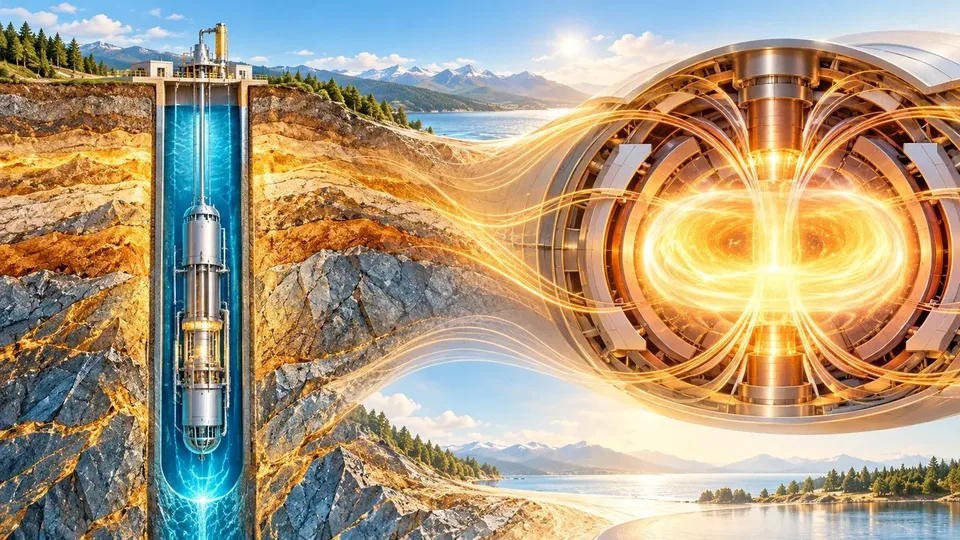
Two listed nuclear companies report progress between June and October 2026
Two Nasdaq-listed companies are approaching nuclear power through fission and fusion. Deep Fission, Inc., based in Berkeley, California, was founded in 2023 by the father-daughter team of Elizabeth Muller and Richard Muller. It plans to place small pressurized water reactors in boreholes about one mile (about 1.6 km) deep. General Fusion Group Ltd., based in Richmond, British Columbia (Greater Vancouver), was founded in 2002 and follows the Magnetized Target Fusion (MTF) approach.
Deep Fission obtained a U.S. Department of Energy (DOE) approved Nuclear Safety Design Agreement in August 2026 and signed a master energy purchase agreement in October. On October 8, General Fusion and the United Kingdom Atomic Energy Authority (UKAEA) announced an electron temperature above 1 keV. This summary follows the companies' press releases and was checked against government, regulator and U.S. Securities and Exchange Commission (SEC) documents; most figures and schedules are company statements.
Deep Fission places a pressurized water reactor in a borehole about one mile deep
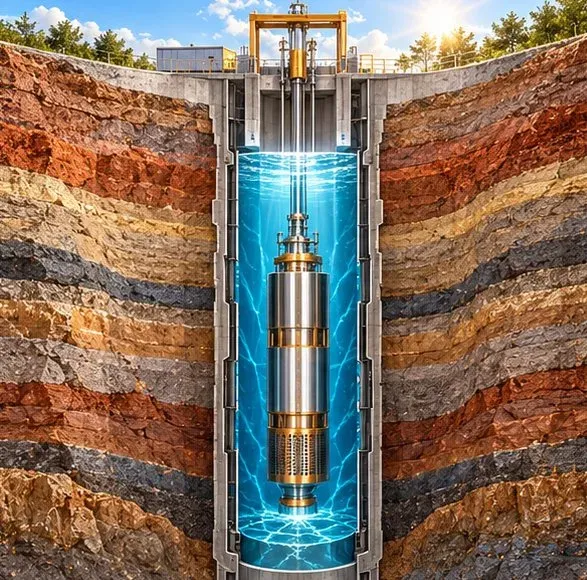
Deep Fission's Gravity™ reactor is a pressurized water reactor that uses standard low-enriched uranium fuel. The company says reactor physics and the fuel cycle stay the same and only the reactor's location changes. The reactor sits at the bottom of a water-filled borehole. According to the company's design, the water column and surrounding rock provide containment, operating pressure, heat transfer and emergency cooling, and the company expects this to remove much of the above-ground infrastructure of a conventional nuclear plant.
In September 2025 the company estimated construction costs could fall by up to 80% and put the levelized cost of electricity at 5 to 7 US cents per kilowatt-hour (kWh) for its first commercial project. These are company estimates and targets, and no actual engineering data exist yet.
DOE approves the safety design agreement; a full-scale prototype canister is lowered and retrieved

Deep Fission was selected for the DOE Reactor Pilot Program, created under Executive Order 14301. The test site is the Great Plains Industrial Park in Parsons, Kansas. The company held a groundbreaking ceremony on December 9, 2025, and has drilled the first 6,000-foot (about 1,829 m) data-collection well.
On August 6, 2026, DOE approved the company's Nuclear Safety Design Agreement (NSDA). On September 15 the company published the full document and said it is the first company in the program to publish a complete NSDA; only a small number of safety-sensitive design details are redacted. The company states that NSDA approval is the first step of safety review and that further documentation and reviews are required before DOE operating authorization. It also says the pilot reactor could convert to commercial operation if it obtains a license from the U.S. Nuclear Regulatory Commission (NRC) and further DOE authorization.
On September 3, 2026, a drilling crew used commercial rigs to lower a 20-foot (about 6.1 m) long, 30-inch-diameter full-scale non-nuclear prototype canister into a 34-inch borehole to about 100 feet (about 30 m), aligned it, and pulled it back to the surface. The canister held no nuclear fuel. The company says no equipment had to be invented, custom-built or adapted for nuclear service.
On September 21, the company announced a collaboration with large-diameter drilling contractor Youngquist Brothers, LLC to test deep-borehole drilling methods. The press release says the September trial validated installation and retrieval mechanics and is a separate stage from full-depth drilling. In that announcement the company gives commercial deployment as early as 2027.
The 25-year purchase agreement covers 150 MW with no minimum purchase
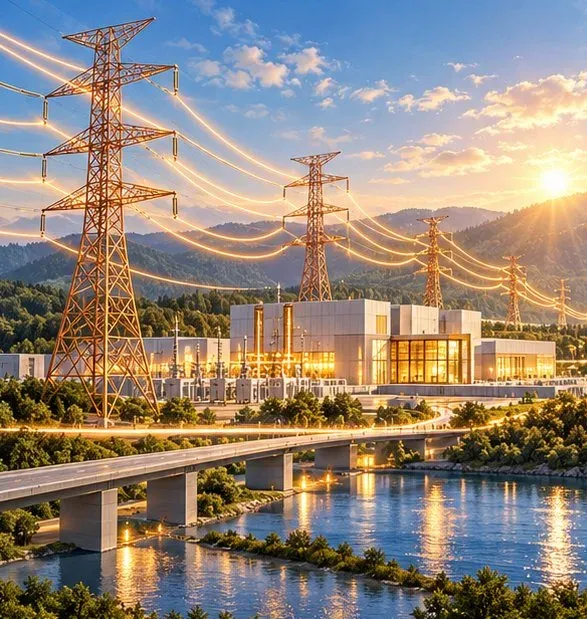
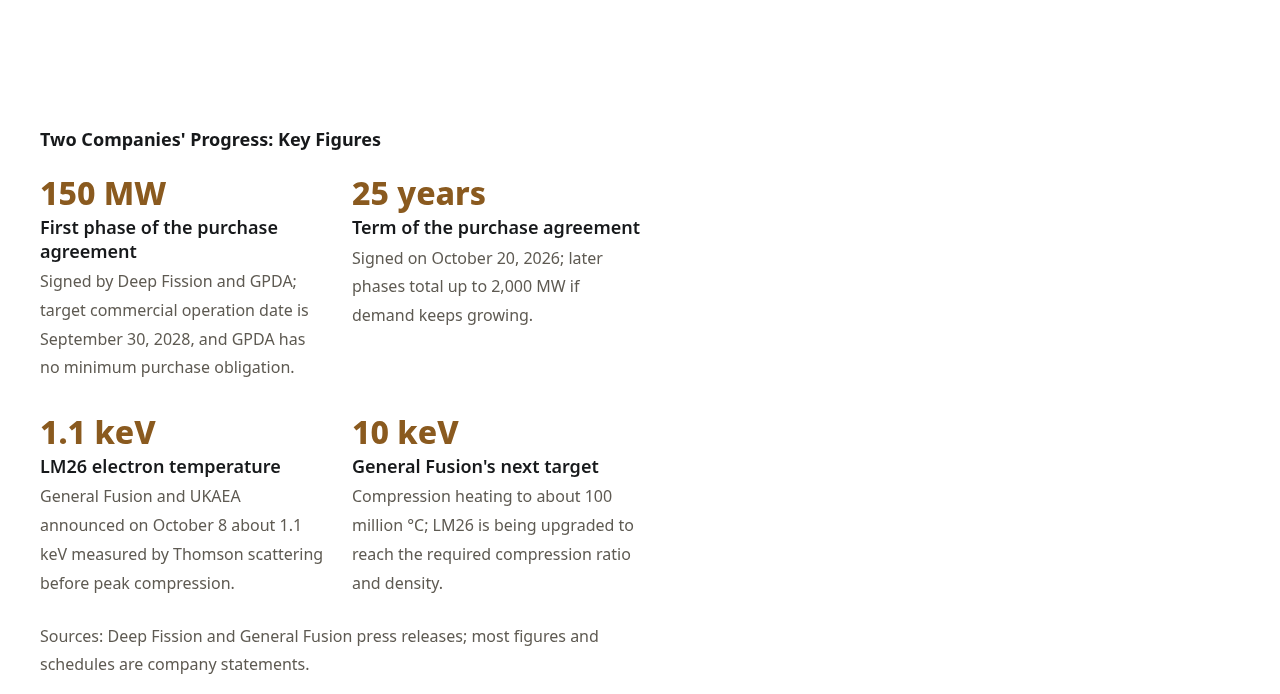
On October 20, 2026, Deep Fission signed a 25-year master energy purchase agreement with the park owner, the Great Plains Development Authority (GPDA). The first phase is expected to be 150 MW (150,000 kW), with a target commercial operation date of September 30, 2028. Later phases total up to 2,000 MW, or 2 GW (2,000,000 kW), if demand keeps growing.
The agreement states that GPDA has no minimum purchase obligation. The company lists risks that include needing an NRC license and Kansas approvals, and the project may be delayed, scaled down or not completed. On financing, the company raised US$30 million in September 2025 and US$80 million in a private placement in February 2026, and listed on Nasdaq under the ticker FISN on June 18 with gross proceeds of US$40 million from its public offering.
General Fusion compresses plasma slowly with a metal liner and measures 1.1 keV
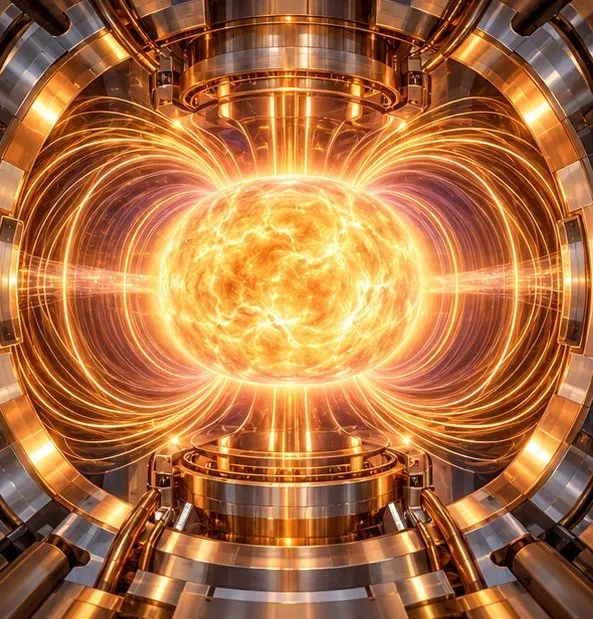
Magnetized Target Fusion first forms a magnetically confined plasma, then compresses and heats it with metal walls on a millisecond timescale. The company contrasts this with approaches that compress over nanoseconds or microseconds, and says its design does not need superconducting magnets or high-power lasers. The demonstration machine LM26 (Lawson Machine 26) compresses plasma with a lithium liner and has about 50% of the diameter of a commercial machine; assembly finished in December 2024, first plasma came in February 2025 and first compression in April.
In June 2026 the company reported an electron temperature of about 0.72 keV (8.4 million °C). On October 8, the company and UKAEA announced about 1.1 keV (12.6 million °C) measured by Thomson scattering before peak compression. Thomson scattering measures temperature by passing a laser through the plasma and analyzing the scattered light. A separate absolute extreme ultraviolet (AXUV) diagnostic gave about 1.2 keV at peak compression, and ion temperature rose to about 0.46 keV, up to twice the starting value; the company says ion temperature is inferred from neutron yield and plasma density profiles.
UKAEA and the company say only a few fusion companies have reached 1 keV, all by other routes, and that LM26 is the first device to do so with slow compression. The two sides developed the diagnostic systems together. Two technical papers have been submitted for peer review and have not yet passed it.
General Fusion lists 10 keV and a first power plant as later goals
The company's next goal is compressional heating to 10 keV (about 100 million °C), and LM26 is being upgraded to reach the required compression ratio and density. After that comes the Lawson criterion, which the company defines as temperature, density and energy confinement time together high enough for deuterium-tritium fusion energy to exceed heat losses; it targets completion by the end of 2028. The company expects its first commercial plant to start operating around 2035.
In the company's commercial design, a liquid-metal wall absorbs neutrons and breeds tritium, and a heat exchanger produces steam to drive a turbine; the company says the tritium breeding ratio can exceed 1.5. The LM26 demonstration machine does not validate the complete commercial fuel cycle. In July 2026 the company completed its merger with Spring Valley Acquisition Corp. III and began trading on Nasdaq on July 13 under GFUZ, calling itself the first publicly listed fusion company; it estimates about US$150 million in cash, enough for several technical milestones through the end of 2028. On June 24 it announced a phased framework agreement with Renexia S.p.A. of Italy, which still requires definitive agreements, and on May 28 it announced a collaboration with General Atomics Energy Group to develop diagnostic systems for 10 keV and above.
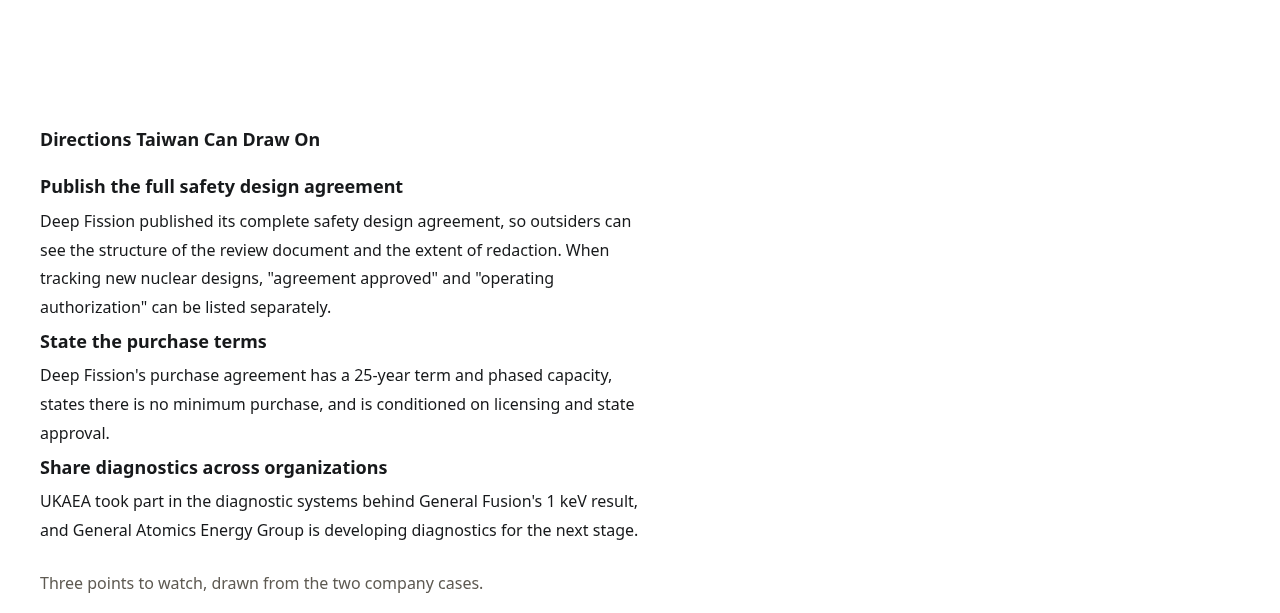
Directions Taiwan can draw on
Leave a comment
Comments are reviewed before publication. Email is private and used only when contact is necessary. Privacy notice