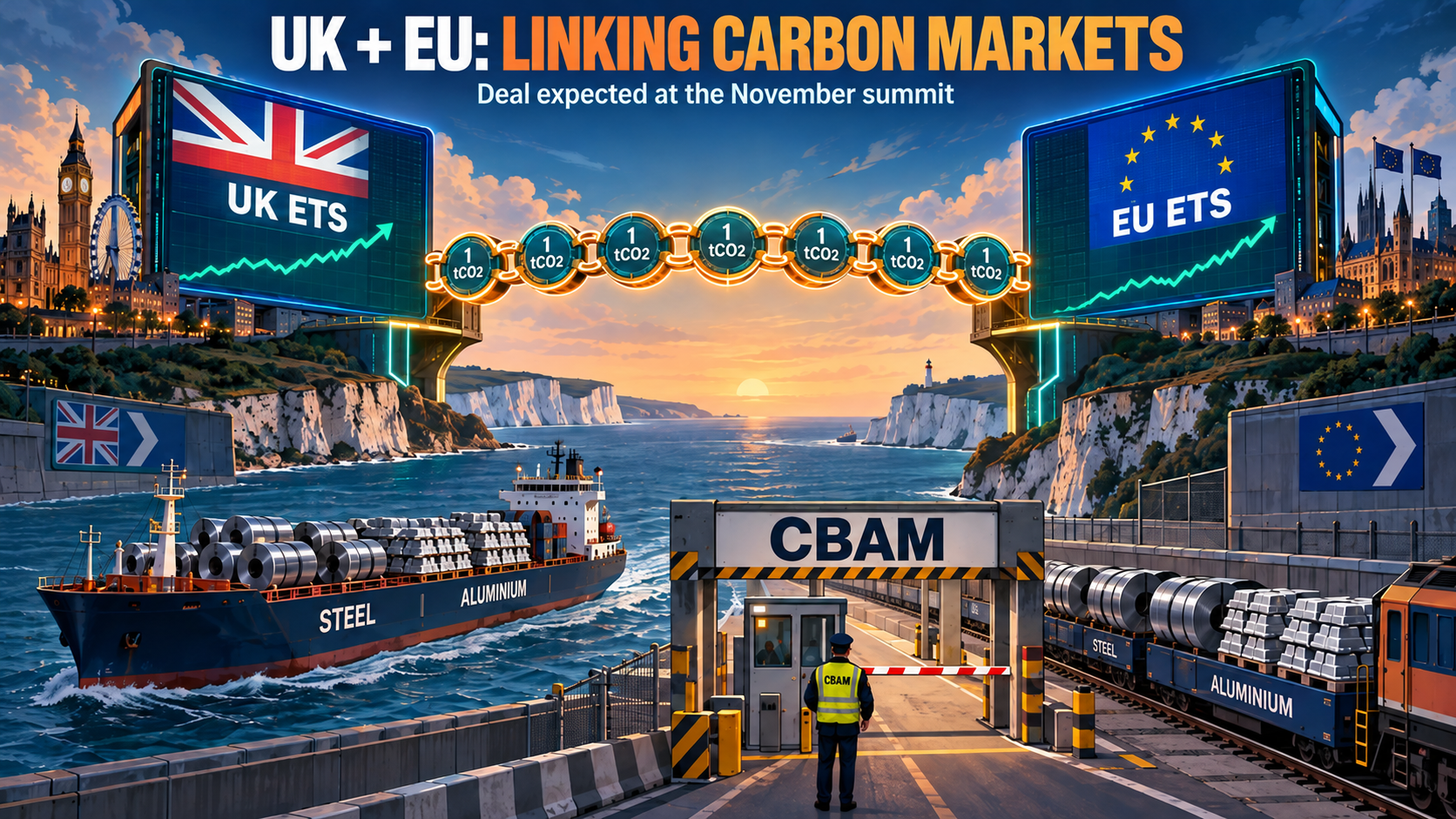
After Brexit, the United Kingdom built its own scheme: it launched the UK Emissions Trading Scheme (UK ETS) in 2021 and went its own way from the EU carbon market. Five years on, the two sides may reconnect: POLITICO reported on October 7, 2026, citing four people briefed on the talks, that the UK and the EU have reached an agreement to link their emissions trading systems, expected to be unveiled at a UK–EU summit in November. For European businesses, the most immediate benefit is that goods from both sides could be mutually exempt from each other's Carbon Border Adjustment Mechanism (CBAM); for carbon markets, it means the UK carbon price may move toward the higher EU price. That said, neither government has confirmed the deal, the text has not been published, and what official documents already say must be kept separate from what is only reported or inferred.
Primer: ETS, allowances, linking and CBAM
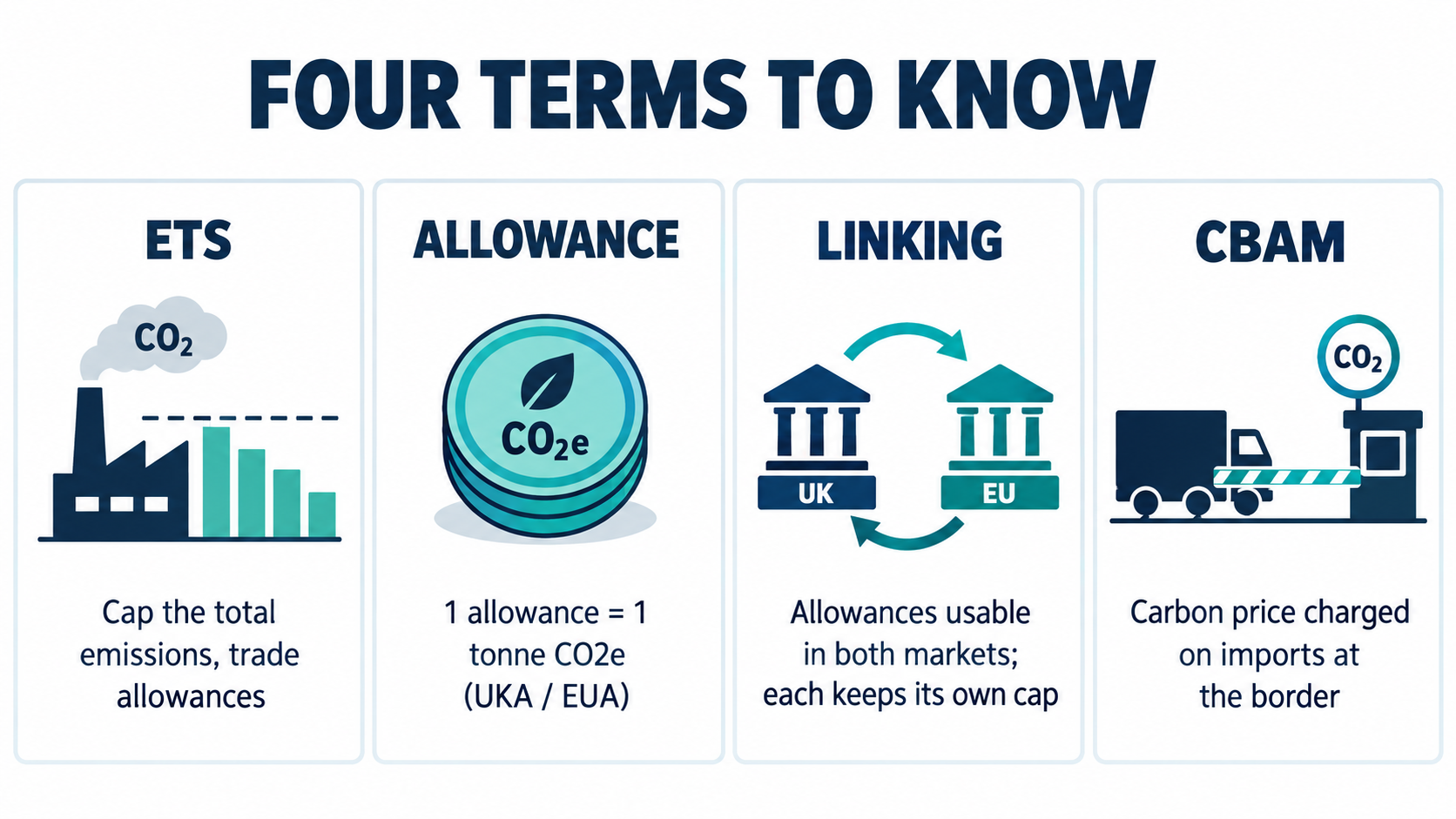
ETS (emissions trading system): the government first sets a total emissions "cap" for power, industry and other sectors, then divides it into "allowances", each representing one tonne of carbon dioxide equivalent. Firms must surrender the same number of allowances as their emissions each year; if they fall short, they buy on the market, and the traded price of those allowances is the carbon price.
UKA and EUA: the allowances of the UK and EU carbon markets respectively. Today the two cannot be used interchangeably, and each market sets its own price.
Linking: allowing allowances from two carbon markets to be mutually recognised and used. The UK government explains that after linking, allowances can circulate between the two systems, but each system can keep its own emissions cap and policy design. The precedent is Switzerland, which linked with the EU carbon market in January 2020.
CBAM (Carbon Border Adjustment Mechanism): a carbon cost charged on high-emitting imports according to the emissions from producing them, so imports face a carbon price similar to domestic goods and "carbon leakage" is avoided. The EU CBAM entered its definitive regime on January 1, 2026; the UK CBAM will start on January 1, 2027.
What happened: POLITICO's report
According to POLITICO, talks on linking the UK and EU carbon markets are done, and the two sides are only "tying a ribbon" (in the words of one EU diplomat), preparing to unveil the deal at a UK–EU summit in the coming weeks. The summit date has not been formally announced, but the report says internal planning is based on November 20; UK European Relations Minister Hamish Falconer would only say he has "a date in mind, but I don't want to say it just yet."
The report also highlighted several points:
This is the first of three negotiation tracks to finish: at the 2025 summit, both sides committed to negotiating carbon-market linking, an agri-food sanitary and phytosanitary (SPS) agreement, and youth mobility visas.
The three deals are a package: both sides say the three form a "package" and will not take effect on their own. Youth mobility visas still face disputes over tuition fees and caps on numbers.
Officials will not comment: the UK government and the European Commission both say they do not comment on ongoing negotiations.
Carbon-market specialist outlet Carbon Pulse reported the same story that day, but its piece mainly retells POLITICO, and this site could not verify the paywalled full text. In other words, every claim that "a deal has been reached" so far comes from media citing anonymous sources; there is still no official document to check against.
From May 2025 to now
The agreement itself has not been published, but the negotiating framework was already written into official documents:
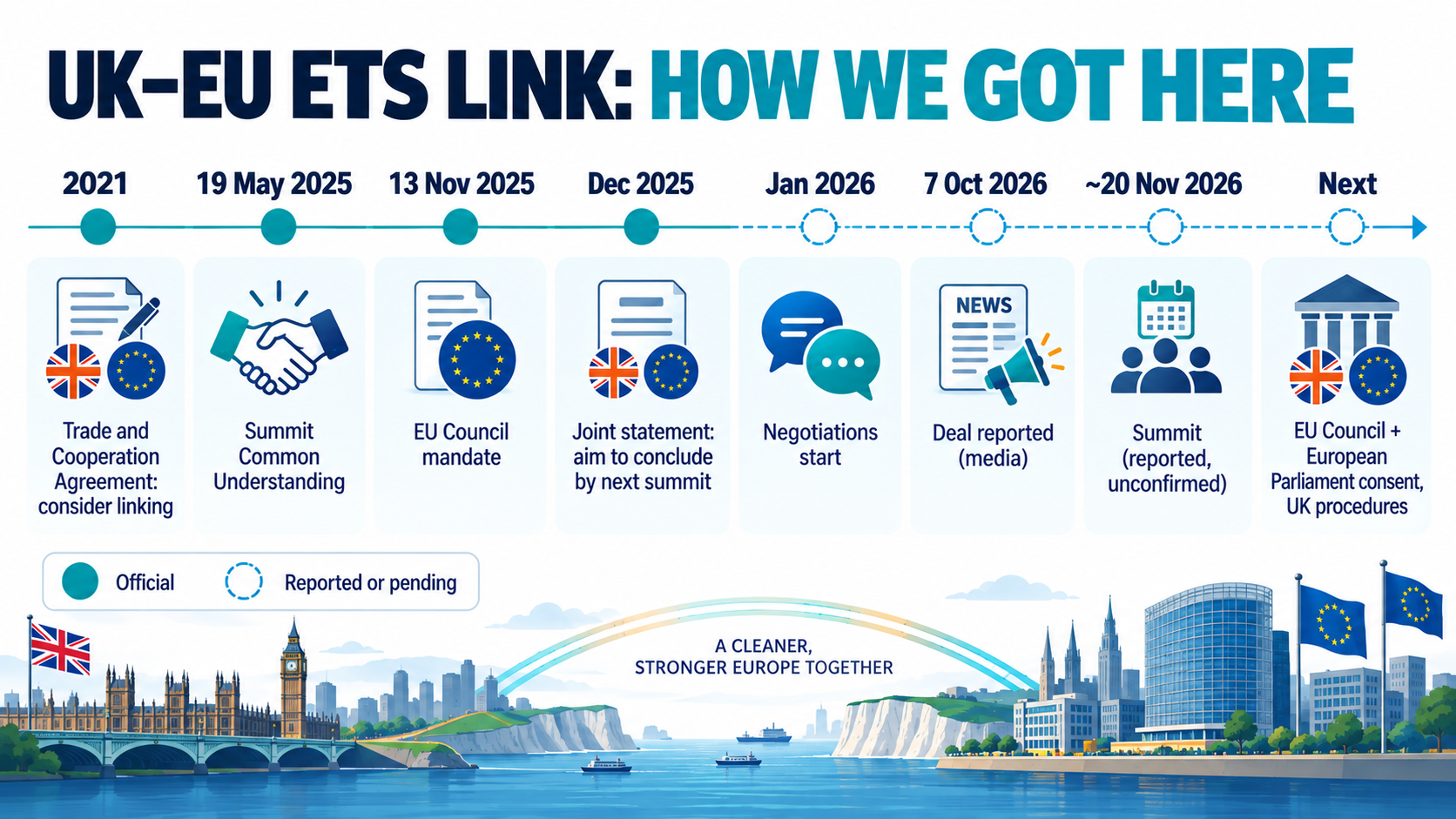
2021: Article 392(6) of the UK–EU Trade and Cooperation Agreement asks both sides to give serious consideration to linking their carbon pricing systems.
May 19, 2025: the first UK–EU summit issued a Common Understanding; paragraphs 34 to 45 deal specifically with carbon-market linking and commit to linking the UK ETS and the EU ETS by bilateral agreement.
November 13, 2025: the Council of the EU formally authorised the Commission to open negotiations with the UK.
December 2025: the UK and EU issued a joint statement aiming to conclude negotiations before the next UK–EU summit.
January 2026: talks formally began; EU Climate Commissioner Wopke Hoekstra said at the time they would start in the week of January 19.
Several conditions in the Common Understanding are worth noting:
Mutual CBAM exemption: the linking agreement should let goods originating in either jurisdiction be mutually exempt from the other's CBAM, subject to compliance with each side's legal requirements.
Covered sectors: at least electricity generation, industrial heat generation (excluding individual household heating), industry, and domestic and international maritime transport and aviation, with a procedure to expand the list later.
UK "dynamic alignment": the UK must keep pace with the EU carbon-market rules that underpin the link; the UK's emissions cap and reduction pathway should be at least as ambitious as the EU's.
Disputes and costs: an independent arbitration mechanism is set up, but questions of EU law are ultimately decided by the Court of Justice of the European Union; the UK must also contribute financially to related EU work.
According to the European Parliamentary Research Service, once negotiations finish the agreement still needs endorsement by the Council of the EU and consent from the European Parliament (Parliament can only approve or reject, not amend); the UK must also complete its own domestic procedures. So even a November announcement would not mean immediate entry into force, and no public start date has been given.
Impact 1: mutual CBAM exemption for UK and EU goods
This is what UK industry cares about most. A 2025 UK government explainer said about £7 billion of UK exports to the EU would be affected by the EU CBAM, and without linking, UK exporters could pay up to £800 million into the EU budget by 2030. Conversely, POLITICO noted that once the UK CBAM starts in 2027, without a linking agreement EU firms would likewise face the UK CBAM.
EU CBAM rules already have similar exemptions: Iceland, Liechtenstein and Norway take part in the EU carbon market, Switzerland's carbon market is already linked with the EU, and goods from all four are on the CBAM exemption list. If the UK completes the link, it could be next.
Impact 2: more liquidity — and a likely rise in the UK carbon price
The UK government itself acknowledges that the UK carbon market is "smaller and less liquid" and more price-volatile; linking would create a larger, more stable market.
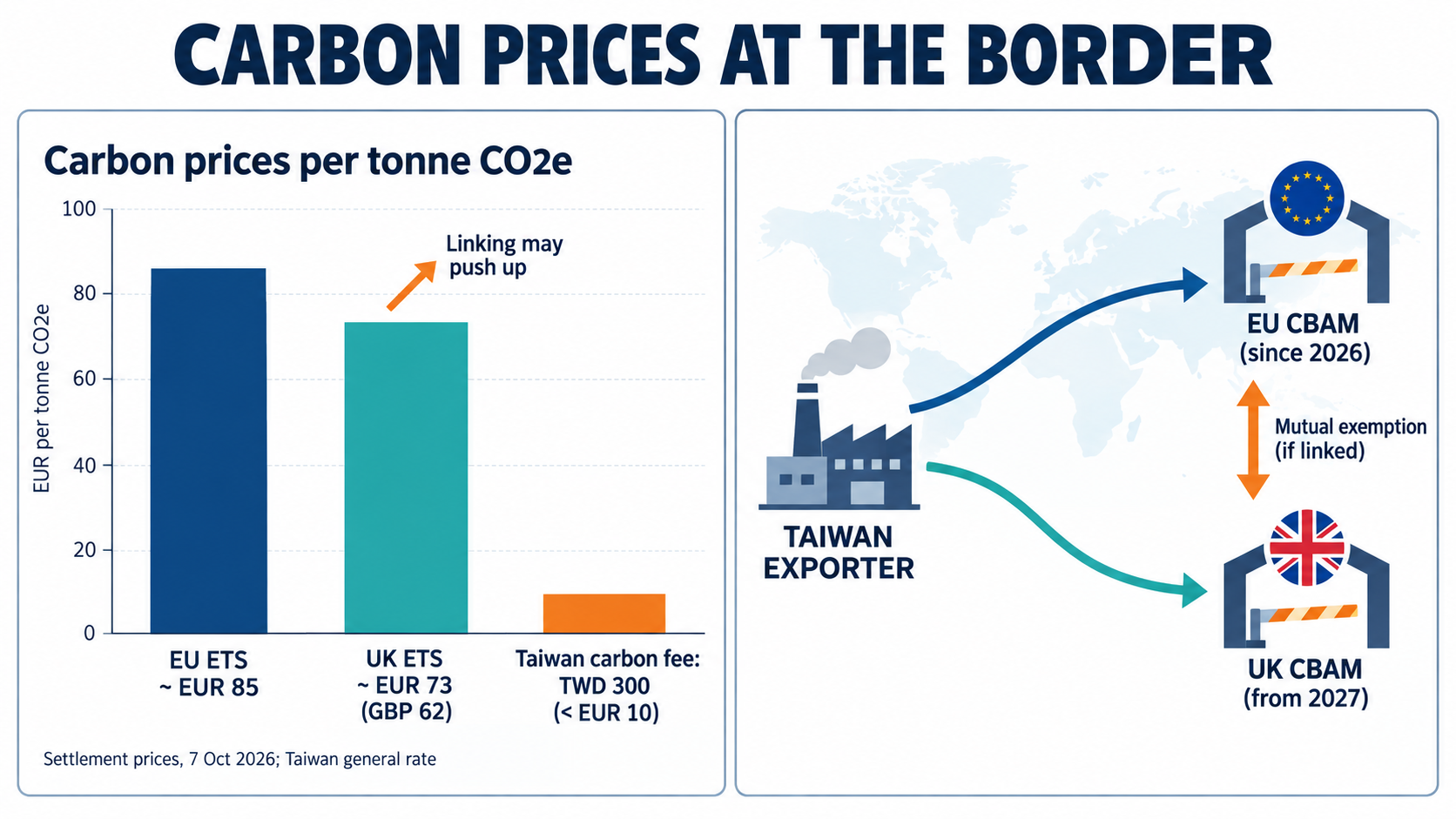
The price gap is what outside observers watch most closely. Settlement prices on October 7, 2026 were:
UK allowance (UKA): £62.43 per tonne.
EU allowance (EUA): €84.92 per tonne.
Using a rough euro-to-sterling rate of about 1.18, the UK carbon price is about €73, more than €11 below the EU — roughly 13%. Market reports show the spread was still about €17.7 on September 25 and had narrowed to around €12.7 in early October; traders were already pricing in linkage expectations. POLITICO also cited critics saying the deal could push up the UK carbon price, at least in the short run, adding to the burden on UK firms already under other economic pressure.
Our view: linking is about making allowances interchangeable, so in theory the two carbon prices should gradually converge. With the UK cheaper today, convergence mostly means the UK moving up, though the EU price itself will also shift as the market grows and supply and demand change; the final level will depend on the agreement's details and when it starts.
What it means for Taiwanese exporters (our view)
The reading below is this site's; it is not an official UK or EU statement about Taiwan.
Exemptions cover only the UK and the EU: Taiwanese goods sold into either market still face each side's CBAM separately. The EU CBAM covers cement, iron and steel, aluminium, fertilisers, electricity and hydrogen; the UK CBAM covers aluminium, cement, fertiliser, hydrogen and iron and steel (not electricity), and UK importers whose imports reach £50,000 or more over 12 months are directly affected.
The UK CBAM rate may rise with it: the UK CBAM rate is based on the average UK carbon-allowance auction price in the previous quarter, then adjusted for free allowances by sector. If linking pulls the UK carbon price toward the EU, carbon costs on steel and aluminium exported to the UK may rise too. For comparison, the EU's published CBAM certificate price for the third quarter of 2026 is €82.32 per tonne.
The two rulebooks may grow more alike: the Common Understanding requires the UK to dynamically align with EU carbon-market rules, but does not say whether the UK CBAM will be unified with the EU CBAM. Once the agreement text is out, it will be worth watching whether emissions calculation, default values and verification requirements converge; if they do, Taiwanese firms will have a better chance of preparing one set of emissions data for both markets.
Whether Taiwan's carbon fee can be deducted: Taiwan's Ministry of Environment Climate Change Administration says it has confirmed with the EU that Taiwan's carbon fee counts as an effective carbon price recognised under the EU CBAM, but importers must prove it was "actually paid" and net out any rebates or subsidies. The UK CBAM also has a "carbon price relief" mechanism, but there is no official statement yet on whether Taiwan's carbon fee meets the UK's conditions. Taiwan's general carbon-fee rate is also only NT$300 per tonne — less than €10 — far below the UK and EU prices of €60 to more than €80, so the deductible share is limited.
Cost pressure will grow year by year: the EU still has 97.5% free allowances in 2026, so importers that year only need to buy certificates for 2.5% of emissions; free allowances are phased out and reach zero in 2034. In other words, CBAM costs that look small now will clearly grow in a few years.
For Taiwanese firms, the UK–EU link itself does not directly change export obligations, but it sends a signal: countries with high carbon prices and compatible rules will "green-light" each other, while countries with low carbon prices or no carbon market will have to make up the difference at the border.
What is still unsettled
Agreement text and formal announcement date: November 20 is still only internal planning in media reports.
Whether the package talks stall: carbon-market linking is tied to SPS and youth mobility visas, and the latter two are still being negotiated.
Entry into force: the Council of the EU, the European Parliament and UK domestic procedures all have to finish first; there is no public timetable.
Transitional arrangements: whether UK goods can enjoy CBAM exemption before the link formally starts is not spelled out officially.
How the UK emissions cap will be set: the UK cap should be "at least as ambitious as the EU's"; the concrete numbers and pathway have not been published.
Our view: carbon markets are becoming a "club"
On the surface, linking the UK and EU carbon markets is a post-Brexit repair job. In practice it reflects a larger trend: carbon pricing is moving from every country going it alone toward a club model of mutual recognition and mutual exemption from border carbon charges. The club's entry ticket is a high enough carbon price, rigorous enough rules, and a willingness to align institutions with partners.
Taiwan's carbon fee has only just begun, and joining that kind of club anytime soon is unlikely. The more practical path is to make product emissions data strong enough to withstand third-party verification, watch the UK CBAM rate and rule details closely, and keep tracking how domestic carbon pricing connects with international systems. If the November summit announces an agreement on schedule, how the text is written will be the next thing to watch.
Sources
UK government, UK-EU Summit - Common Understanding (2025-05-19)
European Parliamentary Research Service, Linking the EU and UK emissions trading systems (2025)
ICAP, EU and UK commit to linking emissions trading systems in landmark cooperation agreement
UK government, Carbon Border Adjustment Mechanism (CBAM): Policy summary
UK government, Carbon Border Adjustment Mechanism (import threshold and covered sectors)
European Commission, Carbon Border Adjustment Mechanism (CBAM)
EUR-Lex, summary of Regulation (EU) 2023/956 (CBAM scope and Annex III exempt countries)
Catalyst Commercial, UK Energy Market Report (2026-10-05, including UK–EU carbon price spread)