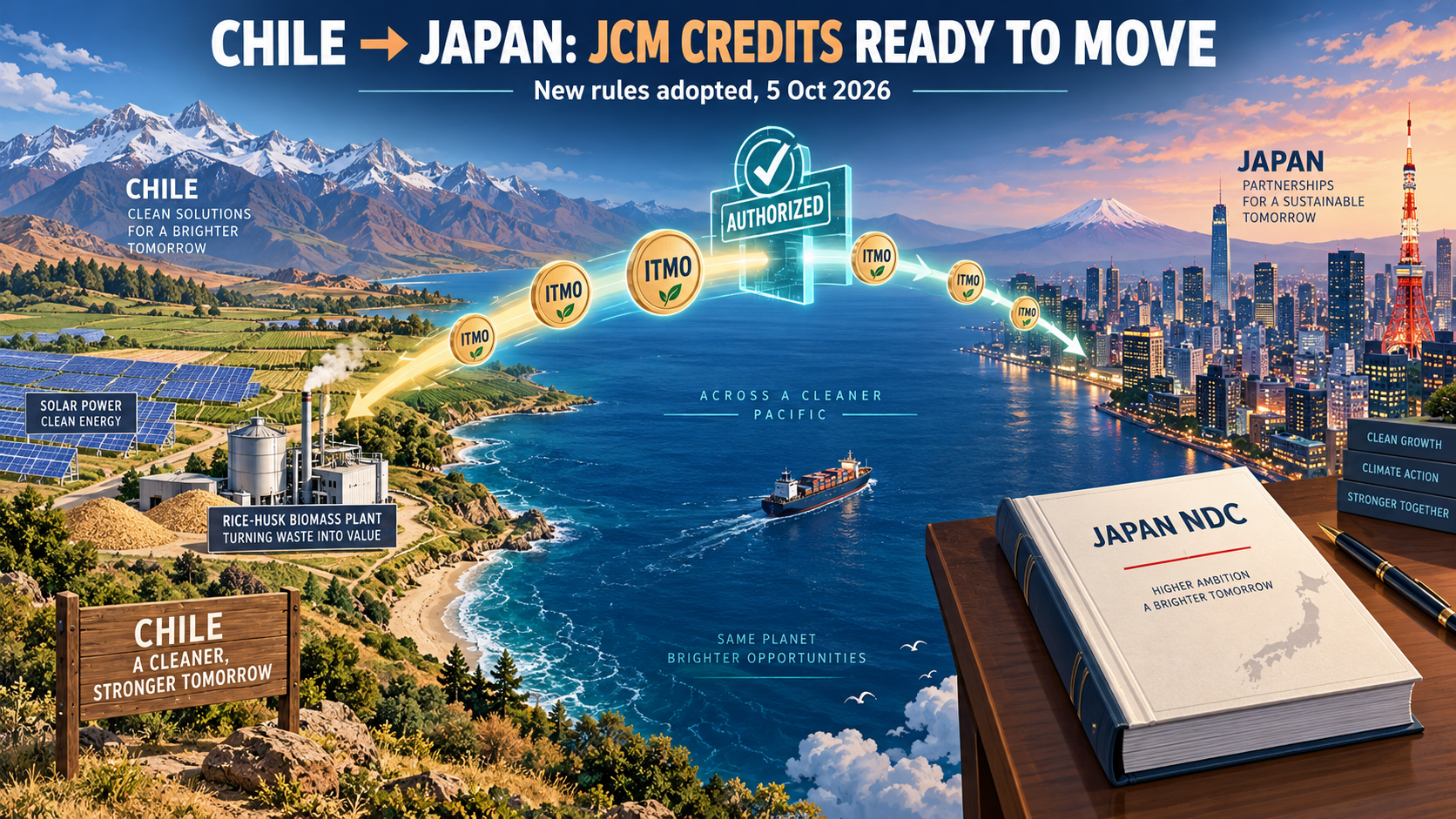
Japan has long run a kind of "overseas emission reduction ledger" called the Joint Crediting Mechanism (JCM): Japan provides technology and finance for emission reduction projects in partner countries, then brings part of the resulting reductions home and counts them towards its own national target. On October 5, 2026, that ledger took another step forward in South America: the Chile–Japan JCM Joint Committee adopted updated rules and guidelines. According to a Chilean official quoted by carbon market outlet Carbon Pulse, Chile can now authorize JCM projects and transfer internationally transferred mitigation outcomes (ITMOs) to Japan to be counted towards its mitigation results. It is another example of Article 6.2 of the Paris Agreement moving from "signing memoranda of understanding" to "actual trades", and it makes a useful comparison with the Canadian ITMO framework we covered a few days ago.
Primer: the JCM, ITMOs, authorization and corresponding adjustments
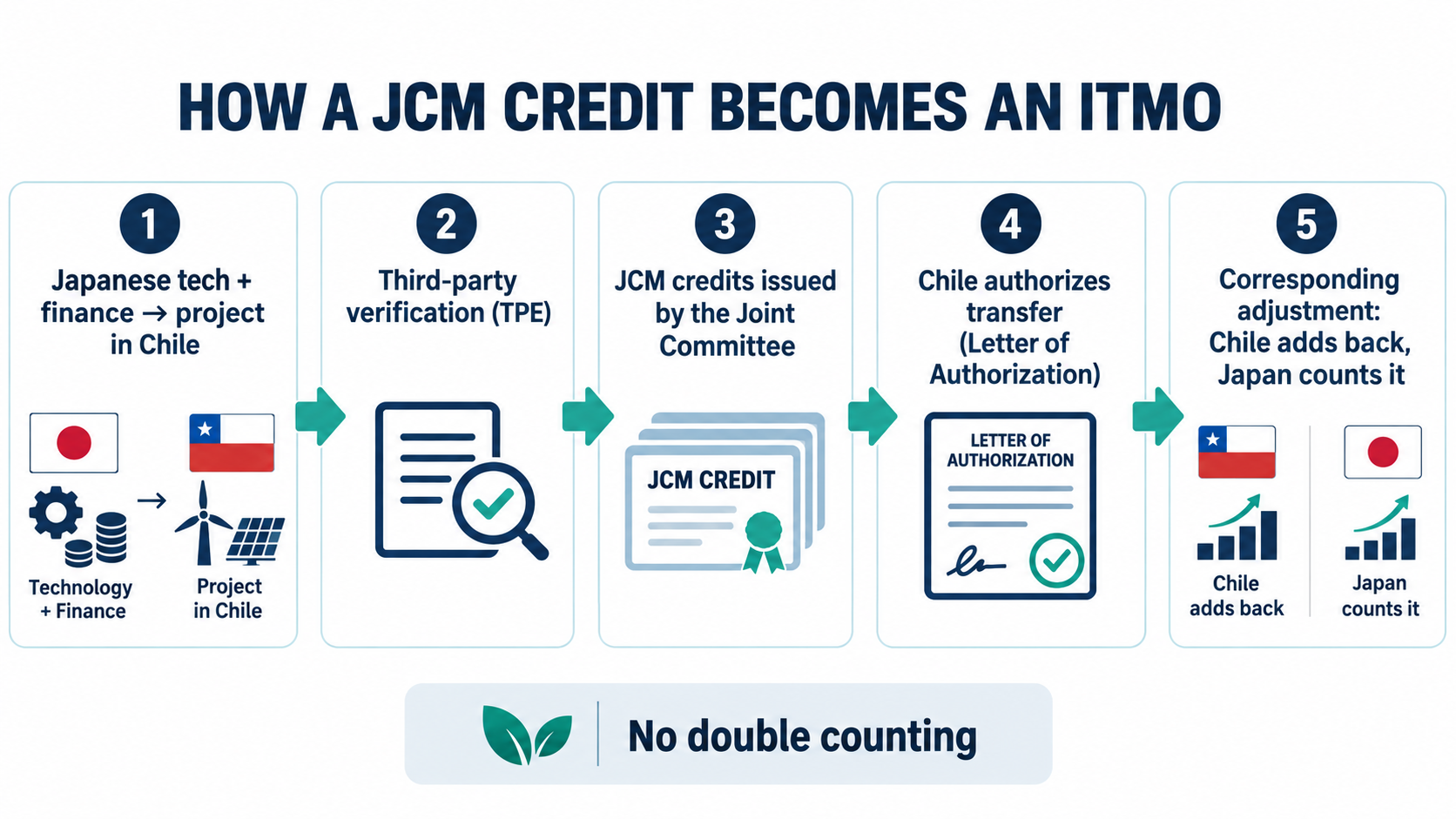
JCM (Joint Crediting Mechanism): a bilateral emission reduction partnership that Japan signs one-to-one with each partner country. Japanese companies bring energy efficiency, renewable energy and other technologies to the partner country; once verified, the resulting reductions are issued as JCM credits and divided between the two countries according to their contributions.
ITMOs (internationally transferred mitigation outcomes): under Article 6.2 of the Paris Agreement, one country transfers government-authorized emission reductions or removals to another country, which can then count them towards its nationally determined contribution (NDC).
Authorization: the host government's formal consent for a project's reductions to be "exported", usually evidenced by a Letter of Authorization (LoA). Without authorization, reductions cannot be transferred as ITMOs.
Corresponding adjustment: once reductions are transferred to Japan, Chile must "add back" the same amount to its own emissions ledger, so that the same tonne of reductions is not counted twice by two countries.
Joint Committee and TPEs: the Joint Committee is made up of representatives of both countries and is responsible for setting rules, approving methodologies and registering projects; TPEs (third-party entities) carry out project validation and verification, a role similar to that of auditors.
What happened on October 5
The JCM Implementation Agency (JCMA) designated by the Japanese government announced on October 5 that the 4th Joint Committee of the Chile–Japan JCM was held in Santiago, Chile, and online, and decided to adopt the rules and guidelines and to designate third-party entities (TPEs). The announcement is only two sentences long; most of the details come from Carbon Pulse's report:
The meeting: held behind closed doors on October 5 and attended by representatives of both countries.
The official line: Cristina Vargas Figueroa, carbon pricing and markets coordinator at Chile's Ministry of the Environment, said the rules and guidelines are a milestone in the two countries' cooperation, as "Chile can now authorise projects and transfer ITMOs to be accounted for in Japan".
Number of projects: according to Vargas, there are currently 17 projects in the JCM pipeline, some of them financed by the Japanese government, which could be authorized to generate ITMOs and transfer them to Japan.
Next steps: of the 17 projects, eight are at a more advanced stage of validation and verification and were originally scheduled to be evaluated on Thursday, October 8, by Chile's National Article 6 Committee to begin the process of issuing letters of authorization; as of our deadline we have not seen the results published.
Rules document not yet public: Chile's Ministry of the Environment said it will be published in the coming days.
It should be noted that the figure of "17 projects" matches the number of Chilean projects listed in Japan's official JCM pamphlet (April 2026 edition), but the "eight projects up for authorization evaluation" and the committee's evaluation results currently come from a single source, Carbon Pulse; we have not yet seen an official Chilean announcement.
The Chile–Japan JCM: from 2015 to today
Chile and Japan signed the bilateral document for the JCM on May 26, 2015, making Chile Japan's 14th JCM partner country. The official JCM website currently lists 8 Chilean projects, mostly solar PV:
3 registered: a 1 MW rooftop solar system at a university (registered in 2019), and two 3 MW solar PV projects (registered in 2022 and 2024).
5 under validation: two 9 MW solar projects, a 2 MW factory rooftop solar project, a 3 MW farmland solar project, and a 3.4 MW rice husk power project.
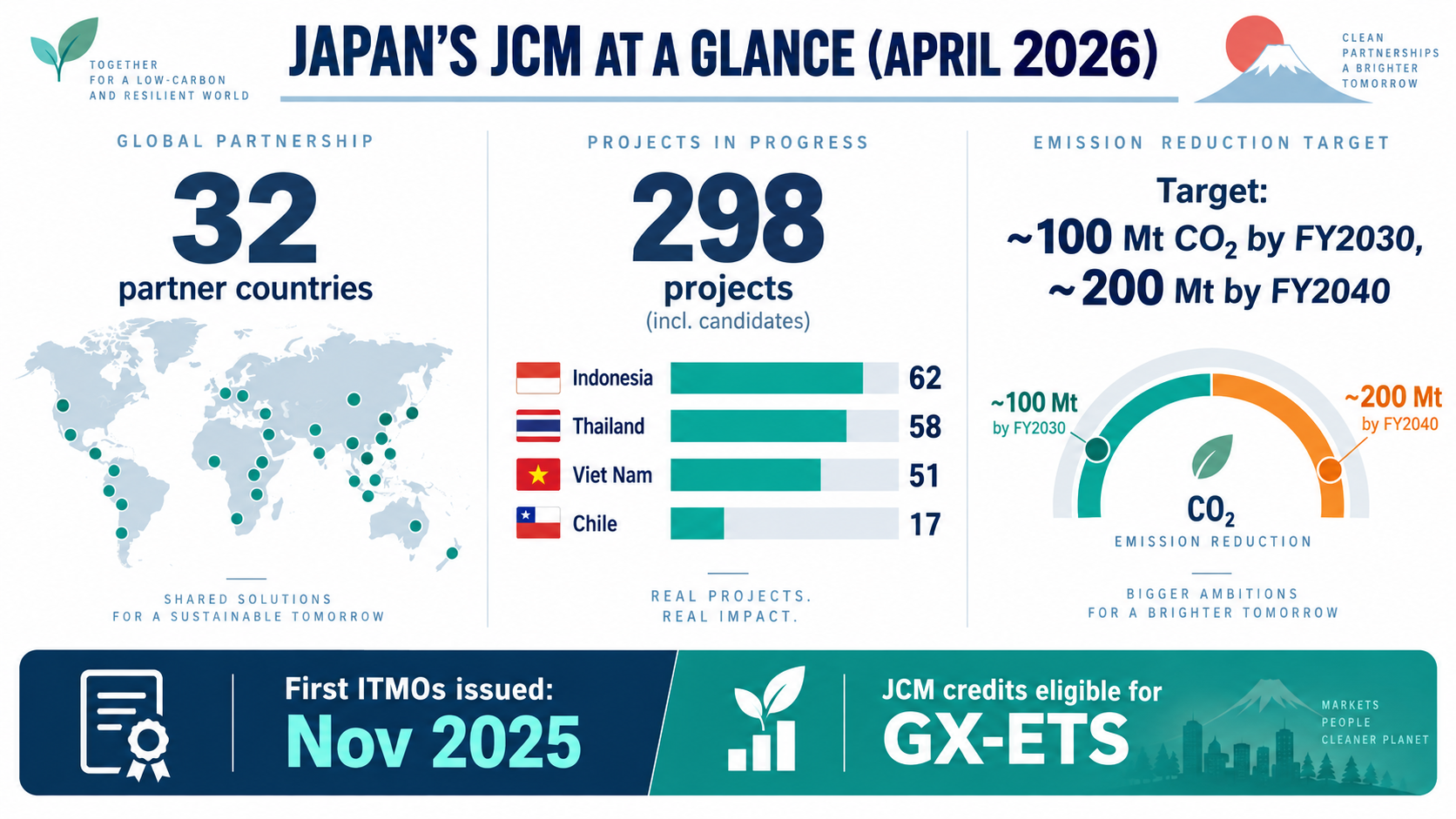
The gap between the 8 projects on the website and the 17 in the Japanese pamphlet may be because the pamphlet also counts candidate projects, including those subsidized by the Ministry of the Environment and the Ministry of Economy, Trade and Industry and private-sector projects. Either way, Chile's JCM portfolio is still small to medium-sized: Indonesia, Thailand and Viet Nam each have between 50 and just over 60 projects.
Chile was already an Article 6 "model student"
This deal came together in part because of Chile's own institutional groundwork:
It started with Switzerland: Chile and Switzerland signed an Article 6.2 cooperation agreement in December 2023. In October 2025, Chile's Ministry of the Environment authorized its first project (a plant in the Ñuble Region replacing a coal-fired boiler with a biomass boiler), making Chile the first country in Latin America and the Caribbean to issue an Article 6.2 authorization.
Authorizations keep growing: according to Reporte Minero, Chile's Ministry of the Environment said that by early April 2026 it had issued 17 letters of interest and 5 authorizations under the Swiss agreement.
Dedicated regulations and a specialized committee: Chile has an Article 6 implementing regulation, under which the National Article 6 Committee reviews applications for authorization.
No break with the change of government: Carbon Pulse noted that although Chile moved this year from the left-wing Boric government to the right-wing Kast government, its Article 6 work has not stopped.
On Japan's side: the JCM is part of its emissions target
For Japan, the JCM is not just diplomatic cooperation; it is a piece of the national emission reduction target. According to Japan's official JCM pamphlet (April 2026):
Scale: as of April 16, 2026, Japan had 32 JCM partner countries and a total of 298 projects (including candidates).
Target: under the Plan for Global Warming Countermeasures adopted by Cabinet decision in February 2025, Japan aims to secure, through public-private collaboration, accumulated international emission reductions and removals of about 100 million t-CO2 by FY2030 and about 200 million t-CO2 by FY2040.
ITMO issuance has begun: in November 2025, the Japanese government issued ITMOs under the JCM for the first time, based on Article 6, for a 5 MW floating solar project in Thailand.
Usable at home too: JCM credits are eligible credits under Japan's domestic emissions trading system, the GX-ETS.
In other words, if this batch of Chilean projects obtains authorization, the reductions will ultimately flow into Japan's national ledger, and even into the carbon trading accounts of Japanese companies.
Also on the same day: India and Japan get going too
Also on October 5, India's environment ministry announced that the India–Japan JCM Operational Manual had been launched in New Delhi on September 30, covering the full process from submission of a project idea note to the issuance and authorization of credits. The two countries signed a Memorandum of Cooperation on August 7, 2025 and adopted the Rules of Implementation on June 8, 2026; the manual marks the move of India's JCM from institutional preparation to project implementation. Within a single week, the JCMs with both Chile and India took a step forward, a sign that Japan is speeding up the expansion of its ledger.
Comparison with Canada's ITMO framework (our view)
In "Canada Develops ITMO Framework to Bring Companies Into Paris Agreement Article 6 Carbon Markets" we described Canada's new direction. Seen side by side, the differences are clear:
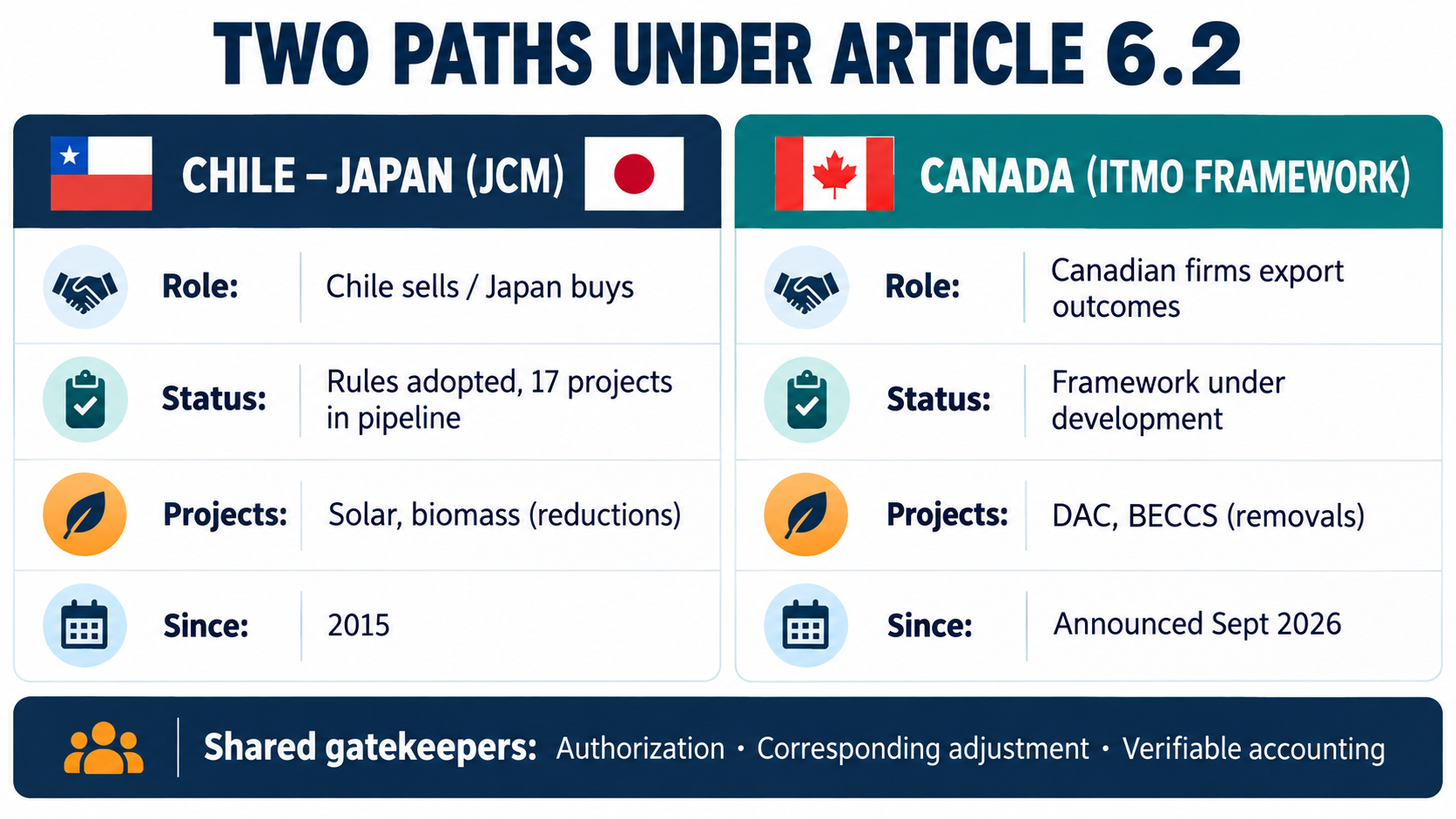
Different roles: Chile is the seller (host country), authorizing and transferring out ITMOs; Japan is the buyer, counting the reductions towards its own target. Canada, for its part, wants its companies to take part in international carbon markets, with a focus on developing carbon removal and other projects and exporting mitigation outcomes; its framework is still being developed.
Different levels of maturity: the Chile–Japan JCM already has ten years of cooperation, a joint committee, methodologies and verification bodies, and is now adding the final piece, ITMO authorization and transfer. Canada is still consulting with the provinces, Indigenous organizations and others, and its final rules have yet to be released.
Different technologies: Chile's JCM is dominated by emission reduction projects such as solar PV and bioenergy; Canada emphasizes removal projects such as direct air capture (DAC) and bioenergy with carbon capture and storage (BECCS), which cost more and depend more on stable international buyers.
Shared hurdles: whichever the country, there is no getting around government authorization, corresponding adjustments and verifiable accounting. That it took Chile ten years to align these three things with Japan also shows that the institutional cost of Article 6 trading is not low.
What it means for Taiwan (our view)
The following is our own reading, not what the Chilean or Japanese governments have said about Taiwan.
Taiwan can hardly join bilateral mechanisms like this directly: Taiwan is not a Party to the United Nations Framework Convention on Climate Change, so it would be difficult for it to sign a JCM with Japan as a Party, or to engage directly in country-to-country Article 6 authorization and corresponding adjustments.
But Taiwan has started "trial runs": in September 2026, the Ministry of Environment announced that the Industrial Technology Research Institute (ITRI) and a Paraguayan company had launched a "Paris Agreement Article 6 pilot", using a small afforestation project to test step by step validation, measurement, reporting and verification (MRV), credit issuance, and host-country authorization and transfer. Once the Chile–Japan JCM rules are published, they could serve as a reference template for this kind of pilot.
The recognition criteria for foreign credits are worth following: under the Regulations Governing the Collection of Carbon Fees, businesses not classed as high carbon-leakage risk may use foreign emission reduction credits recognised by the Ministry of Environment to offset emissions subject to the fee, up to 5%. Whether recognition of foreign credits will require host-country authorization and corresponding adjustments is a key question for Taiwanese companies weighing overseas carbon credits.
Taiwanese companies with a base in Japan: JCM credits can be used in Japan's GX-ETS, so if the Japanese subsidiary of a Taiwanese company is covered by the scheme, the supply and price of JCM credits will indirectly affect its compliance costs.
Four things to watch next
Publication of the rules: what the updated Chile–Japan JCM rules and guidelines say about authorization, corresponding adjustments and credit allocation.
The evaluation of the eight projects: whether Chile's National Article 6 Committee issues letters of authorization, and when the first ITMOs are transferred to Japan.
How credits are split: JCM credits are allocated between the two governments and project participants according to their contributions; how much Chile keeps and how much goes to Japan will affect whether Chile meets its own NDC.
Whether the project types expand: Chile's JCM is currently dominated by solar PV; will it in future take in types already authorized under the Swiss agreement, such as energy storage, electric mobility and biogas?