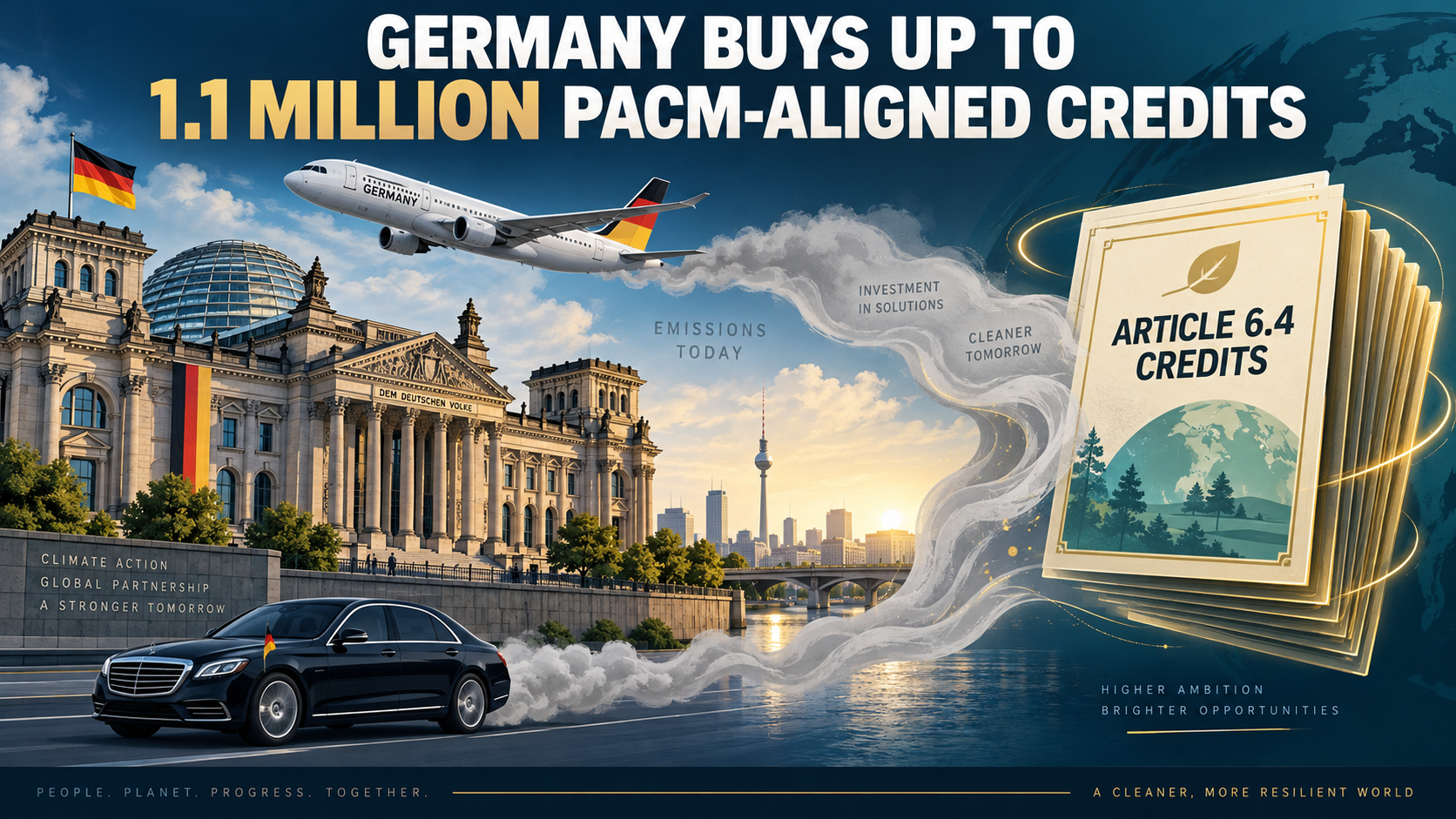
On October 7, the German Environment Agency (Umweltbundesamt, UBA) published a new carbon credit tender on Germany's public procurement notice platform: it plans to buy up to 1,101,743 emission reduction credits generated under the rules of Article 6, paragraph 4 of the Paris Agreement (Article 6.4) to offset the federal government's 2025 emissions. UK carbon market outlet Carbon Pulse also reported the tender the same day.
Primer: what is an Article 6.4 carbon credit?
The Article 6.4 mechanism (PACM): the Paris Agreement Crediting Mechanism, a carbon credit mechanism under the Paris Agreement that is run centrally by a UN supervisory body. It is seen as the successor to the Kyoto-era Clean Development Mechanism (CDM), and many older CDM projects are applying to transition into it.
Offsetting: balancing out emissions you cannot avoid with emission reductions made elsewhere. For the German government this is voluntary, not a legal obligation.
What does the tender cover?
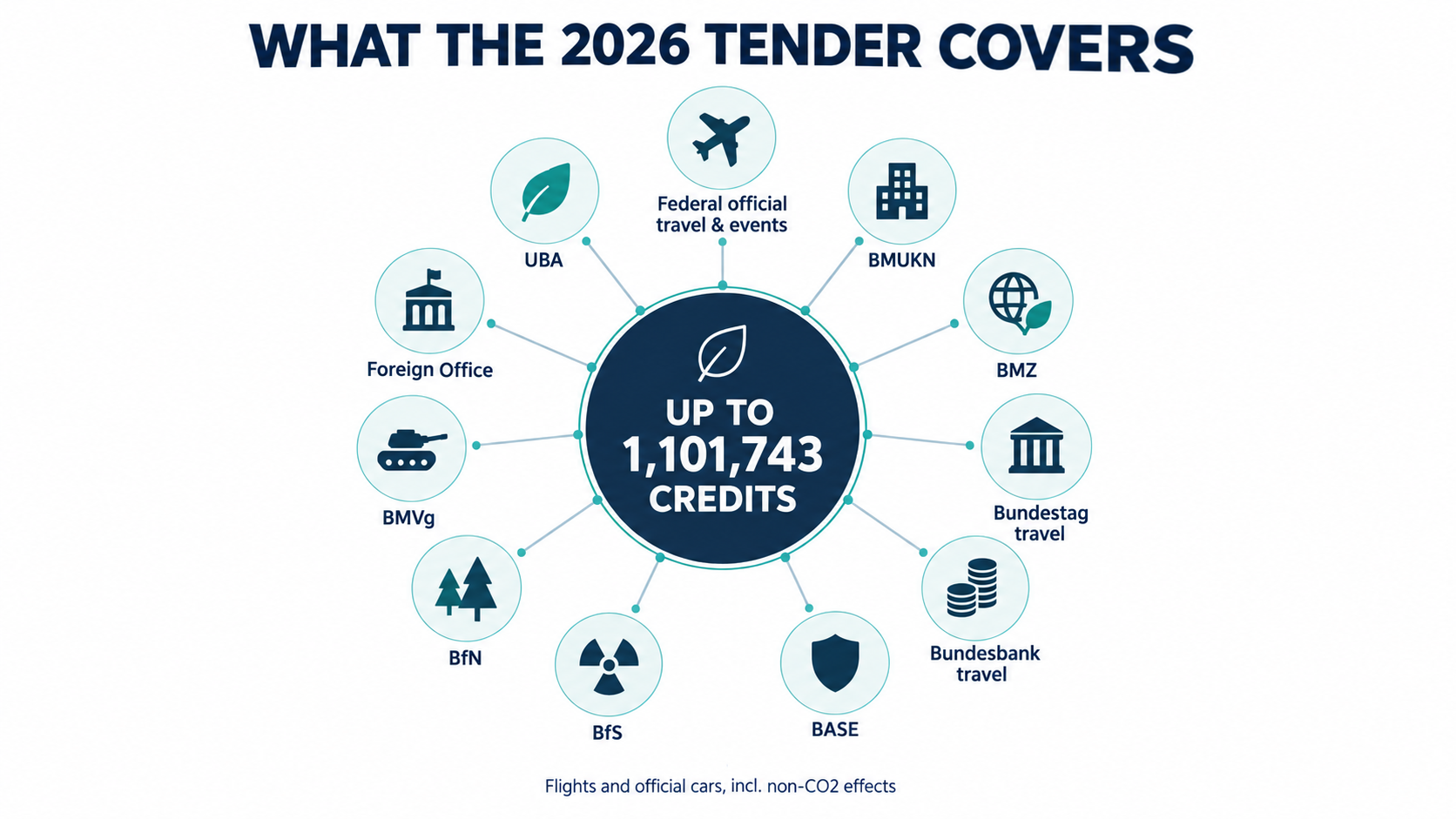
According to the notice, this procurement covers 11 items:
Official travel by the federal government and the federal administration (including federal events).
"Climate-neutral" programmes of individual bodies: the Federal Ministry for the Environment, Climate Action, Nature Conservation and Nuclear Safety (BMUKN), the Federal Ministry for Economic Cooperation and Development (BMZ), official travel of the German Bundestag, official travel of the Deutsche Bundesbank, the Federal Office for the Safety of Nuclear Waste Management (BASE), the Federal Office for Radiation Protection (BfS), the Federal Agency for Nature Conservation (BfN), the Federal Ministry of Defence (BMVg), the Federal Foreign Office (AA), and the German Environment Agency itself.
The notice explains that the travel offsetting covers the climate impact of trips by air and by official car made by staff of the supreme and higher federal authorities, including non-CO2 effects. Federal events (including meetings held during European or international presidencies) are also to be as climate-neutral as possible, and participants' unavoidable flight emissions must be offset.
Why only Article 6.4 credits?
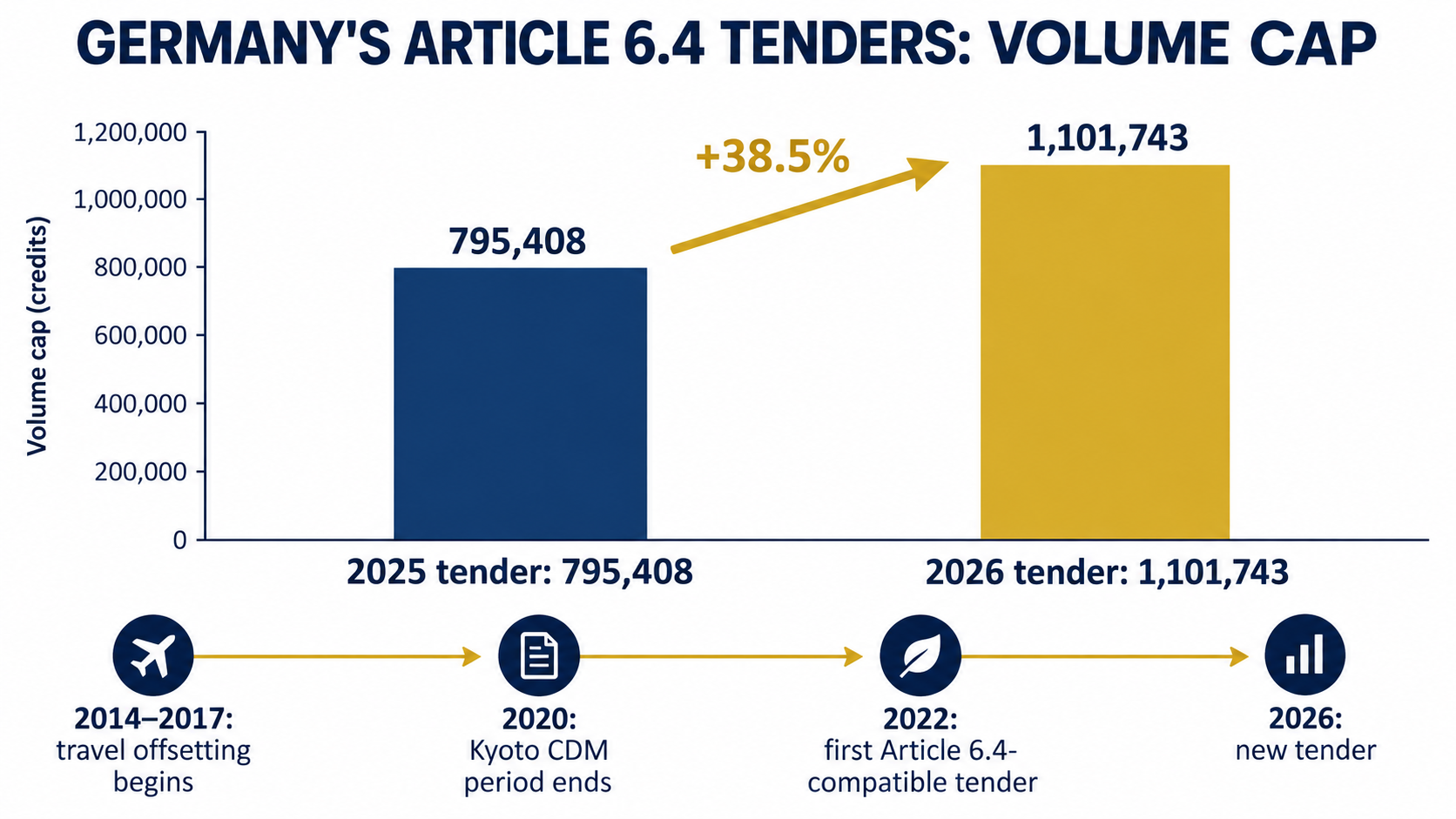
The German federal government has been offsetting emissions from official travel since the 2014–2017 legislative term. The notice states that after the second commitment period of the Kyoto Protocol ended at the end of 2020, the government stopped buying Kyoto-era CDM certificates for emissions from 2021 onwards and switched to credits compatible with the Paris Agreement. Since 2022, Germany has been using tenders to buy credits compatible with the Article 6.4 rules, and this year's tender follows the same approach.
Compared with last year: last year's tender (deadline November 4, 2025) had a cap of 795,408 credits, so this year's cap is about 38.5% higher. Last year's conditions were that projects had to be registered under the CDM (or classified by the CDM Executive Board as temporary measures) and had to have applied to the UN to transition to Article 6.4; because no credits were available for delivery at the time, delivery was deferred. This year's eligibility details are set out in the attached service specification, which we have not yet obtained and have not been able to check point by point; for the bid deadline, the tender documents are authoritative.
According to an information page of the German Emissions Trading Authority (DEHSt), the government has so far bought credits for about 1.9 million tonnes in total, used to offset the years up to 2020, mainly from household biogas and cookstove projects in Asia and Africa.
Our view: the public sector is "test-buying" PACM credits
What follows is our own reading.
A buyer signal: the first PACM credits were only approved in February this year, and the market is still thin. By tendering several years in a row, and at a larger scale, the German government is in effect giving the mechanism steady public-sector demand.
Quality disputes will reach buyers: Germany has mostly bought cookstove and biogas credits in the past, and cookstoves are currently the most contested credit type under PACM. The UN supervisory body is discussing this week whether cookstove credits should be subject to a reversal-risk buffer deduction (analysed in our research note "Two tests for the UN carbon market: how fast should baselines fall, and should cookstove credits pay for "permanence insurance"?"), and the outcome will affect how many credits buyers like this can get and how much they will pay.
What Taiwan can learn: for Taiwanese companies and government agencies that want to offset travel emissions, Germany's approach offers a clear template: first define the scope clearly (including aviation's non-CO2 effects), then specify which set of international rules the credits must meet. On the link between aviation and carbon credit demand, see also our note "A 175-Million-Tonne Gap: CORSIA's Carbon Credit Crunch and Where Taiwan's Airlines Stand".