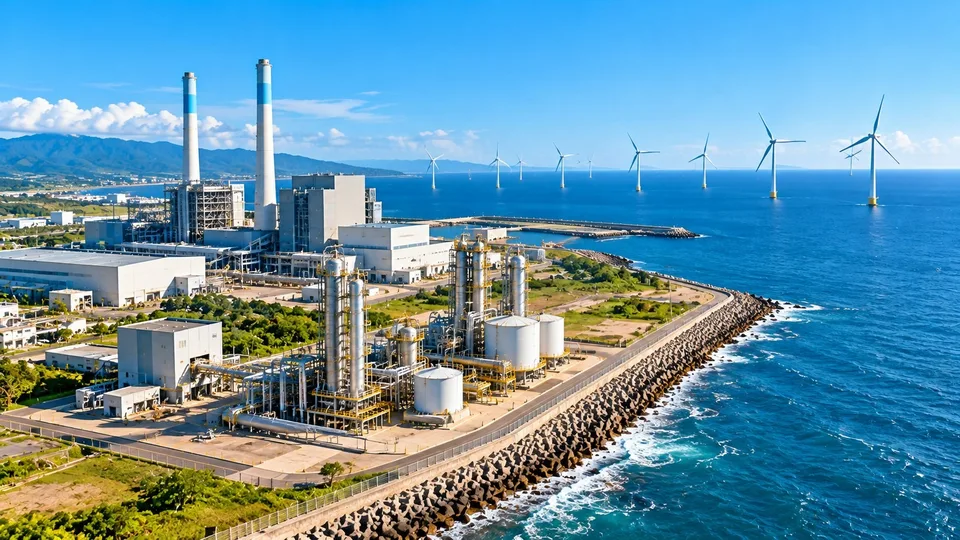
Carbon capture and storage (CCS) in Taiwan has reached the field-trial stage at two sites: Taipower's pilot at the Taichung Power Plant and CPC Corporation's CO₂ geological storage test site at Tiechenshan, in Tongxiao, Miaoli. Both are small-scale trials, and neither is in commercial operation.
How carbon capture and storage works
CCS means capturing carbon dioxide (CO₂) emitted by power plants or factories and injecting it deep underground into rock formations for long-term storage. A suitable formation needs a reservoir that can hold the gas, such as porous sandstone, topped by an impermeable caprock that seals it in. When part of the captured CO₂ is put to use, the approach is called carbon capture, utilization and storage (CCUS).
The two trial sites
The map marks three locations: the Taipower Taichung Power Plant, CPC's Tiechenshan (Tongxiao, Miaoli), and the Changbin Industrial Park (on the Changhua coast, where Taipower drilled a geological exploration well). They are three different places. A 2023 ITRI presentation lists the two announced CCS field test sites in Taiwan: Taichung targets a deep saline aquifer, and Tiechenshan a saline aquifer in a gas field.
Taipower's Taichung Power Plant: a pilot for the power sector
Taipower plans an integrated capture and storage pilot at the Taichung Power Plant, with about 2,000 tonnes of CO₂ injected per year. The figure appears in a CICHE feature article by Lin Dian-Shun et al. (National Central University) citing Taipower's plans, and in a 2023 ITRI presentation.
Wells and depth: the ITRI presentation describes a two-well storage project, one injection well and one monitoring well, each about 3,000 meters deep. The monitoring well is used to detect the movement of the CO₂ plume.
Environmental review: according to the ITRI presentation, an update to the environmental impact assessment for the storage site was approved in March 2023.
Permitting: the Taichung pilot is an existing pilot project that had passed environmental review before the Regulations for the Management of Carbon Dioxide Capture and Storage were issued, and under Article 28 it must, within two years of the regulations' issue date, apply for storage approval under Article 8, paragraph 2 without first applying for exploration consent documents (Central News Agency, August 25, 2026).
Taipower also drilled a geological exploration well about 3,000 meters deep (Changbin No. 1 well) in the Changbin Industrial Park; the CICHE feature dates it to around 2013. The Changbin Industrial Park is on the Changhua coast and is a different place from the Taichung Power Plant. This well is a geological exploration well and is separate from the Taichung Power Plant pilot.
CPC's Tiechenshan: from gas field to storage test site
Tiechenshan, in Tongxiao, Miaoli, sits on a well-pad site in the injection and production zone. It was an onshore natural gas field and was later used for underground gas storage. On April 1, 2026, the Ministry of Environment approved the carbon capture and storage trial plan here, making it Taiwan's first CO₂ storage test site approved through Ministry of Environment review.
The stages run in this order:
2023: the plan passed environmental impact assessment, and the facilities have been built.
April 1, 2026: the Ministry of Environment approved the storage plan in three stages, at cumulative injection totals of 10,000, 100,000 and 300,000 tonnes.
Formal staged injection trials: a local public briefing must be held again before formal injection begins.
After each stage reaches its cumulative injection target, a results report must be submitted and pass review before the next stage can begin. The three-year schedule starts from the date of the Ministry of Environment approval letter and can be extended once, by up to three more years. Only CO₂ captured in Taiwan may be stored.
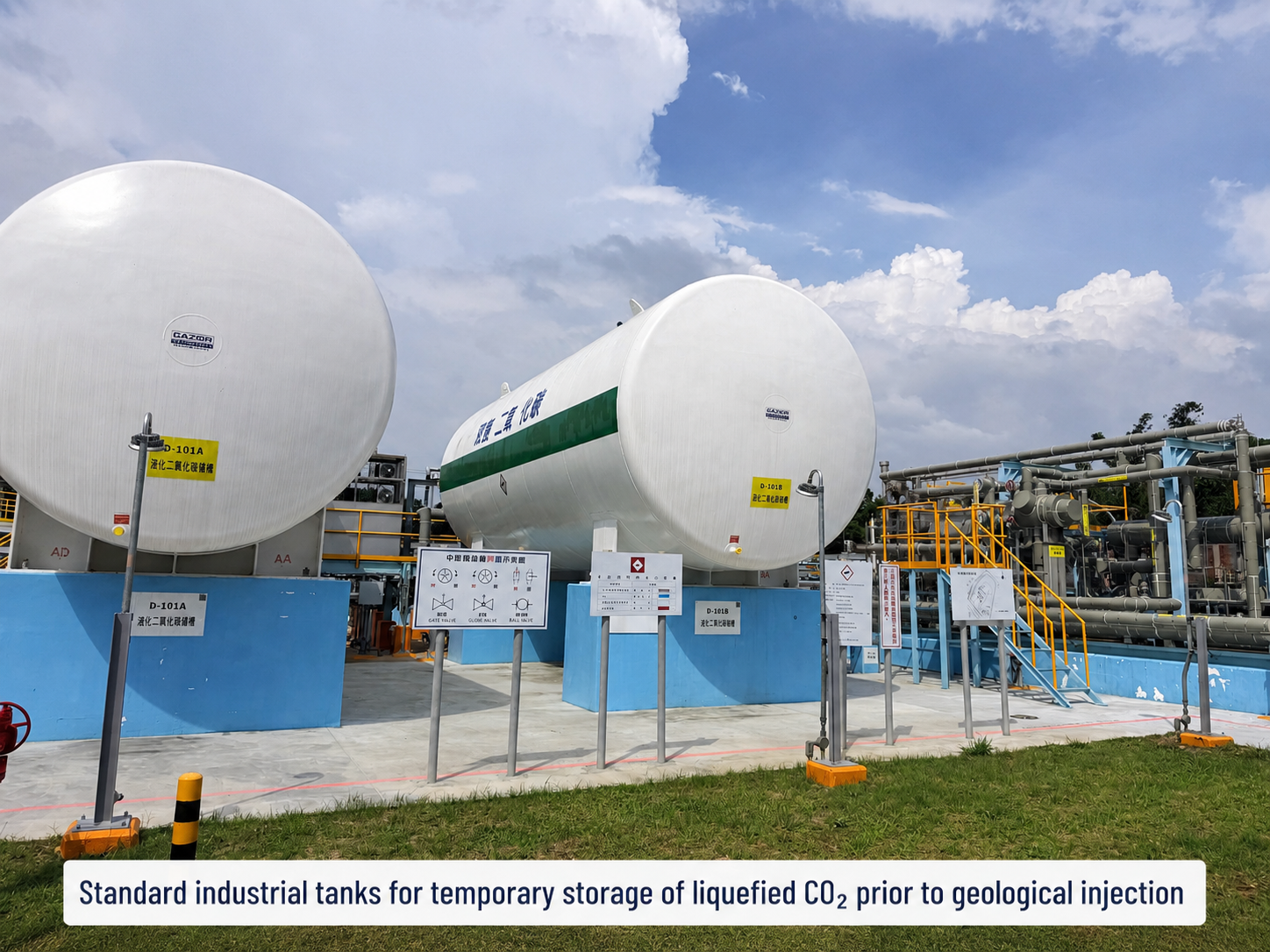
Monitoring covers bottom-hole pressure, microseismicity, CO₂ concentration at the site, groundwater, soil and the atmosphere, within a 1.6-kilometer monitoring range. An earthquake of magnitude 2.7 is the threshold for an anomaly report and the start of emergency response.
Regulatory update: the storage regulations have been issued
On August 25, 2026, the Ministry of Environment issued the Regulations for the Management of Carbon Dioxide Capture and Storage, which have 30 articles. The main points:
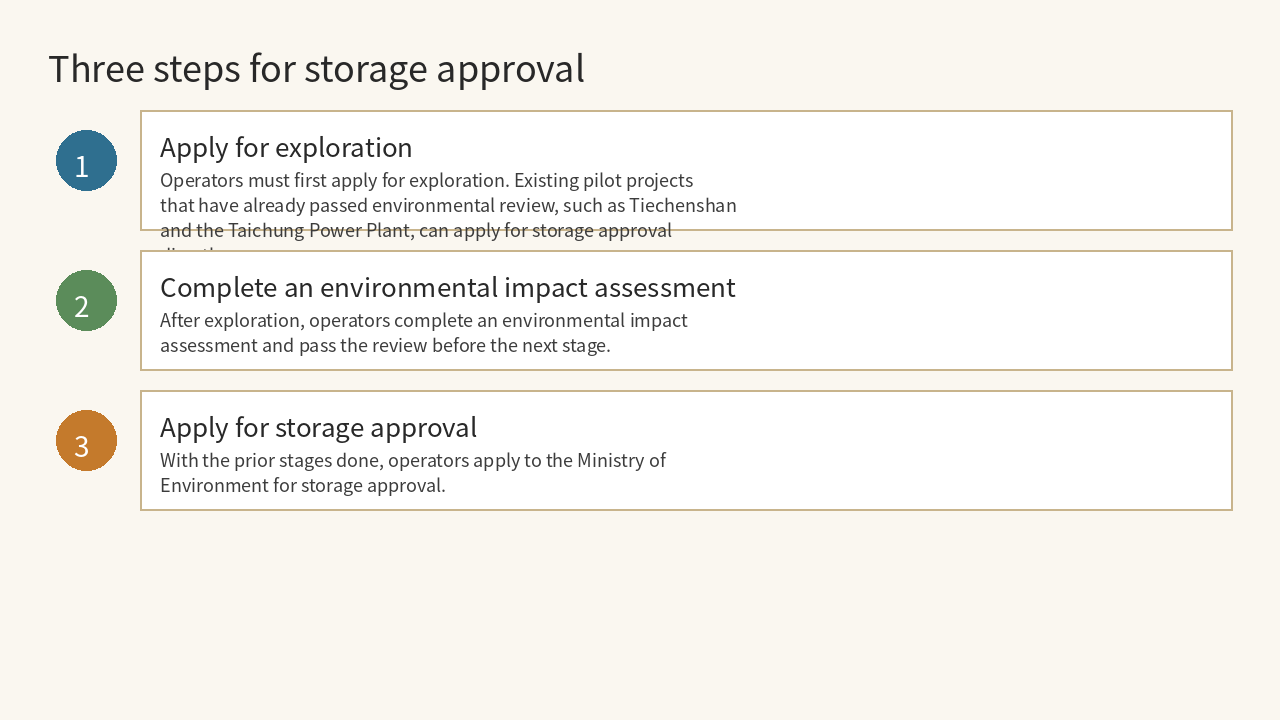
Procedure: operators first apply for exploration, then complete an environmental impact assessment, then apply for storage approval.
Existing pilot projects (Article 28): Operators of existing pilot projects do not need to apply for exploration consent documents under the regulations if they apply within two years of the issue date, and apply directly to the competent authority for storage approval under Article 8, paragraph 2. Under Article 8, paragraph 2, some documents may be omitted, and the environmental review approval of the existing pilot can stand in for the environmental assessment document.
Transparency (Article 15): after approval, operators must set up an online platform to publish information, and must upload to a website designated by the competent authority, in real time, live images of the onshore storage site, the CO₂ concentration in the air around the onshore injection wellhead, and seismic monitoring data.
Anomalies and leaks (Article 19): If an anomaly reaches the injection-stop condition, or CO₂ leaks, the operator must stop storage operations, carry out the approved remedial measures and emergency response plan, and notify the competent authority within 24 hours. Storage may resume only after the anomaly is cleared and the review is passed.
Long-term responsibility: the statutory monitoring period after well closure is 20 years, and operators must submit financial guarantee documents and environmental liability insurance for the following year every year.
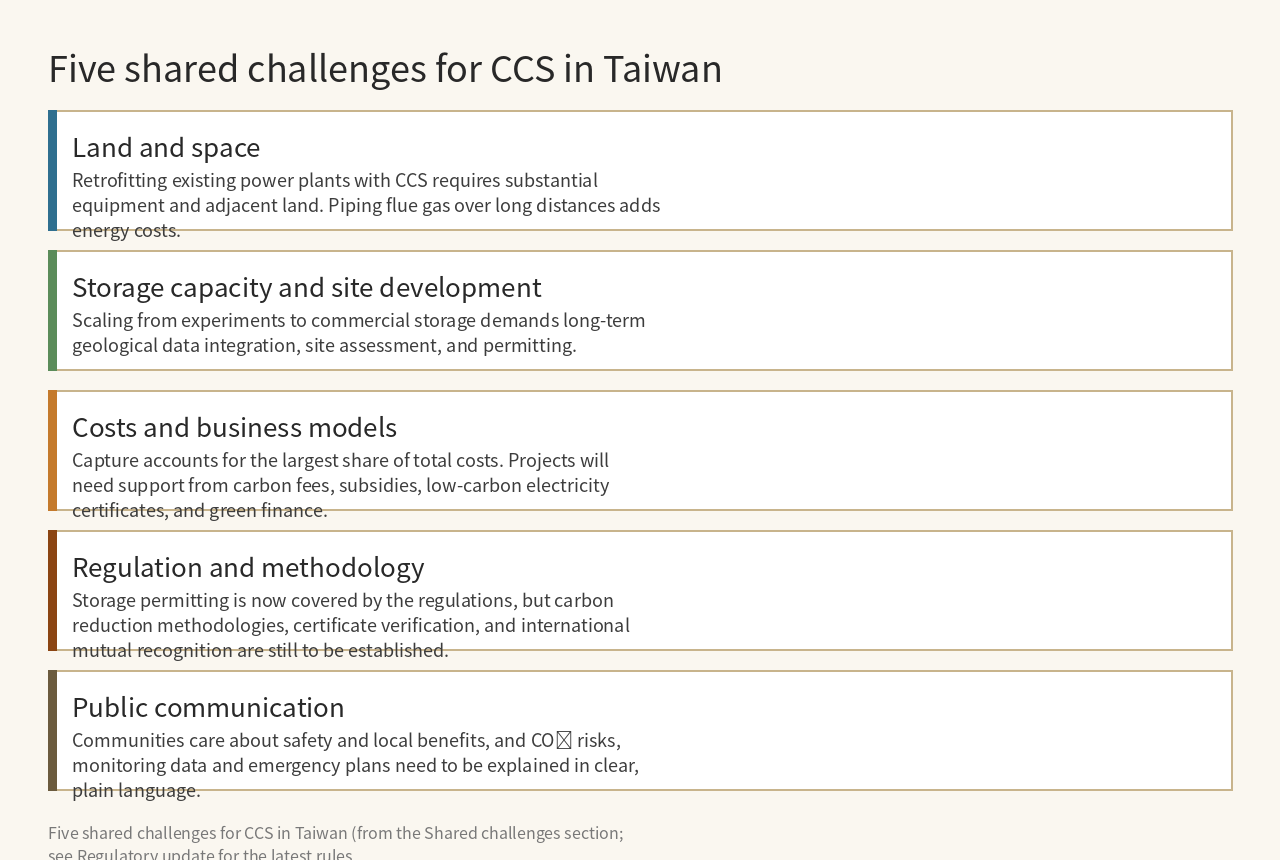
Shared challenges
Possible directions for Taiwan
The two trials and the newly issued regulations give Taiwan's CCS a path that can be built up step by step.
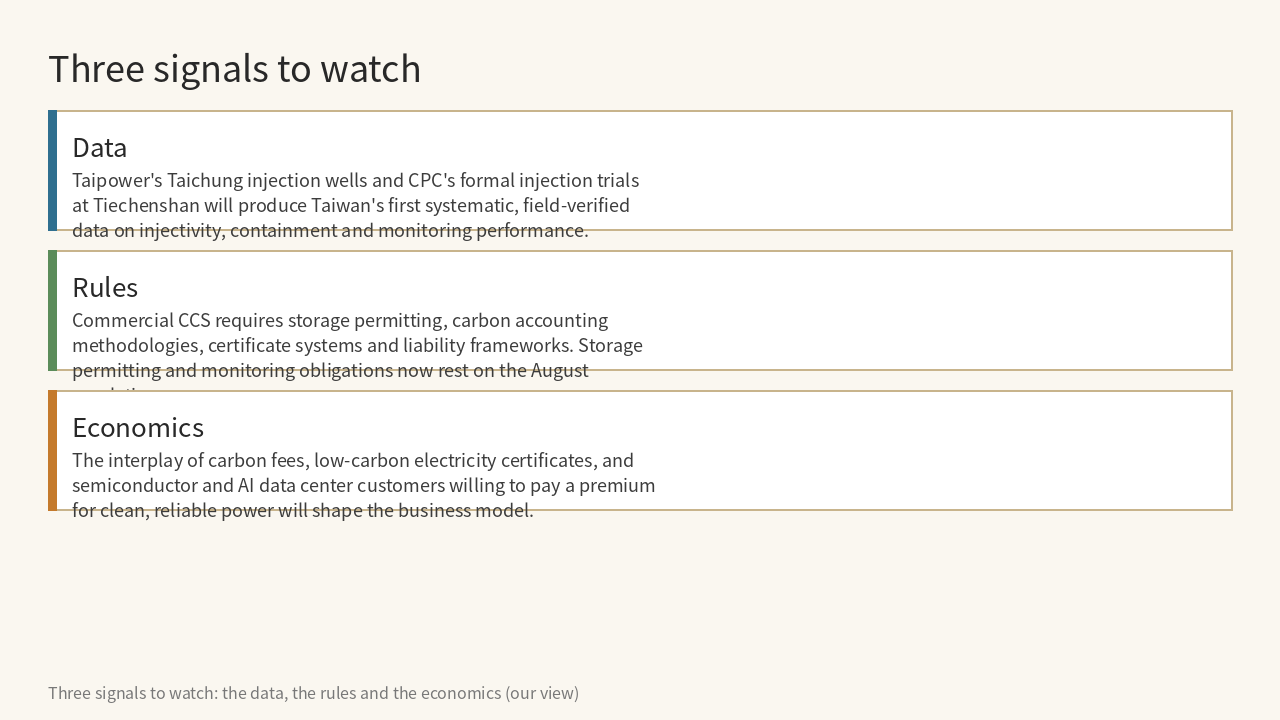
As Tiechenshan's staged review and the Taichung pilot advance, injection and monitoring data can accumulate as a basis for assessing later sites. The regulations require existing pilots to apply for storage approval within two years without first seeking exploration consent documents, and set requirements for real-time monitoring, leak notification and 20 years of post-closure monitoring. Carbon fees and industrial power demand can also be reviewed as references for assessing business models.
Sources
Island Frequency (Substack), Taiwan's Carbon Capture and Storage Experiments (July 15, 2026, original version of this article): https://islandfrequency.substack.com/p/taiwans-carbon-capture-and-sto-experiments
Ministry of Environment press release (in Chinese), Ministry of Environment approves CPC's Tiechenshan carbon capture and storage pilot project (April 1, 2026): https://enews.moenv.gov.tw/moenv-news/zh-tw/News/1824
Commercial Times (in Chinese), Taiwan's first carbon storage site approved, CPC Tiechenshan plan in 3 stages (April 1, 2026): https://www.ctee.com.tw/news/20260401701918-431401
Central News Agency (in Chinese), carbon storage regulations announced, with 20 years of monitoring required after well closure (August 25, 2026): https://www.cna.com.tw/news/ahel/202608250285.aspx
Ministry of Environment laws and regulations database (in Chinese), Regulations for the Management of Carbon Dioxide Capture and Storage (issued August 25, 2026): https://oaout.moenv.gov.tw/law/LawContent.aspx?id=GL007972
Lin et al. (National Central University), CO₂ geological storage: opportunities and challenges for Taiwan (CICHE feature, December 2023, in Chinese, PDF): CICHE feature PDF
ITRI (Yang), Taiwan CO₂ storage field tests (2023, Gulf Coast Carbon Center presentation): https://gccc.beg.utexas.edu/files/gccc/research/goi/2023/2.11%20Yang_Taiwan_ITRI.pdf
Leave a comment
Comments are reviewed before publication. Email is private and used only when contact is necessary. Privacy notice