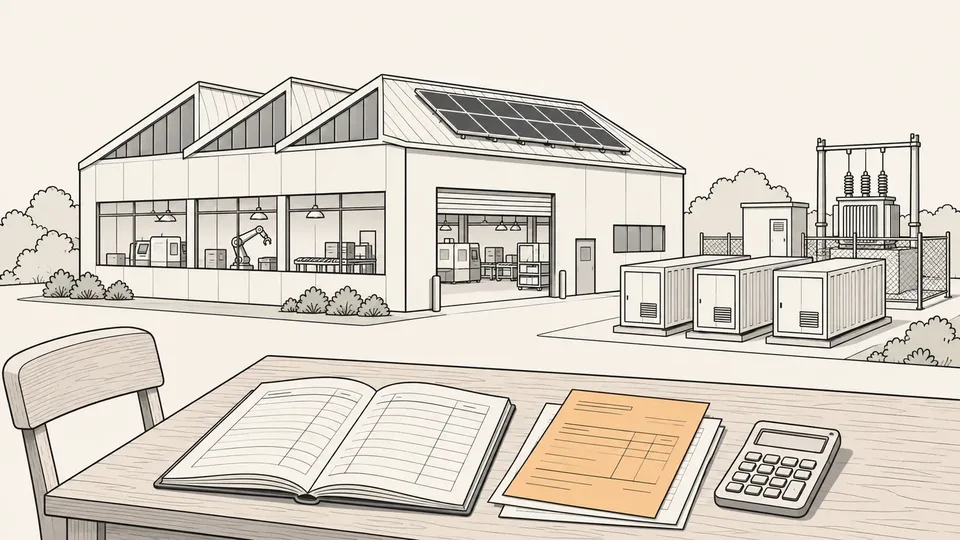
Based on a lecture given on 13 November 2026 in the Cost and Management Accounting course at National Taipei University of Business, titled “Corporate Energy Decisions under Net-Zero Transition: Renewable Energy, Decarbonisation Technologies and Cost-Effectiveness.” When a company’s budget is limited, energy-saving equipment, rooftop solar, green power and storage usually have to be ranked. In the past this was mostly a job for plant and purchasing teams. The same investment now affects the electricity bill, carbon dioxide (CO₂) emissions and supply-chain orders at the same time. It is looked at from two angles: energy technology, and cost and management accounting. First come the changing rules, then the technologies, then how accounting comes in, and finally the options are worked through for a fictional components factory, Qinghe.
Carbon pricing turns emissions into a cost firms must manage
The Paris Agreement aims to keep the rise in global temperature well below 2°C and to pursue efforts to limit it to 1.5°C, and many countries have followed with net-zero pledges. Carbon pricing means putting a price on each tonne of greenhouse-gas emissions. The World Bank’s State and Trends of Carbon Pricing 2026 finds that, as of 1 April 2026, 87 direct carbon-pricing instruments were in force, covering about 29% of global greenhouse-gas emissions, with an average carbon price of nearly US$21 per tonne. Carbon is moving from an external cost to one that companies have to manage.
Firms are being asked for carbon data by regulators, customers and capital markets at the same time. The EU Carbon Border Adjustment Mechanism (CBAM, which can be thought of as a carbon-border charge on certain imports) entered its definitive period on 1 January 2026 and covers specified cement, iron and steel, aluminium, fertilisers, electricity and hydrogen. The duty to declare and surrender certificates sits with EU importers; suppliers in Taiwan are usually asked to provide product emissions data. Preparation points are set out in this site’s article “CBAM Default Values and Verifier Gap: Taiwan Exporters.” The obligation is phased in: it is introduced from 2026 to 2033 in step with the withdrawal of free allocation under the EU emissions trading system, and is fully covered by CBAM certificates only from 2034.
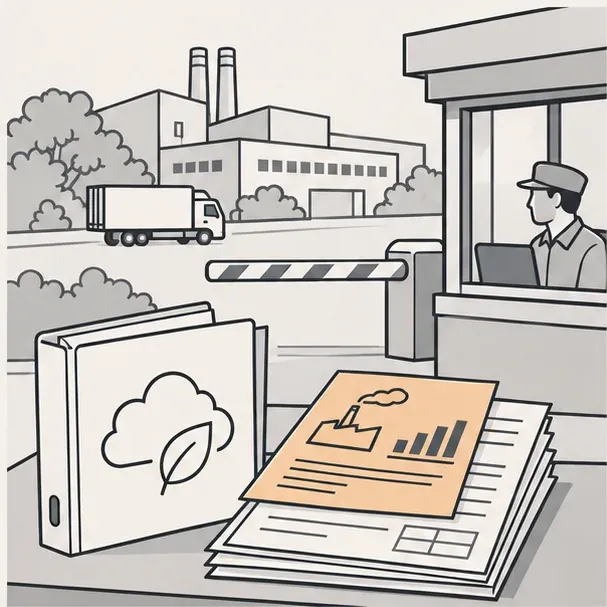
Taiwan’s carbon fee applies to electricity, gas-supply and manufacturing plants whose direct emissions plus indirect emissions from electricity use total 25,000 tonnes of carbon dioxide equivalent (CO₂e) or more a year. The general rate is NT$300 per tonne. Under Article 5 of the Carbon Fee Charging Regulations, chargeable emissions equal (annual emissions minus a K value) times an adjustment factor. The K value works like an amount that is left out of the charge: it is 25,000 tonnes for ordinary firms and zero for firms at high risk of carbon leakage. For example, a plant that emits 50,000 tonnes a year, pays the general rate and is not a high-leakage firm is charged on 25,000 tonnes times NT$300, or about NT$7.5 million. Preferential rates or adjustment factors would change the amount. Even if annual emissions have not yet reached the 25,000-tonne threshold, customers and capital markets may still ask for carbon data, and carbon costs can still enter quotes and orders. The rules are set out in this site’s article “Taiwan’s Carbon Fee and ETS Dual Track: Rate Adjustments, Pilot Timeline and Corporate Impact.”
In accounting terms, emissions are often kept in three ledgers. Scope 1 is direct emissions from fuels the firm burns and from its own processes, such as an on-site gas boiler. Scope 2 is indirect emissions from purchased electricity and heat, the carbon behind the power bill. Scope 3 is other indirect emissions in the upstream and downstream supply chain, such as materials, logistics and product use. This site’s article “Scope 3 Emissions Guide: 55.61% of Taiwan Listed Firms Disclose, 11.01% Set Targets” can be read alongside this explanation.

The value of renewable energy depends on when the power is generated
Solar photovoltaics, wind, geothermal, biomass and hydropower each have a role. Output from solar and wind varies with weather and time of day; geothermal and biomass are more dispatchable.
Electricity generated equals installed capacity times hours times the capacity factor. The capacity factor is simply the share of the year in which a plant actually generates, compared with running at full output all the time. A 100 kW solar array with a 15% capacity factor generates about 131,000 kWh a year (100 kW × 8,760 hours × 15% = 131,400 kWh, rounded). For the same 100 MW, solar at 15% and offshore wind at 45% differ by about a factor of three in annual output. One kilowatt-hour is one unit of electricity.

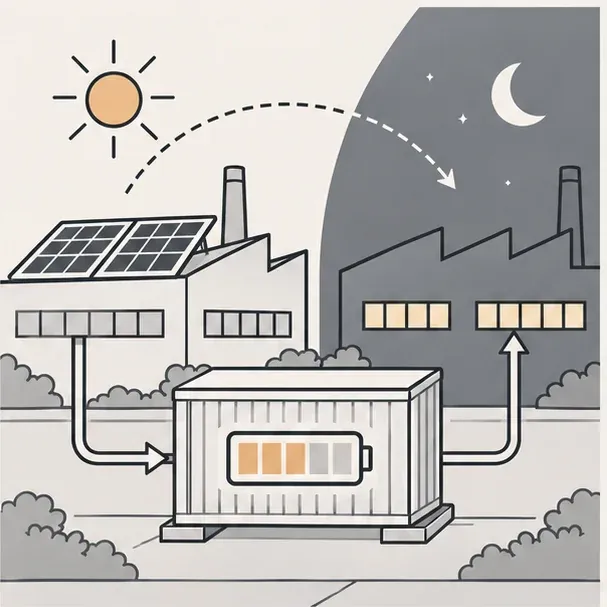
Solar power is generated mainly in daylight, and only the part that overlaps with the factory’s demand can directly replace purchased electricity. If the factory switches to a night shift, the amount that can be replaced directly may fall sharply. Storage and virtual power plants move electricity from one period to another. Storage has charging and discharging losses: at 90% efficiency, 100 kWh charged yields only 90 kWh discharged.
Firms usually obtain green power in three ways: building it themselves, signing a power purchase agreement (PPA, a long-term contract that sets how much power will be bought and at what price), or buying renewable energy certificates. Renewable energy certificates, carbon credits and allowances are different rights and cannot substitute for one another. International trends in green-power procurement are discussed in this site’s article “Green Power Procurement Shifts Toward Hourly and Local Supply: Notes from an International Renewable Energy Market Forum.”

The order and cost of abatement tools
When factories put reductions in order, they usually start with the earlier steps and move later. Cost and uncertainty usually rise further down the list. The law does not require this sequence.

Energy-saving technologies are mostly mature and have short payback periods, for example variable-speed drives, chiller improvements, compressed-air leak repairs, LED lighting and waste-heat recovery. The abatement cost of such measures is often negative, meaning they cut emissions and save money at the same time.
Electrification depends on efficiency and on the carbon intensity of electricity. The emissions of three technologies supplying 100 kWh of heat are shown below. The coefficient of performance (COP, roughly how many units of heat are delivered for each unit of electricity) changes the result. The factors in the figure were set for the class. The kWh here refers to heat or electricity; the “unit” on a gas meter is measured in cubic metres.

Carbon capture has to be judged on net reductions. If 1,000 tonnes are captured and the capture process itself emits 200 tonnes, the net reduction is only 800 tonnes. With an annualised cost of NT$5 million, the cost per tonne rises from NT$5,000 to NT$6,250. The cost per tonne should be worked out from the net reduction after process emissions are deducted.
Recording electricity costs, carbon costs and proven reductions in the accounts
The electricity bill is the first energy-management report. When savings are calculated, only the “avoidable” part should be counted, meaning money the decision will actually stop the firm from paying. A fall in kilowatt-hours does not guarantee that the contracted demand charge will fall at the same time.
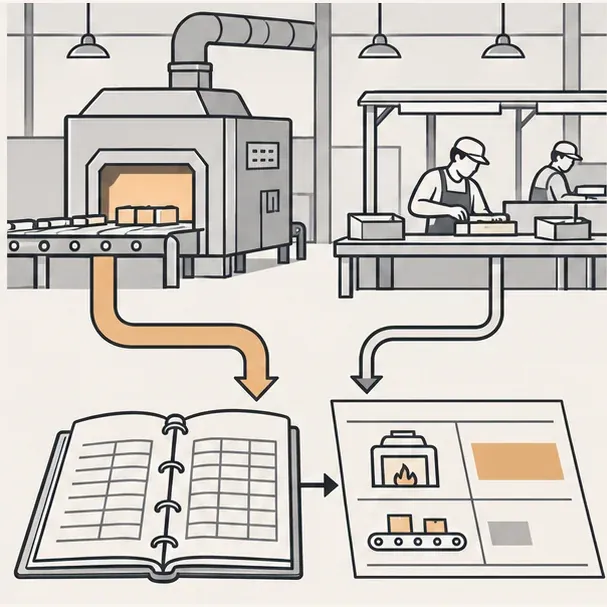
Carbon costs can be grouped into three kinds: carbon fees already paid; implied costs from a green-power premium and customer decarbonisation requirements; and the risk of higher future carbon prices and of CBAM. The way costs are allocated changes the unit cost we see. For example, a heat-treatment line makes 200,000 pieces and uses 1.2 million kWh, while an assembly line makes 800,000 pieces and uses 800,000 kWh, at NT$3.5 per kWh, for a total of NT$7 million. Allocated evenly by piece, each piece costs NT$7; allocated by electricity use, heat treatment costs NT$21 a piece and assembly NT$3.5. The total is unchanged; what changes is where the cost is assigned, and that can be enough to alter quotes and the order of improvements.
Savings also have to be proved. The baseline is the amount of electricity that would have been used if nothing had been done. If the original baseline is 1 million kWh and metered use is 800,000 kWh, it looks as if 200,000 kWh were saved; but if the baseline adjusted for output is 850,000 kWh, only 50,000 kWh can be attributed to the energy-saving project. Accounting has to record the carbon, assign it to the right place, put a price on it, and be able to explain it outside the firm.
Investment appraisal should start from a comparison with doing nothing
Every option should be compared with the same “do nothing” case, and only cash that changes because of the decision should be counted. The figures below are worked out for a fictional components factory used in class, Qinghe; the investment, power price and emission cuts are numbers set for the class.
First, the fictional factory. Qinghe makes 1 million parts a year and uses 2 million kWh, at an avoidable energy price of NT$3.5 per kWh, so the annual energy bill is NT$7 million, or NT$7 a part. The emission factor is taken as 0.5 kg of CO₂e per kWh, so electricity use emits 1,000 tonnes a year, or 1 kg a part. The class first assumes that Qinghe does not currently pay the carbon fee: it has provided only electricity data, and 1,000 tonnes is still below the ordinary 25,000-tonne threshold, although customers may still ask for carbon data.
Qinghe can spend at most NT$6 million this year on energy-saving and decarbonisation investment. The sum of project outlays cannot exceed that cap, and options A, B and C cannot be done only halfway. They are compared with the same ruler: money is spent now, cash is counted at the end of each of the next 10 years, and the discount rate is 8%. The discount rate means the firm treats this money as if it could earn about that return elsewhere, so future cash is converted into today’s value and then added up. That total is net present value (NPV). That means counting the money that must be paid today, then asking what the extra cash in later years is worth now. This run leaves out inflation, subsidy, residual value and changes in working capital, and sets financing and income tax aside. For 8% over 10 years with a constant annual amount, the annuity factor used to discount is 6.7100814. Think of it as a conversion multiple: NT$10,000 received at the end of each of the next 10 years is worth about NT$67,100 today at 8%. Later NPV figures are the investment paid today (a negative number) plus annual net cash times this multiple.
Option A is energy saving: an investment of NT$2 million saves 250,000 kWh a year. At NT$3.5, the gross benefit is NT$875,000; after new operating costs of NT$75,000, annual net cash is NT$800,000. At 8% over 10 years, NPV is about NT$3.3681 million, and annual reductions are about 125 tonnes (250,000 kWh × 0.5 kg). In this set of assumptions, paying NT$2 million now in order to keep about NT$800,000 more each year is the most economical choice.
Option B is rooftop solar: an investment of NT$4 million. The class first assumes that all 200,000 kWh are used on site, times NT$3.5, minus NT$100,000 of annual operating costs, giving annual net cash of NT$600,000, annual reductions of about 100 tonnes, and an NPV of only about NT$26,000, which is barely break-even. The self-consumption share is the part of generation used in the factory itself. If self-consumed generation falls by 10%, the cash flow becomes 180,000 kWh × NT$3.5 minus NT$100,000, or NT$530,000, and NPV turns into a negative NT$443,700, which shows how sensitive the result is to the assumption.
Option C is storage: an investment of NT$3 million. The class sets compatible price arbitrage at NT$350,000 plus a measured saving of NT$350,000 on the contracted demand charge, minus NT$150,000 of operating costs, for annual net cash of NT$550,000 and an NPV of about NT$690,500. Emission reductions have not been evidenced in this case, so they are counted as zero and cannot be used to meet a reduction threshold.
Option D is a green-power purchase: there is no initial investment. The firm buys 1 million kWh of green power a year at a premium of NT$0.5 per kWh, so the extra annual cost is NT$500,000 and NPV is about minus NT$3.355 million. What is being bought is an environmental attribute, for disclosure or customer requirements, and it cannot be added directly to the engineering reductions from A and B.
Option E is an energy-saving service: the provider funds the same equipment and operating costs as option A. Qinghe pays nothing at the outset, but still takes on a 10-year payment obligation. The customer’s gross annual saving remains NT$875,000; after a service fee of NT$550,000, annual net cash is NT$325,000, and A’s NT$75,000 of operating costs is not deducted again. NPV is about NT$2.1808 million, lower than self-purchased A, and E is mutually exclusive with A, so both cannot be chosen. Before signing, at least the following should be confirmed: the scope of the service, price adjustments, compensation if performance falls short, repair times, who owns the environmental attributes, and what happens if the contract is ended early.

The figures are a little like a home-renovation budget: there is a cap, the kitchen and bathroom cannot each be done halfway, and paying upfront or spreading payments over 10 years leads to different answers.
Investment packages under a limited budget
When the budget is limited and A, B and C cannot be done only in part, the feasible packages should be listed and compared. The lecture’s basic exercise first assumes that the benefits of these three options have already been adjusted so that they can be added together; a real project would still have to re-estimate how much solar can be used on site after the energy saving, and how storage would be dispatched. Option D is an operating premium and is not included in the capital-expenditure packages below.

When the objective changes, the best package changes too. If the aim is to maximise NPV, the best choice is A+C, investing NT$5 million, with an NPV of about NT$4.0586 million and annual reductions of only the 125 tonnes from A; the remaining NT$1 million cannot be used to buy half of B. If annual reductions of at least 200 tonnes are also required, A+C falls short, and the only package that meets both the budget and the threshold is A+B, investing NT$6 million, with an NPV of about NT$3.3941 million and annual reductions of about 225 tonnes. If the budget is tightened to NT$4 million and the 200-tonne threshold remains, the service option, which is mutually exclusive with A, can be used: E+B invests NT$4 million, has annual net cash of NT$925,000, an NPV of about NT$2.2068 million, and annual reductions of about 225 tonnes. Meeting the capital cap does not mean that service fees over the next 10 years can be spent without limit.

Shadow carbon prices and internal carbon pricing
Before a government charge takes effect, a company can also set an internal price on carbon, so that reductions are visible when investment decisions are made. Two common approaches have similar names but different cash meanings.
A shadow carbon price is used only in investment appraisal: it enters the decision score, but there is no actual charge, and it does not create extra cash in the company’s accounts. An internal carbon fee is actually charged to business units, and the money collected is usually paid into a decarbonisation fund for energy saving or green power. For a single unit, the fee changes what it has to pay; at group level, this is mostly an internal transfer and cannot be treated as new external income.

In practice, the price is often set by referring to three things: published or expected carbon fees and international carbon prices, the cost of the firm’s own next tonne of reduction, and whether the price should rise over time. Choosing a number is not enough; the firm also needs to write down which emissions are included, who is responsible, how often the price is updated, whether money is actually collected, and where it is used. CDP’s 2026 technical note on carbon pricing states that in 2025 more than 5,900 companies disclosed to CDP that they use an internal carbon price or expect to do so within two years.
Taiwan’s general rate of NT$300 a tonne is a statutory charge for specified firms; CBAM affects the emissions data and cost risk of exports to the EU. An internal price can be set above the current statutory rate, as a way of flagging carbon costs that may rise later, but a shadow benefit should not be added on top of a carbon fee that will already be paid. Qinghe’s electricity emissions are about 1,000 tonnes a year, and the class first assumes that it does not currently pay the fee; customers and future rules may still write carbon into orders and quotes, so an internal price remains useful.
Returning to Qinghe’s packages, financial NPV counts only cash that will actually be received or paid, so the ranking remains A+C at about NT$4.0586 million, ahead of A+B at about NT$3.3941 million. If a shadow price of NT$1,200 per tonne is then introduced, the method is to multiply annual reductions by NT$1,200, discount that stream at the same 8% over 10 years, and add it to financial NPV to obtain a “carbon-price-adjusted decision value.” A+B therefore gains about NT$1.81 million, for an adjusted value of about NT$5.2058 million; A+C gains about NT$1.01 million, for about NT$5.0651 million, and the ranking flips. A+B cuts 100 tonnes a year more than A+C; at NT$1,200 a tonne, that extra cut is worth about NT$805,000 today, just enough to outweigh the original financial gap of about NT$664,500, so the ranking changes. The financial gap between the two packages is about NT$664,500, and the reduction gap is 100 tonnes a year, so the shadow price that would flip the ranking is about NT$990 a tonne. If the current published rate of NT$300 a tonne is used only as a scenario, A+C still ranks higher. Financial NPV itself does not change; what changes is the ranking after carbon risk is included. If the firm already requires engineering reductions of at least 200 tonnes a year, A+C is eliminated by that threshold and there is no need to wait for the shadow price to flip the result.
Five checks are useful before a decision, as set out below.

Accounting translates technology into the language of decisions: understand the technology, calculate clearly, and produce evidence.
Possible directions for Taiwan
Taiwan already has a carbon-fee system and is preparing an emissions-trading pilot. Suppliers that export to the EU also face CBAM data requirements. Even if annual emissions have not yet reached the 25,000-tonne charging threshold, customers and capital markets may still ask for carbon data. Factories can place energy saving, solar, green power and storage in the same “compare with doing nothing” appraisal, start with energy-saving measures that pay back quickly and save money, then test whether the self-consumption share is high enough to support rooftop solar, and use management accounts to record electricity costs, carbon fees and evidence of reductions. An internal carbon price can be used to rank options, but it should be presented separately from financial NPV: a shadow price changes the decision score, while an internal carbon fee actually moves money between units. Existing tools, including the rooftop solar potential lookup, green-power procurement practice, and the official notes on the carbon fee and ETS, can serve as a starting point for the next step.
Companies or schools that want a further assessment of their own case, or a course or workshop on this topic, can contact the author.
The external figures used here are based mainly on the World Bank’s State and Trends of Carbon Pricing 2026, the European Commission’s explanation of the CBAM definitive period, the Ministry of Environment’s Carbon Fee Charging Regulations, the 21 October 2024 announcement of carbon-fee rates, and CDP’s Carbon Pricing: CDP Disclosure Best Practice (2026 technical note). The case figures come from the class calculations and lecture notes for the course above.
Leave a comment
Comments are reviewed before publication. Email is private and used only when contact is necessary. Privacy notice