Japan’s transport ministry plans to hold the founding meeting for a civil engineering physical AI consortium on December 1. Industry, academia, and government will work on data, testing, and safety for fields such as road and river engineering. 1
From shared data to field testing
Physical AI uses local sensor data to inform actions in the physical world. For example, it can help construction equipment adjust to conditions on site. The ministry’s attachment lists 213 registered members as of November 25. The figure counts registered members, not deployments. 2
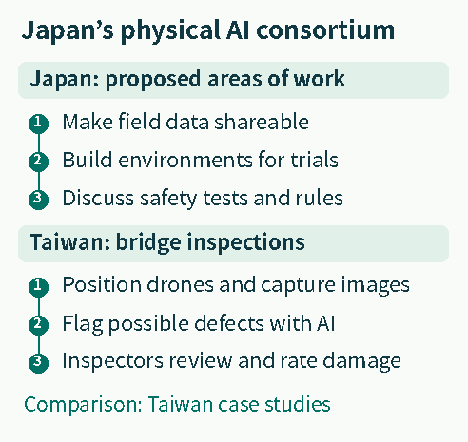
The ministry’s recruitment notice calls for joint work on data, development infrastructure, safety, evaluation, and rules. The founding meeting is scheduled to introduce the work and its timeline, with materials to be released afterward. 1, 3
Taiwan: from images under a bridge to human review
Taiwan’s Institute of Transportation tested a drone beneath a bridge where satellite signals were unavailable. It paired visual positioning with ultra-wideband radio positioning. The drone photographed bridge components, and an image recognition system looked for signs such as cracking and spalling. 4
The Highway Bureau’s pilot uses AI for screening, then has inspectors review the results and rate component deterioration. Together, the two cases show how to collect images under bridges and how to bring the results into maintenance decisions. 5, 6
Our view
This is our reading, not the ministry’s official position. Marking a crack in a photo shows an engineer where to take a closer look. Using a similar result to direct machinery would also require testing operating limits, stops when signals fail, and who can take over. That is why it matters that Japan’s consortium puts data and safety on the same agenda.
Possible directions for Taiwan
For a bridge inspection pilot, link image locations and times to suspected defects and the results of human review. Once those records can be traced, define field-test thresholds and manual stop conditions for any action that will be linked to machinery.
References
- Japan transport ministry: founding meeting notice
- Japan transport ministry: founding meeting materials and member registrations
- Japan transport ministry: recruitment and scope
- Taiwan Institute of Transportation: drone-assisted bridge inspection research
- Taiwan Highway Bureau: annual report, PRECISE bridge inspection system
- Related coverage: Highway Bureau Drones Grow to 201; Cesium Adds BIM/CAD
Leave a comment
Comments are reviewed before publication. Email is private and used only when contact is necessary. Privacy notice