
Ministry of Environment approves Mailiao carbon storage geological exploration plan

On October 29, 2026, Taiwan's Ministry of Environment held a review meeting and approved the "carbon storage geological exploration plan" that Formosa Petrochemical Corporation (台塑石化) submitted for the Mailiao area, and it issued a press release on October 30. It is the first storage-site exploration plan to pass review since the Regulations on Carbon Dioxide Capture and Storage Management (二氧化碳捕捉後封存管理辦法) were promulgated and took effect on August 25, 2026. According to the United Daily News, Tsai Ling-yi (蔡玲儀), director-general of the ministry's Climate Change Administration, said Formosa Petrochemical's is currently the only application submitted since the regulations took effect.
The plan that passed is a geological exploration plan. Its purpose is to collect measured data on the underground formations and judge whether the Mailiao area can serve as a storage site for CO₂.
Exploration area covers the Formosa Plastics industrial complex and nearby waters
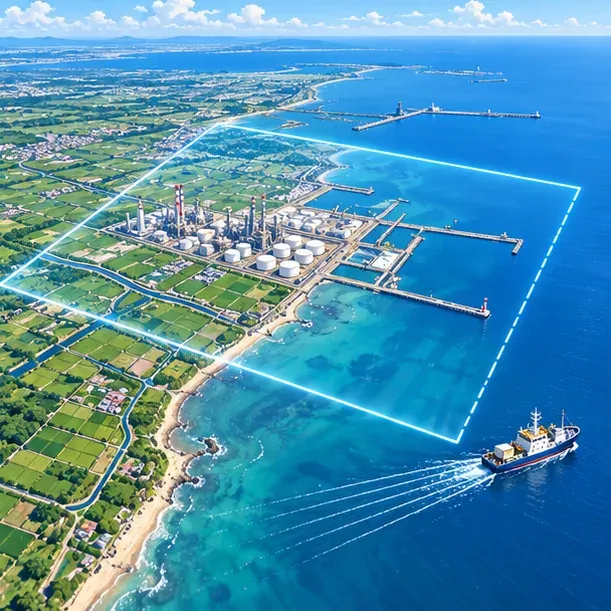
- Location: the Formosa Plastics Group's Sixth Naphtha Cracker complex (六輕) in Mailiao Township, Yunlin County, and the adjacent sea area, roughly 50 km × 50 km.
- Depth: reservoir and caprock layers at about 1,000 to 1,800 meters underground.
- Application: Formosa Petrochemical applied in early September 2026 under the regulations.
- Exploration period: from the approval date to December 31, 2031. Tsai said the period is about five years.
Seismic surveys, drilling and core analysis supply measured site data
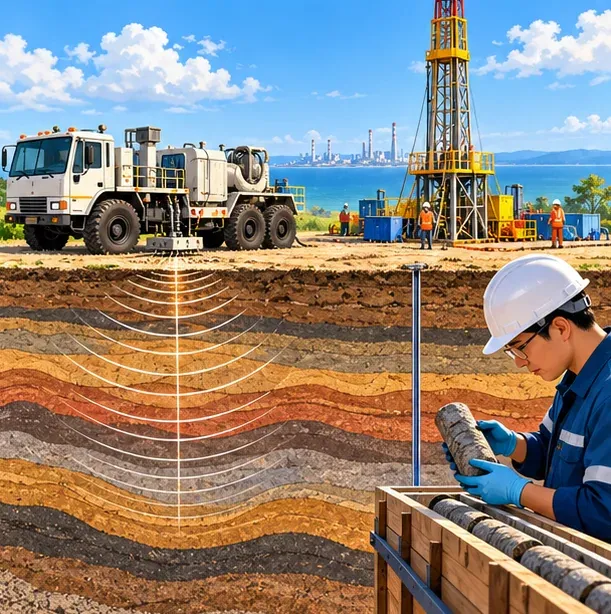
The ministry explains that a storage site needs a continuous reservoir thick enough to hold CO₂, an intact and dense caprock above it as a sealing barrier, and a check of the surrounding area for potential leakage pathways such as faults. These conditions must be verified with measured data from seismic surveys and drilling.
The approved exploration work includes:
- Onshore and offshore seismic surveys
- Drilling of geological exploration wells and downhole testing
- Physical and mechanical analysis of rock cores
- Monitoring facilities and model evaluation
After this work, the results are used to assess the site's storage volume and safety. The ministry approved the plan's exploration area, period and methods after inviting experts, scholars and agencies including the Ministry of Economic Affairs to two review meetings.
Approval states that CO₂ injection tests are not allowed
In approving the plan, the ministry stated that if an injection-reservoir evaluation is carried out in the future, no CO₂ injection test may be conducted. The United Daily News reported that the review committee asked for reference to Japan's practice.
The review committee also made three recommendations:
- Establish an environmental baseline survey before the exploration wells are spudded.
- Apply environmental protection measures during drilling.
- Begin stakeholder communication early and set up a mechanism for public disclosure.
The exploration area is non-exclusive and carries no priority for storage approval
The exploration area the ministry approved is non-exclusive and does not give the operator priority for a later storage approval. After exploration, the operator must still complete the subsequent procedures before it can apply for storage.
Under the regulations, an operator establishing a storage site goes through three steps:
- Submit a geological exploration plan to the ministry and, after obtaining the document of consent for exploration, carry out the exploration.
- Based on the survey results, conduct an environmental impact assessment under the Environmental Impact Assessment Act and pass the review.
- Apply to the ministry for storage approval with the consent document, the approved environmental impact assessment documents, financial guarantee documents for storage and post-closure monitoring, an environmental damage liability insurance plan and other items (Article 3 and Article 8, paragraph 1).
Environmental assessment still lies ahead, and emission reductions await a methodology
The United Daily News quoted Tsai as saying that storage potential and feasibility will be known only after the exploration results, and that actual storage requires passing the environmental impact assessment and obtaining a permit from the Climate Change Administration. China Times quoted Tsai as saying that how much carbon is reduced, and how it is offset against emissions, can be calculated only after a "carbon storage" methodology is approved.
China Times reported that Formosa Petrochemical plans a storage scale on the order of one million tonnes of CO₂. The ministry's press release and the regulations do not list this figure.
Directions Taiwan can draw on

The review treats exploration, environmental assessment and storage approval as three separate gates, each with its own documents and review. The exploration stage collects measured subsurface data first, and the data then feed into the environmental assessment, so that the decision on storage rests on evidence from the site. See also Taiwan’s Carbon Capture and Storage Experiments and Australia’s Bonaparte offshore storage formation declaration.
- The review committee recommended an environmental baseline survey before the exploration wells are drilled.
- The committee recommended early stakeholder communication and a public disclosure mechanism.
- The exploration area is non-exclusive. After approval, the operator must still complete the environmental assessment and storage approval in order, and each stage has its own review.
Leave a comment
Comments are reviewed before publication. Email is private and used only when contact is necessary. Privacy notice