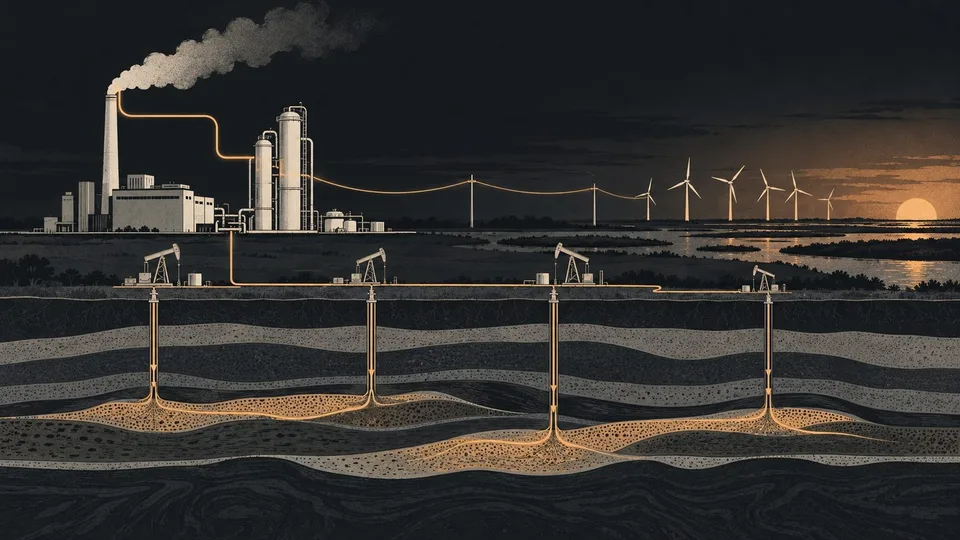
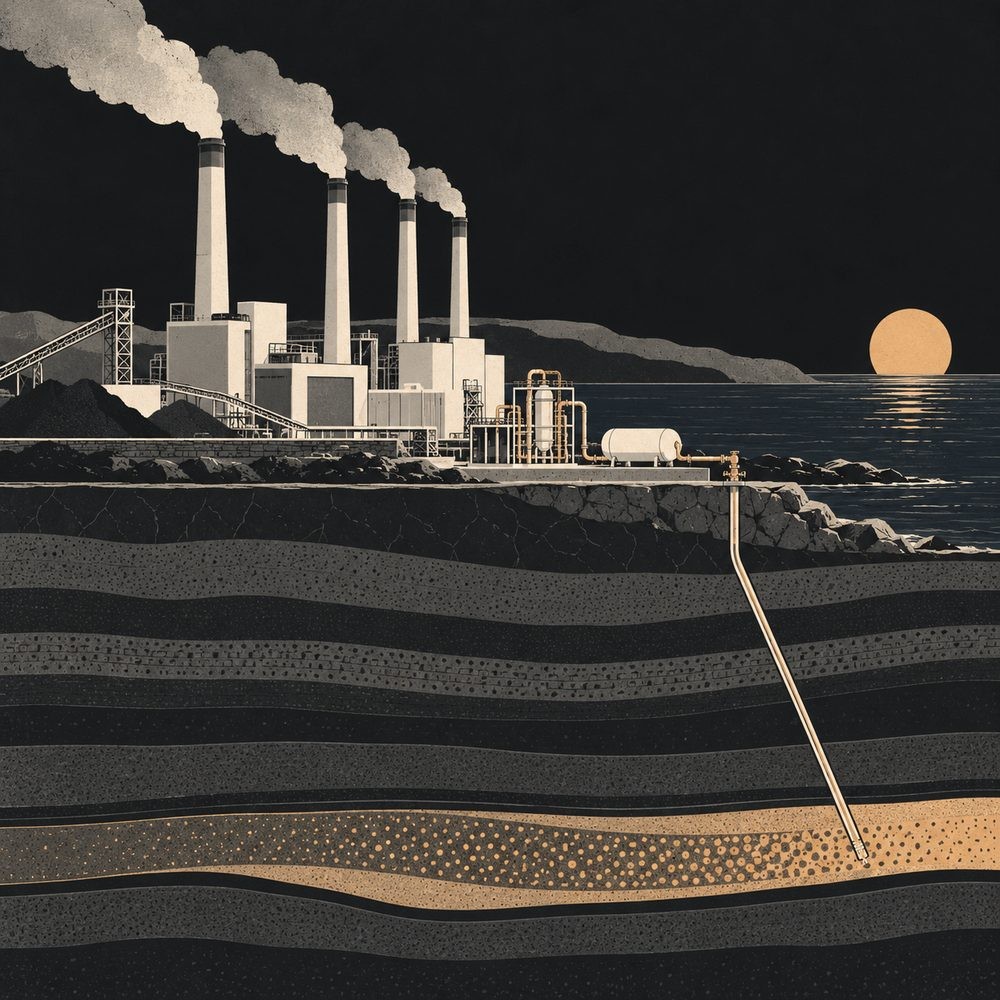
On 16 October Sinopec announced that Shengli Oilfield had started building a "megatonne-scale low-concentration CCUS full-chain demonstration project", which it describes as the first of its kind in China. CCUS stands for carbon capture, utilization and storage. The project will capture carbon dioxide (CO₂) from low-concentration flue gas at a coal-fired power plant and use all of it for enhanced oil recovery (EOR) and storage, with completion expected by the end of 2028.
Capturing CO₂ from coal plant flue gas
Flue gas from coal-fired plants contains only 12% to 15% CO₂, along with impurities such as sulphur and nitrogen oxides, which makes capture harder than from high-concentration sources. Yang Yong, the head of Shengli Oilfield, said its in-house solvent and energy-saving regeneration process achieve:
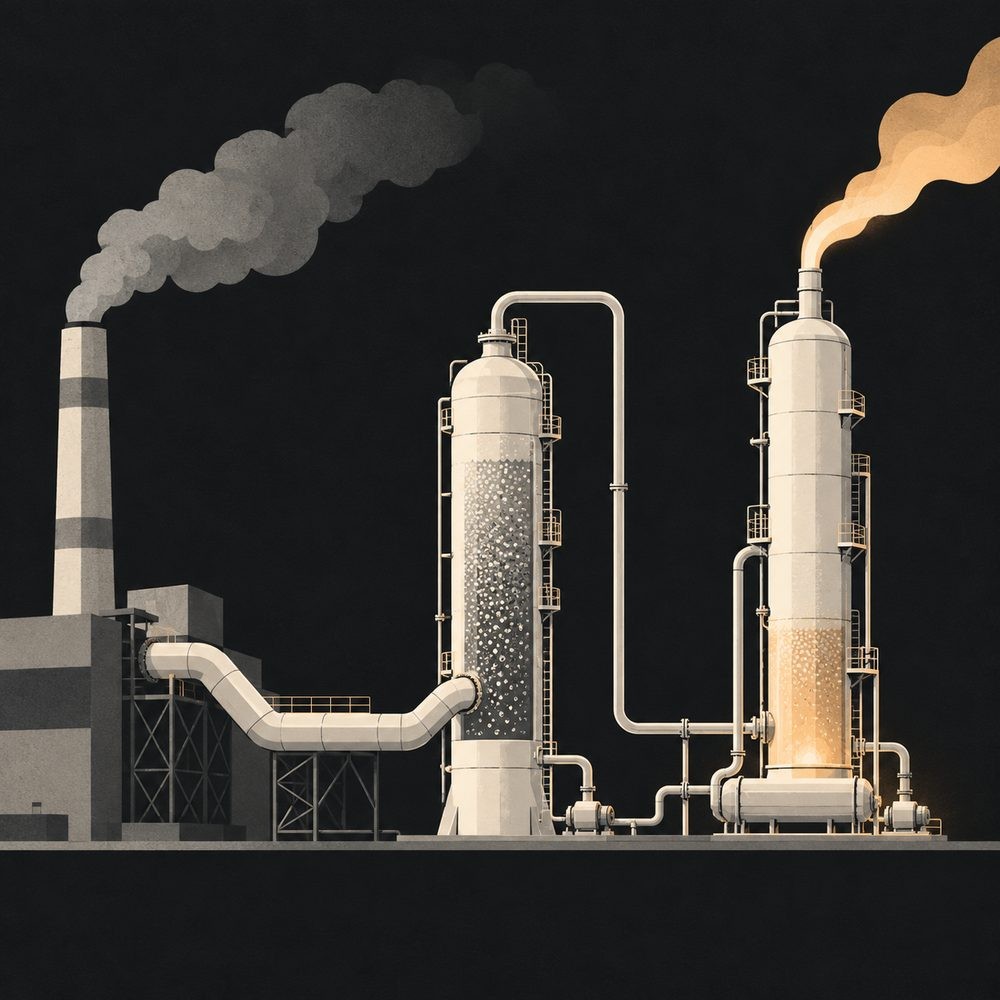
- A capture rate above 90%.
- CO₂ product purity above 99.5%.
- A capture heat duty below 2 GJ per tonne of CO₂.
Heat duty is the heat needed to regenerate the solvent and release the CO₂, the main energy cost of chemical absorption. Sinopec's release does not say at what scale or under what operating conditions these figures were measured.
EOR and storage through more than 70 wells
According to Sinopec's release, also reported by the People's Daily and China News Service, the captured CO₂ will be injected through more than 70 injection wells into different reservoir types, including beach-bar sandstone, turbidite and shale oil reservoirs.
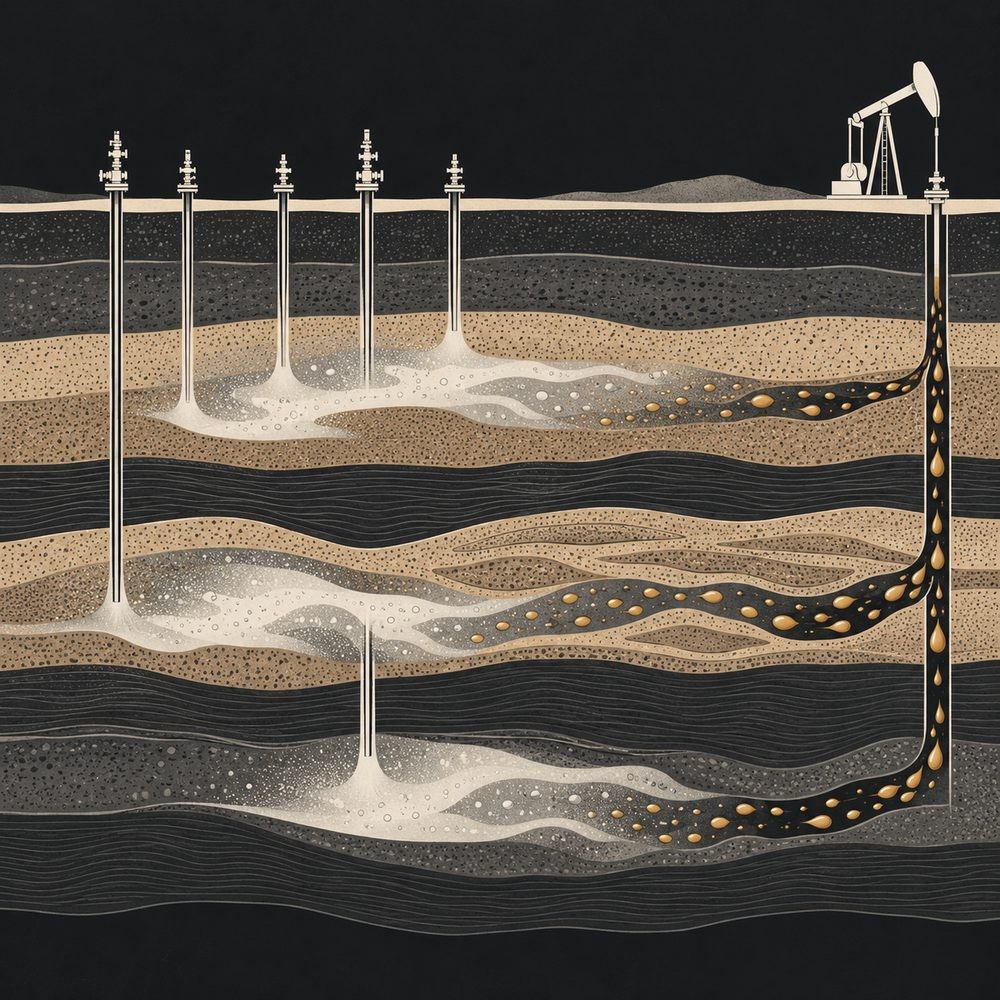
EOR and storage are separate outcomes. EOR injects CO₂ into a reservoir to raise oil recovery; storage keeps CO₂ underground over the long term. Sinopec's release does not give separate figures for EOR and storage, and does not explain how stored volumes will be monitored and measured.
Wind power wired directly to the capture plant
The project includes a "wind + storage + direct line + CCUS capture" system:
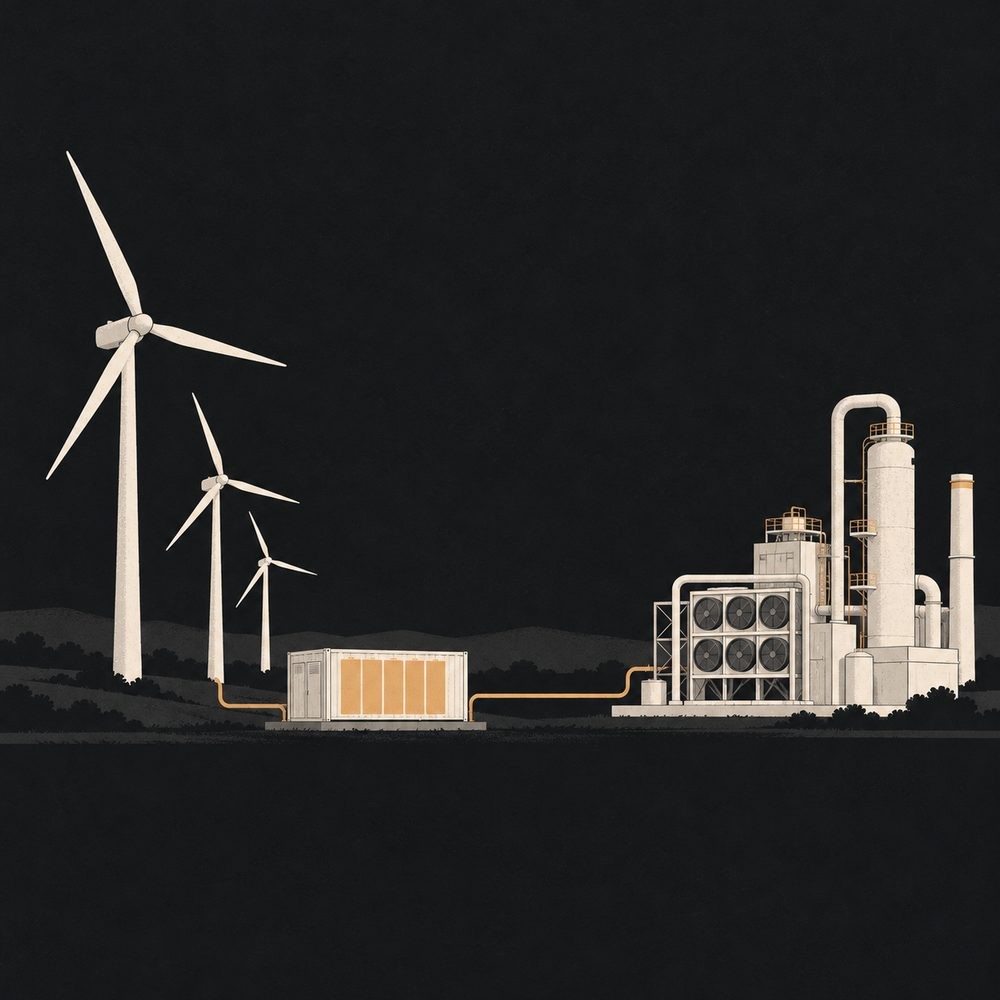
- 13 wind turbines with a combined capacity of 98.8 MW are planned.
- They will generate 217 GWh a year and supply the capture plant directly.
Sinopec says this direct green power supply is a first in China.
Experience from the Qilu Petrochemical–Shengli project
Shengli Oilfield already runs the Qilu Petrochemical–Shengli Oilfield megatonne CCUS project, which China describes as its first megatonne-scale CCUS project. It captures high-concentration tail gas, about 90% CO₂, from a coal-to-hydrogen unit.
- Since it started in August 2022 it has stored a cumulative 1.4 billion standard cubic metres of CO₂, about 2.77 million tonnes at standard density (our conversion).
- Oil recovery has risen by more than 15 percentage points, and daily oil output in the demonstration area has grown from 220 to 525 tonnes.
- It came with China's first CO₂ trunk pipeline of around 100 km.
The new project switches the source from high-concentration chemical tail gas to low-concentration coal flue gas, which is emitted in larger volumes and is harder to capture.
Capture heat duty against international benchmarks
Commonly used reference points:
- A 2019 IEAGHG assessment found that 30 wt% monoethanolamine (MEA) is no longer a representative benchmark and adopted a 40 wt% piperazine and AMP blend (PZ+AMP) instead. For an ultra-supercritical coal plant, the new benchmark's reboiler duty is 2.46 GJ per tonne of CO₂.
- A 2007 IEA Clean Coal Centre review cites an optimised reboiler duty of about 3.45 GJ per tonne for a coal case with 30 wt% MEA and 90% capture.
- In a US DOE NETL reference case, adding 30 wt% MEA capture to a 550 MW (net) coal plant cuts net efficiency from 39.28% to 28.43%, with a capture cost of US$56.44 per tonne of CO₂ (2011 dollars).
Shengli's figure of below 2 GJ is about a fifth lower than the IEAGHG benchmark. It is the operator's own figure, and plant operating data will be needed to confirm it.
Taipower's capture trial at Taichung
According to a 2022 report in the Commercial Times, Taipower's Taichung Power Plant has 10 coal-fired units and four gas turbine units. Taipower has set up a carbon reduction technology park at the plant to capture CO₂ from coal unit flue gas with chemical solvent absorption. According to BASF's May 2025 release:
- The contract was awarded at the end of 2023. The contractor, Carbon Capture Application Technology (CCAT), uses BASF's OASE blue technology for a design capture of 2,000 tonnes of CO₂ a year.
- CO₂ captured in this phase is stored within the Taichung plant; the next phase will assess storage in formations off Taiwan's coast.
- If the trial succeeds, Taipower will assess a new commercial unit, with a next-phase target of 1 million tonnes a year, the same scale as Shengli's new project.
The site has covered the Taichung injection wells in Taiwan's carbon capture and storage experiments, the scale of Taiwan's storage sites in EU pre-commercial CCS testing, and Formosa's Mailiao plans as an example of gas-fired power paired with carbon storage.
Possible directions for Taiwan
- Publish heat duty and capture rate data from the trial: The 2,000-tonne Taichung trial could report reboiler duty per tonne of CO₂, capture rate and solvent consumption, so they can be compared on the same basis with IEAGHG's 2.46 GJ, MEA's 3.45 GJ and Shengli's sub-2 GJ.
- Estimate the effect on generating efficiency early: In the NETL case, capture costs about 11 percentage points of net efficiency. If Taipower scales from 2,000 tonnes to 1 million tonnes a year, the steam and power source for capture and its effect on unit output need to be assessed together with grid dispatch. Shengli's dedicated wind supply is one approach.
- Where the CO₂ goes shapes the cost structure: Shengli uses its CO₂ for EOR, so extra oil output can offset part of the cost. Taiwan's current trials store CO₂ within the Taichung plant and at CPC's Tiechenshan site, with no EOR revenue, so capture, transport and storage costs have to be covered by electricity prices, the carbon fee or subsidies.
- Measure EOR and storage separately: If Taiwan later adopts CO₂ utilization or EOR, stored volumes should be monitored and reported separately from utilized volumes, so injected volumes are not counted as storage by default.
Sources
- Sinopec Group press release (published on China Petroleum & Petrochemical), "我国首个百万吨级低浓度CCUS全链条示范工程在胜利油田开工", 2026-10-16: http://www.chinacpc.com.cn/info/2026-10-16/news_12179.html
- Sinopec Group website (reprinting China Petrochemical News), "我国首个百万吨级低浓度CCUS全链条示范工程在胜利油田开工建设", 2026-10-19: http://www.sinopecgroup.com/group/000/000/073/73164.shtml
- People's Daily Online, "我国首个百万吨级低浓度CCUS全链条示范工程开工建设", 2026-10-17: http://finance.people.com.cn/n1/2026/1017/c1004-40816582.html
- People's Daily, "我国首个百万吨级低浓度CCUS全链条示范工程开工", 2026-10-17: http://finance.people.com.cn/n1/2026/1017/c1004-40816375.html
- China News Service, "中国首个百万吨级低浓度CCUS全链条示范工程在山东东营开工", 2026-10-16: https://www.chinanews.com/cj/2026/10-16/10715865.shtml
- IEAGHG, "Further Assessment of Emerging CO2 Capture Technologies for the Power Sector and their Potential to Reduce Costs", 2019-09: https://ieaghg.org/publications/2019-09%20Further%20Assessment%20of%20Emerging%20CO2%20Capture%20Technologies.pdf
- IEA Clean Coal Centre (published by IEAGHG), "Post Combustion Carbon Capture from Coal Fired Plants – Solvent Scrubbing", 2007: https://ieaghg.org/publications/2007-15%20Post%20Combustion%20Carbon%20Capture%20from%20Coal%20Fired%20Plants%20%E2%80%93%20Solvent%20Scrubbing.pdf
- NETL, RTI presentation "Engineering Scale Testing of Transformational Non-Aqueous Solvent" (citing DOE Cases 11 and 12): https://netl.doe.gov/sites/default/files/netl-file/22CM_PSC16_Lail.pdf
- BASF, "巴斯夫 OASE® blue 氣體處理技術支援 CCAT 在台灣發電廠的碳捕集與封存項目", 2025-05-07: https://www.basf.com/tw/zh/media/news-releases/asia-pacific/2025/05/apac-25-48
- Commercial Times, "拚淨零 台電秀碳捕捉技術", 2022-09-15: https://www.chinatimes.com/newspapers/20220915000163-260202
Leave a comment
Comments are reviewed before publication. Email is private and used only when contact is necessary. Privacy notice