Singapore and Australia signed a cross-border carbon capture and storage (CCS) agreement on November 24, 2026. Under the agreement, national emissions accounting responsibility for future carbon dioxide (CO₂) shipments shifts at first offload in Australian jurisdiction.1, 2
Measurements at export and offload
Singapore must ensure the quantity and composition are measured at export and send the results to Australia before each shipment. Australia requires a second measurement at the handover point. The handover measurements determine how much CO₂ is covered by the transfer of accounting responsibility. Singapore accounts for associated and fugitive emissions before handover. Australia accounts for them from handover onward. Singapore also uses the handover measurements to calculate the amount it claims as abatement in international reporting.2
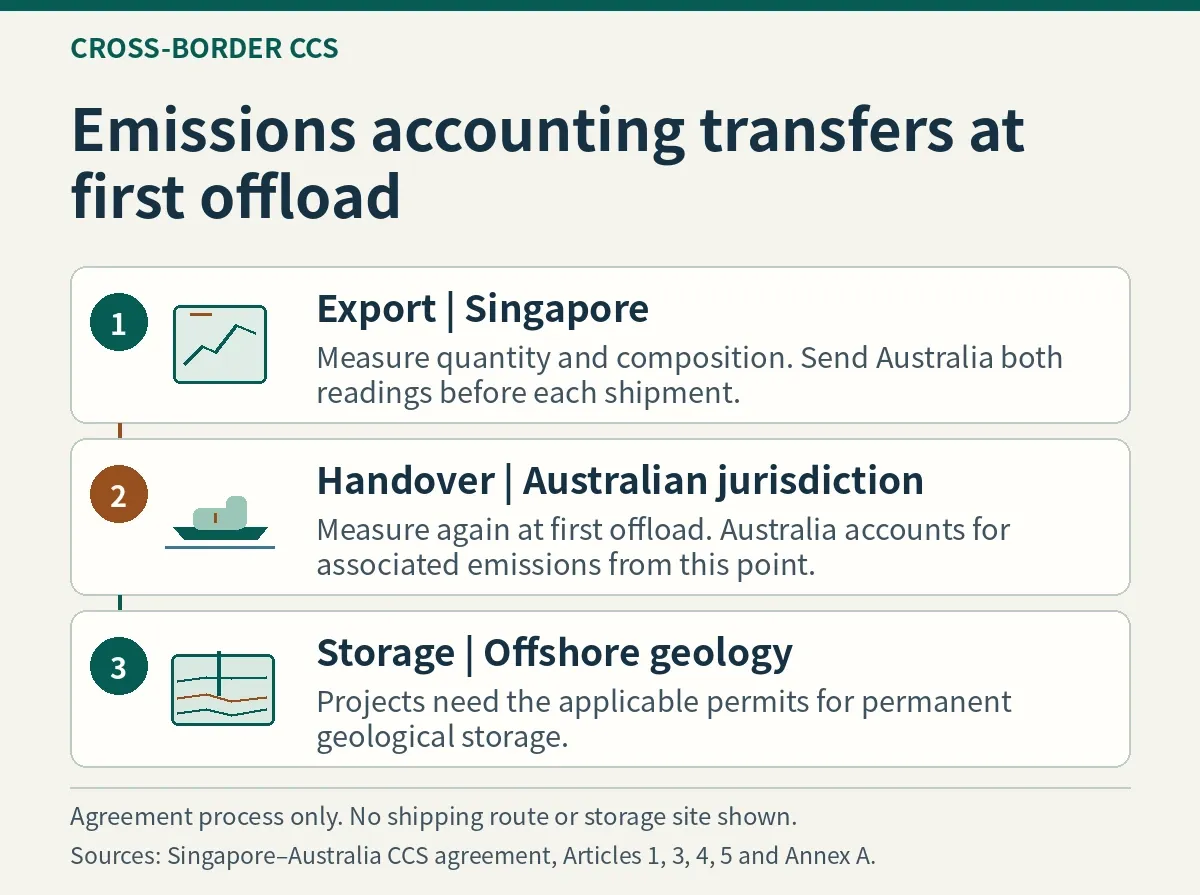
First offload can take place at a port or an offshore receiving facility in Australian jurisdiction. A joint committee established at entry into force will discuss the location and technical details. Both countries will jointly determine measurement, verification, and data exchange methods.2
Signing, entry into force, and permits
Each country must give written notice through diplomatic channels after completing its domestic procedures. The agreement enters into force on the 30th calendar day after the last notice.2
Individual projects still need permits under applicable domestic law. Under Annex A, Singapore evaluates information about proposed export sources and confirms its assessment to Australia in writing. Australia handles the permits under its jurisdiction, including applicable permits for sub-seabed geological storage.2
International rules for cross-border storage
A July 27 joint statement confirmed that formal negotiations were underway. The agreement signed in November sets out permitting responsibilities and the handover for emissions accounting.3
The amendment to Article 6 of the London Protocol provides a route for exporting eligible CO₂ streams for sub-seabed geological storage. The International Maritime Organization says the countries involved need an agreement or arrangement that addresses permitting responsibilities. Before the amendment formally enters into force, eligible parties can declare provisional application under a 2019 resolution.4
Taiwan reviews domestic storage projects
Article 39 of Taiwan’s Climate Change Response Act requires operators to apply for storage approval. Trial or implementation plans must describe the site, storage method, and environmental impacts, among other matters. After approval, operators must monitor the environment during storage and report their results regularly.5
Under Taiwan’s Regulations for the Management of Carbon Dioxide Capture and Storage, issued on August 25, 2026, a standard new application needs an approved geological survey document and evidence of a passed environmental impact review. These Taiwanese provisions govern storage approval and monitoring. The Singapore–Australia agreement also addresses cross-border shipments and national emissions accounting.6
Our view
This is our reading, separate from either government's position. Germany Advances Cross-Border CO₂ Storage: Issues for Taiwan looks at delivery, verification, and long-term responsibilities through a European example. The new agreement gives a more specific example of an accounting handover. Australia Declares Bonaparte CCS Offshore CO₂ Storage Site separately explains how a storage formation declaration fits into Australia's permitting process.
Possible directions for Taiwan
To assess overseas storage for CO₂ captured in Taiwan, first identify any applicable cross-border arrangement and the authorities that would authorize export and receipt. Then compare measurement, verification, and emissions reporting on each side of the handover. The agreement offers an example of how to design that handover. A Taiwanese company still needs to confirm how Taiwan’s applicable rules treat its own reporting and carbon fee.
Sources (6)
Sources
- Singapore Ministry of Energy, Trade and Industry: signing announcement
- Australian Department of Foreign Affairs and Trade: agreement text, Articles 1, 3–7, 11 and Annex A
- Singapore Ministry of Foreign Affairs: July 27 joint statement, paragraph 13
- International Maritime Organization: London Protocol Article 6 amendment and provisional application
- Taiwan Laws and Regulations Database: Climate Change Response Act, Article 39
- Taiwan Ministry of Environment: Regulations for the Management of Carbon Dioxide Capture and Storage, Articles 3 and 8
Leave a comment
Comments are reviewed before publication. Email is private and used only when contact is necessary. Privacy notice