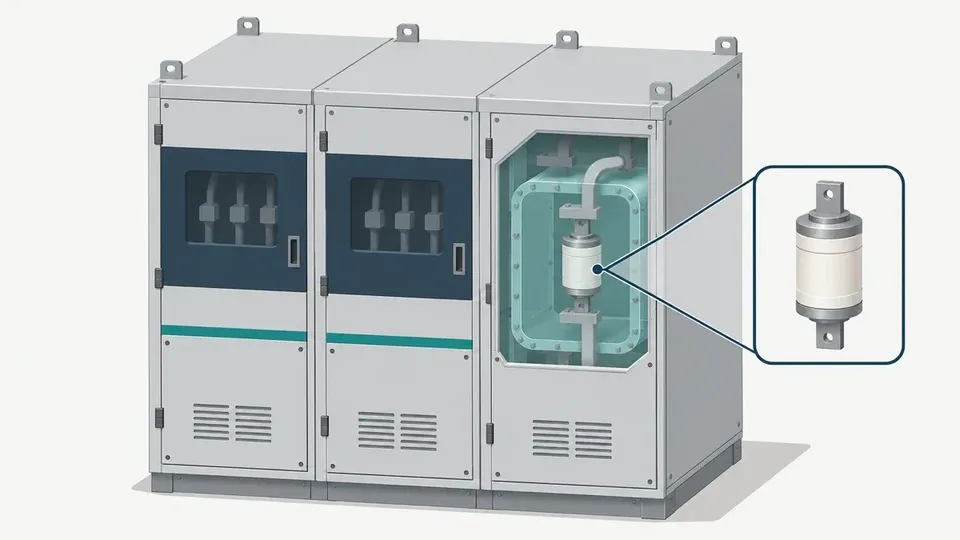
On September 18, 2025, a set of switchgear was energized at Taipower’s Yuli distribution substation in Hualien, according to supplier Lo-Electric Enterprise Corporation. Its job is familiar: connect and disconnect power lines. Inside the cabinet, clean air now insulates the equipment. Sulfur hexafluoride (SF₆), a common insulating gas, has a powerful warming effect when it leaks into the atmosphere. The new design eliminates that source of SF₆ leaks from the cabinet. With one pilot in service, Taiwan has another option to evaluate the next time it buys distribution equipment.1, 2, 3
Inside the cabinet, gas and vacuum do different jobs
Switchgear connects or disconnects circuits. If there’s a short circuit, the circuit breaker isolates the affected line to limit the outage. The cabinet also needs insulation between energized parts packed close together. SF₆ insulates well in a small space, which is why it has long been used in gas-insulated switchgear (GIS).4
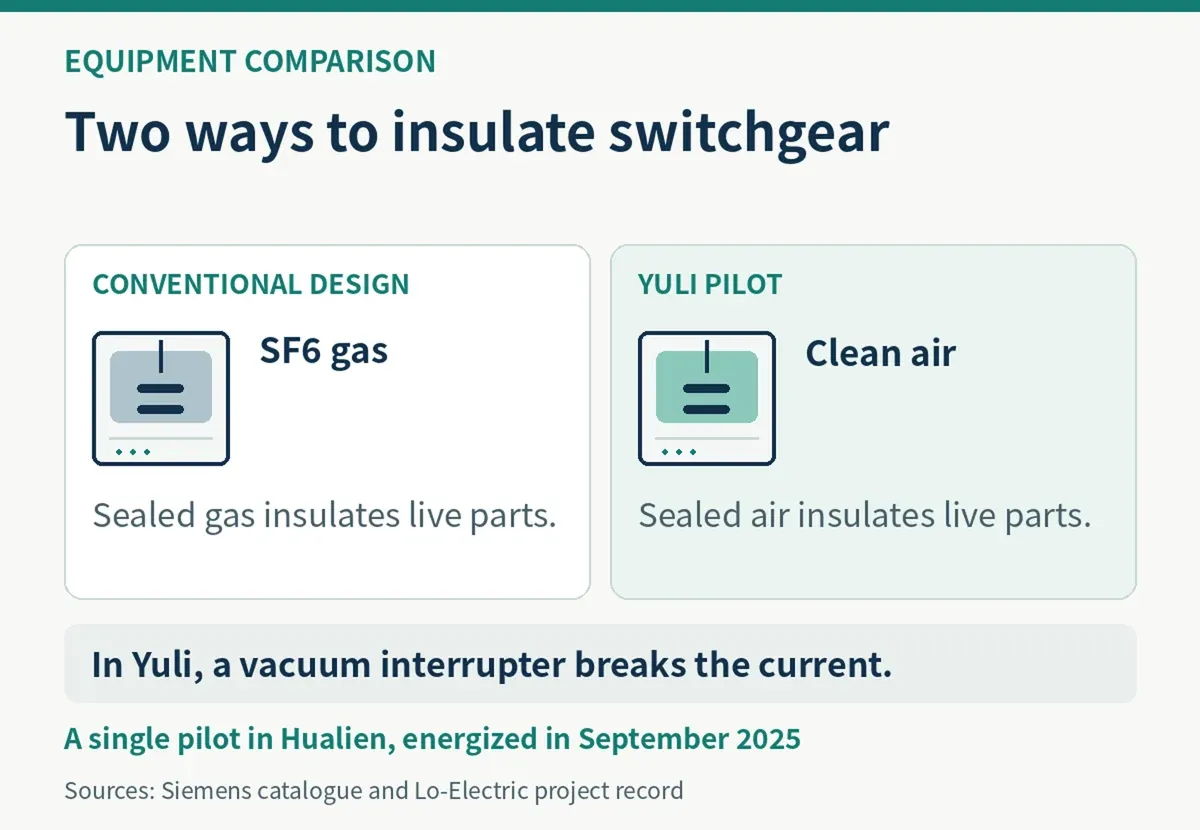
Yuli’s new switchgear uses treated air in a sealed compartment to keep an electrical discharge from jumping between parts. A separate circuit breaker interrupts the current. When its contacts separate, a brief arc forms and goes out in a sealed vacuum interrupter.1, 5
Yuli uses the 8DAB 24, with a maximum rated voltage of 24 kV. Taipower’s manufacturer qualification document lists the corresponding type of distribution equipment in the 23 kV class.1, 6
The gas in existing equipment still needs to be recovered
SF₆ works well inside the cabinet, but it warms the atmosphere if it leaks. On the 100-year scale used in EU regulation, its global warming potential is 24,300 times that of the same mass of carbon dioxide. Taipower’s maintenance practices for existing equipment include recovering, purifying and reusing the gas. Specifying SF₆-free equipment removes a potential source of future leaks, while equipment already in service still needs care. The published record for Yuli describes the installation and connection to the grid. It doesn’t provide the data needed to quantify actual emissions reductions at the site.3, 7, 8
Planning recovery and replacement starts with knowing how much gas is still in the equipment. In November 2026, the UN Climate Technology Centre and Network (CTCN) reported that Kenya had identified about 20 tonnes of installed SF₆, and Senegal’s electric utility Senelec had identified about 24 tonnes. These figures are quantities of gas held in equipment. Estimating how much leaks in a year requires emissions monitoring and maintenance records. At the time of the announcement, both SF₆-free pilots were still in planning or preparation.9
What the next equipment purchase can learn from Yuli
Now that the Yuli pilot is in service, long-term operating and maintenance records can show how it performs. Other substations will have their own checks to make: whether the cabinet fits, whether it can safely interrupt a short circuit, and whether spare parts and trained technicians will be available. If the operating records support further use, utilities can consider SF₆-free switchgear for grid expansion or when existing equipment reaches the end of its service life. The gas in the old cabinets will still need to be recovered when they come out. The value of the pilot is in making both sides of that handover easier to plan.
Sources (9)
Sources
- Siemens: Yuli, Hualien 8DAB 24 clean-air GIS pilot
- Lo-Electric Enterprise Corporation: Energization of the Yuli installation on September 18, 2025
- Ministry of Economic Affairs presentation: Fenglin extra-high-voltage substation, p. 16, Yuli switchgear installation
- Siemens: Medium-voltage switchgear, types 8DA10, 8DB10 and 8DAB 24, technical catalogue HA 35.11
- Siemens: Primary distribution switchgear up to 24 kV, clean-air insulation and vacuum interruption
- Taipower: Manufacturer qualification for gas-insulated switchgear, April 2025 revision
- EU Regulation 2024/573 on fluorinated greenhouse gases, Article 3 and Annex I
- Taipower: Circular economy, recovery and reuse of sulfur hexafluoride from substation equipment
- CTCN: SF₆ inventories and pilot plans in Kenya and Senegal, November 18, 2026
Leave a comment
Comments are reviewed before publication. Email is private and used only when contact is necessary. Privacy notice