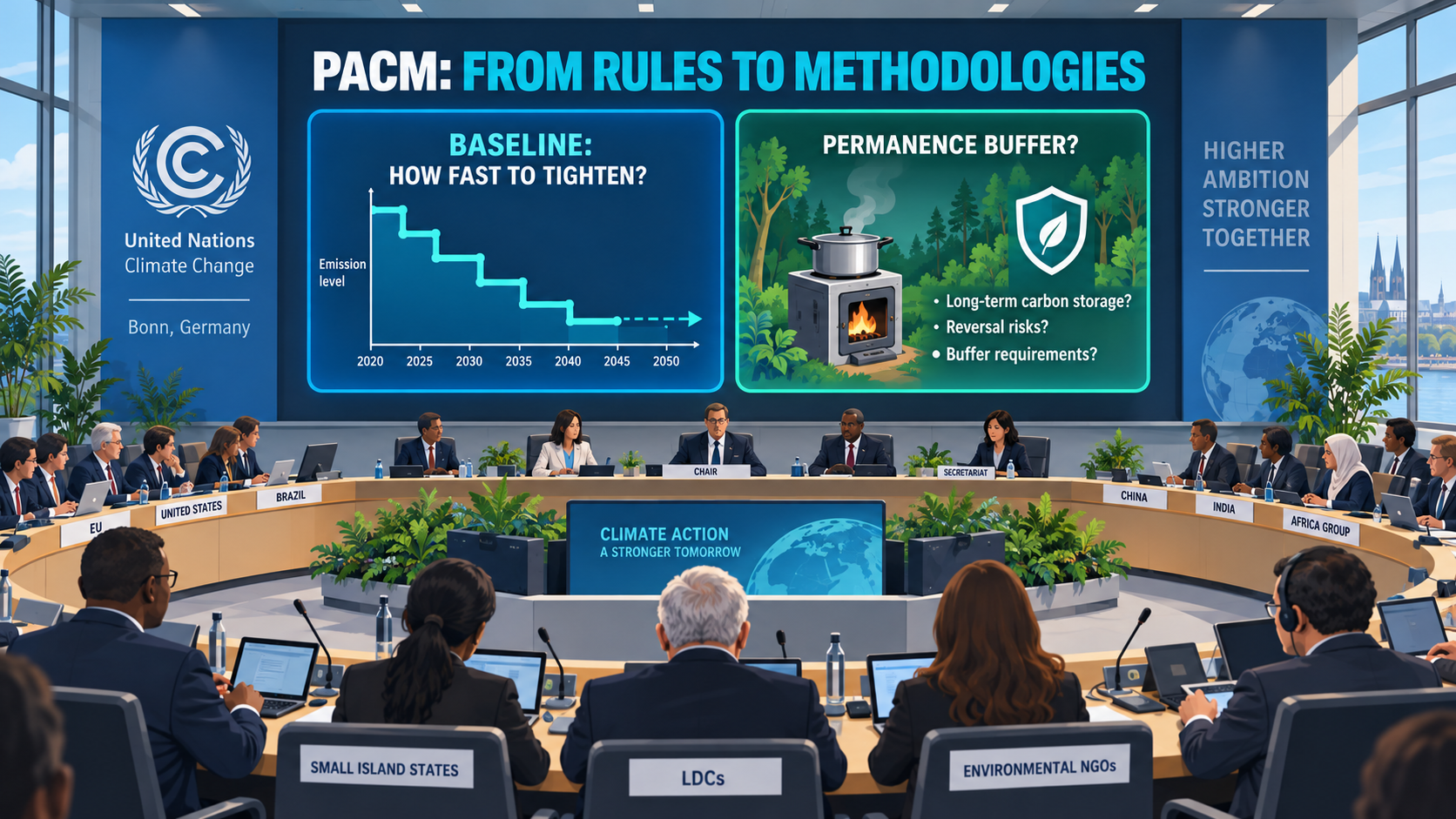
Whether a carbon credit can be trusted often hinges not on grand principles but on the details: how the baseline — "how much would have been emitted without this project?" — is drawn and how often it must be adjusted downward, and whether the carbon that was cut could one day return to the atmosphere. The carbon crediting mechanism the UN set up under Article 6.4 of the Paris Agreement (PACM) has reached exactly the stage where it must answer these questions. Its Supervisory Body is holding its 23rd meeting (SBM 023) in Bonn, Germany, from October 5 to 9, with two cookstove methodologies and a "reversal risk assessment" tool on the agenda. A paywalled feature from UK carbon-market outlet Carbon Pulse described an intensifying fight over how quickly baselines should tighten, as PACM shifts from designing its overarching rules to deciding how those rules apply to individual project types. This article draws only on public UN documents and verifiable reporting to help you make sense of the debate.
Primer: PACM, downward adjustment, reversals and the buffer pool
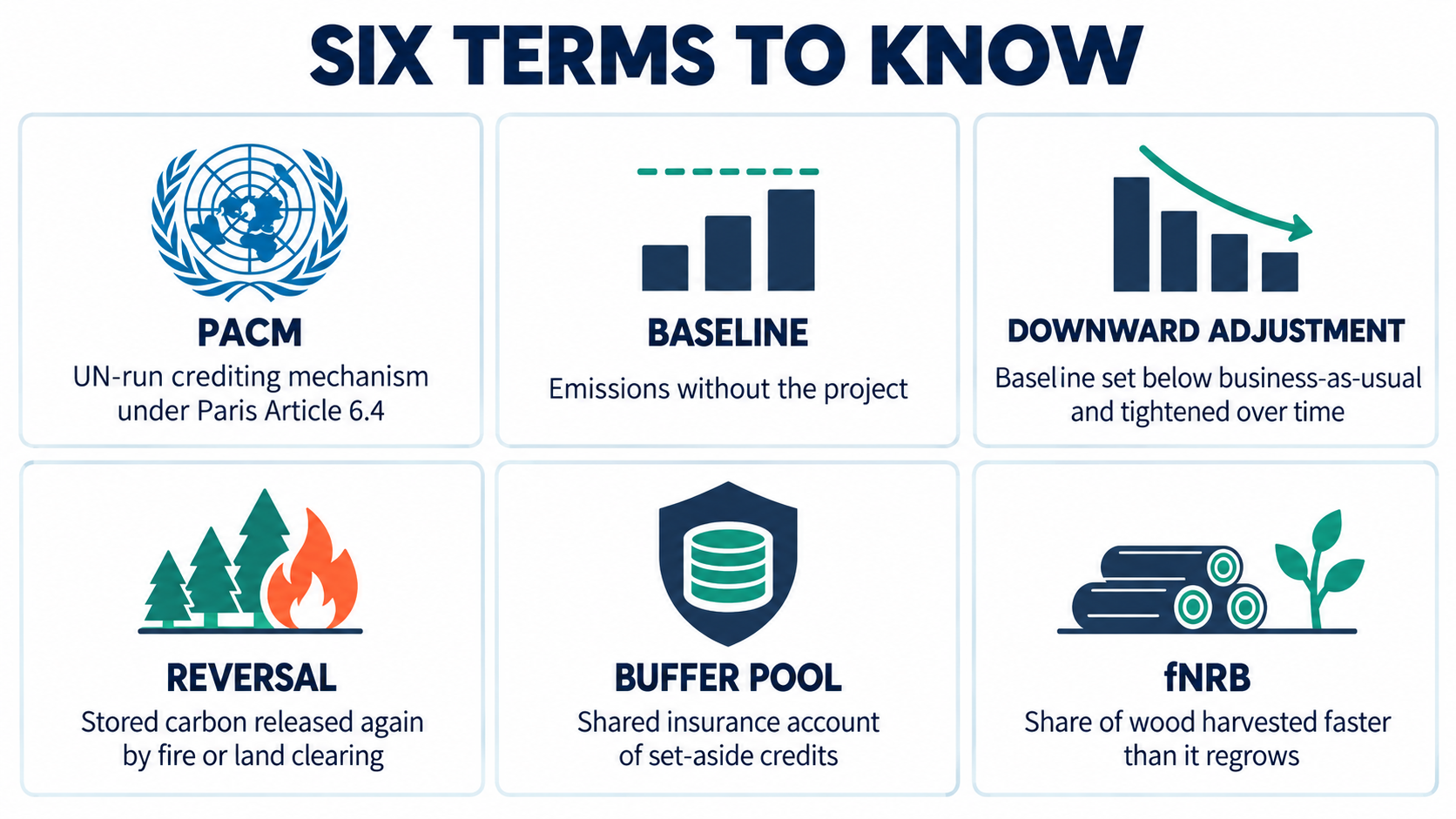
PACM (Paris Agreement Crediting Mechanism): the crediting mechanism established under Article 6.4 of the Paris Agreement and governed by the UN's Supervisory Body, often seen as the successor to the Kyoto-era Clean Development Mechanism (CDM). The credits it issues are called A6.4ERs (Article 6.4 emission reductions). Unlike Article 6.2, where countries deal with each other directly, 6.4 is a centralised mechanism in which the UN manages common rules, methodologies and the registry.
Baseline: the emissions assumed to occur if the project did not exist. A project's reductions equal "baseline minus actual emissions". The higher the baseline is drawn, the more credits a project earns, which puts it at the heart of quality disputes.
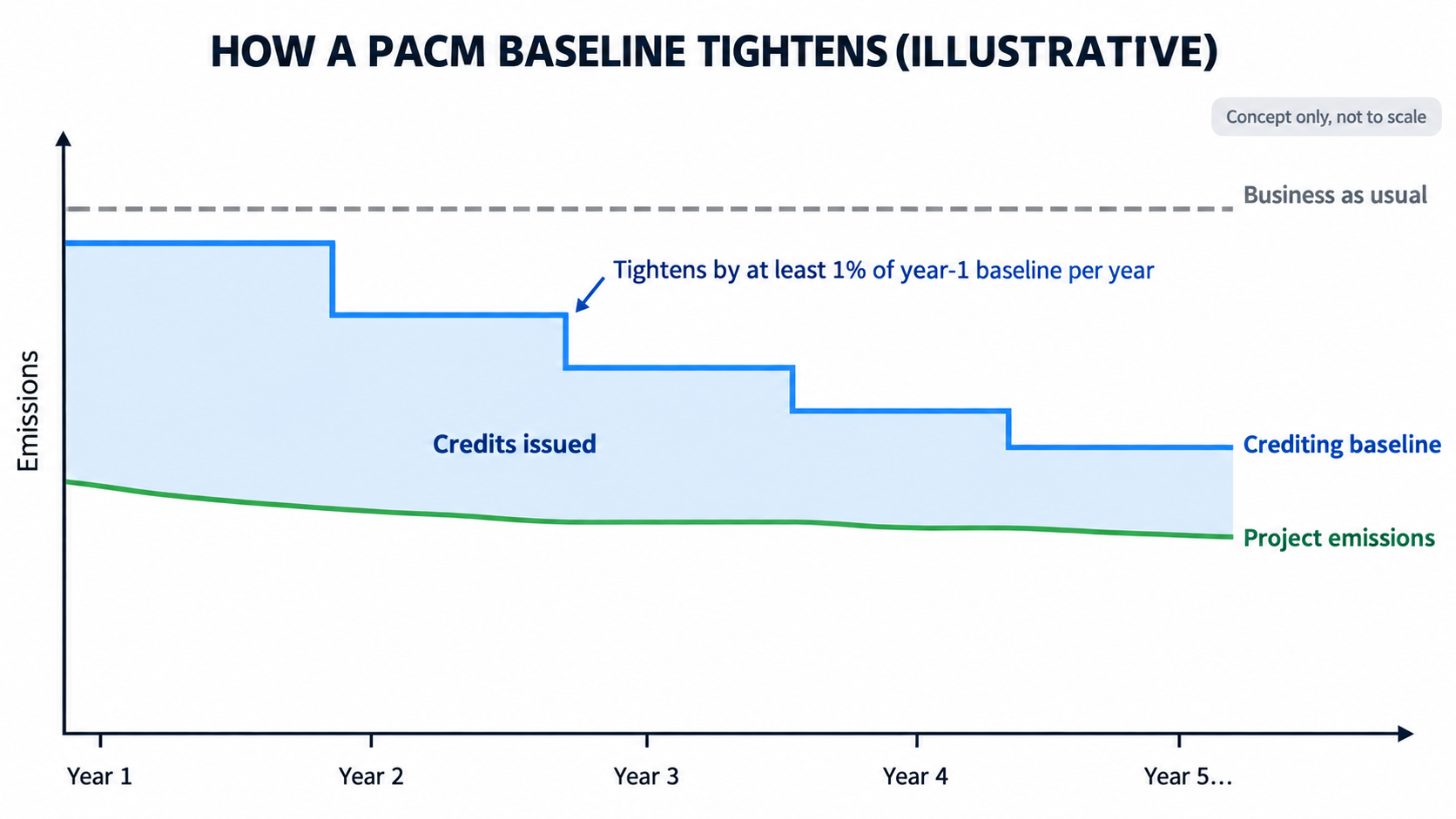
Downward adjustment: PACM rules require baselines to be set below "business as usual" (BAU) and to tighten year after year, so that projects cannot keep earning credits against the same lenient baseline.
Reversal and permanence: carbon stored in forests, soils or geological formations may be released again in the future through fire, logging or leakage; this is a reversal. Credits that involve such "carbon reservoirs" raise a permanence question.
Buffer pool: a kind of collective insurance. Each time a project is issued credits, a share is set aside in a common account; if a reversal occurs anywhere later, credits are cancelled from the pool to make up for it. The more that is set aside, the fewer credits developers can sell.
fNRB (fraction of non-renewable biomass): a key parameter for calculating reductions from cookstove projects, representing the share of harvested fuelwood that exceeds the natural rate of forest regrowth. The higher the fraction, the larger the calculated reductions.
Where PACM stands
PACM's overarching rules were finalised at COP26 in Glasgow in 2021, and the years since have been spent filling in the detailed rules. Progress over the past two years runs roughly as follows:
May 2025: version 1 of the standard "Setting the baseline in mechanism methodologies" took effect, setting out three baseline approaches and the rules for downward adjustment.
October 2025: the standard "Addressing non-permanence and reversals" was adopted, establishing the basic architecture of the buffer pool.
October 2025 to July 2026: the first methodologies were adopted one after another, covering the flaring or use of landfill gas, the abatement of nitrous oxide at nitric acid plants, and grid-connected renewable power generation.
February 26, 2026: the Supervisory Body approved the first-ever A6.4ERs, from an improved cookstove programme in Myanmar that transitioned from the CDM (PoA 10471). Climate Home News reported the first batch at about 60,000 units; the UN said that, because newer and more conservative parameters were applied, issuance was about 40% lower than under the CDM calculation.
September 21, 2026: according to the SBM 023 annotated agenda, 130 countries had designated national authorities for PACM, and 70 had submitted information on meeting the participation requirements.
In other words, PACM is already "open for business", but most project types still have no dedicated methodology. Each methodology adopted effectively sets the quality bar for an entire category of credits, which is why every meeting is so hard-fought.
Test 1: how fast should baselines fall?
Under the baseline standard in force since 2025, a methodology can draw its baseline using one of three approaches: best available technology, an ambitious benchmark (the best-performing 20% or fewer of comparable activities), or existing actual or historical emissions adjusted downward. The key points of the downward-adjustment rules are:
Different starting points: baselines based on best available technology or a benchmark need no downward adjustment in the first year (they are already strict enough); those based on historical emissions must be adjusted downward from the first year according to uncertainty, by at least a set margin.
Tighter every year after that: from the second year, the downward adjustment must grow each year by at least an amount equal to 1% of first-year baseline emissions; it can also be applied in steps every three years.
Exemptions are possible: only methodologies using best available technology or a benchmark can ask the Supervisory Body to approve an exemption from downward adjustment from the second year onward, and the grounds can include economic viability.
The cookstove methodology runs straight into this question. According to the SBM 023 annotated agenda, the Methodological Expert Panel (MEP) recommends that the Supervisory Body consider exempting the "Energy efficiency measures in household cooking" methodology from downward adjustment from the second year onward. Another point of contention is how to calculate the benchmark: in July, the Supervisory Body asked the panel to assess whether the "median" would be more representative when data are heavily skewed (for example, when a small number of highly efficient induction stoves pull up the weighted average of the top performers). The panel's indicative "baseline cookstove efficiency" figures were: about 16.6% for the weighted average of the top 20%; about 14.0% for the downward-adjusted historical-emissions approach; and only about 11.8% for the median of the top 20%. The lower the baseline cookstove efficiency, the more wasteful the starting point is assumed to be, and the larger the calculated reductions. The panel concluded that using the median would put the baseline at the "business as usual" level, so it could no longer count as "ambitious", and that any such change would first require amending the baseline standard itself.
Pushback from the market has been just as direct. Fastmarkets reported that Pascal Siegwart, vice president for carbon markets at TotalEnergies, wrote on LinkedIn that the buffer pool, the downward adjustment factor and the uncertainty deductions are each enough on their own to halt new clean-cooking investment. He argued that quality should be secured through science-based fNRB and stronger monitoring, reporting and verification, rather than "stacked discounts".
Test 2: should cookstove credits pay for "permanence insurance"?
This is the most closely watched question of the meeting. Intuitively, cookstove projects are about "burning less wood", so how could the emissions they avoid be "reversed"? The logic set out in a 40-page explanatory note that the expert panel published in September goes like this:
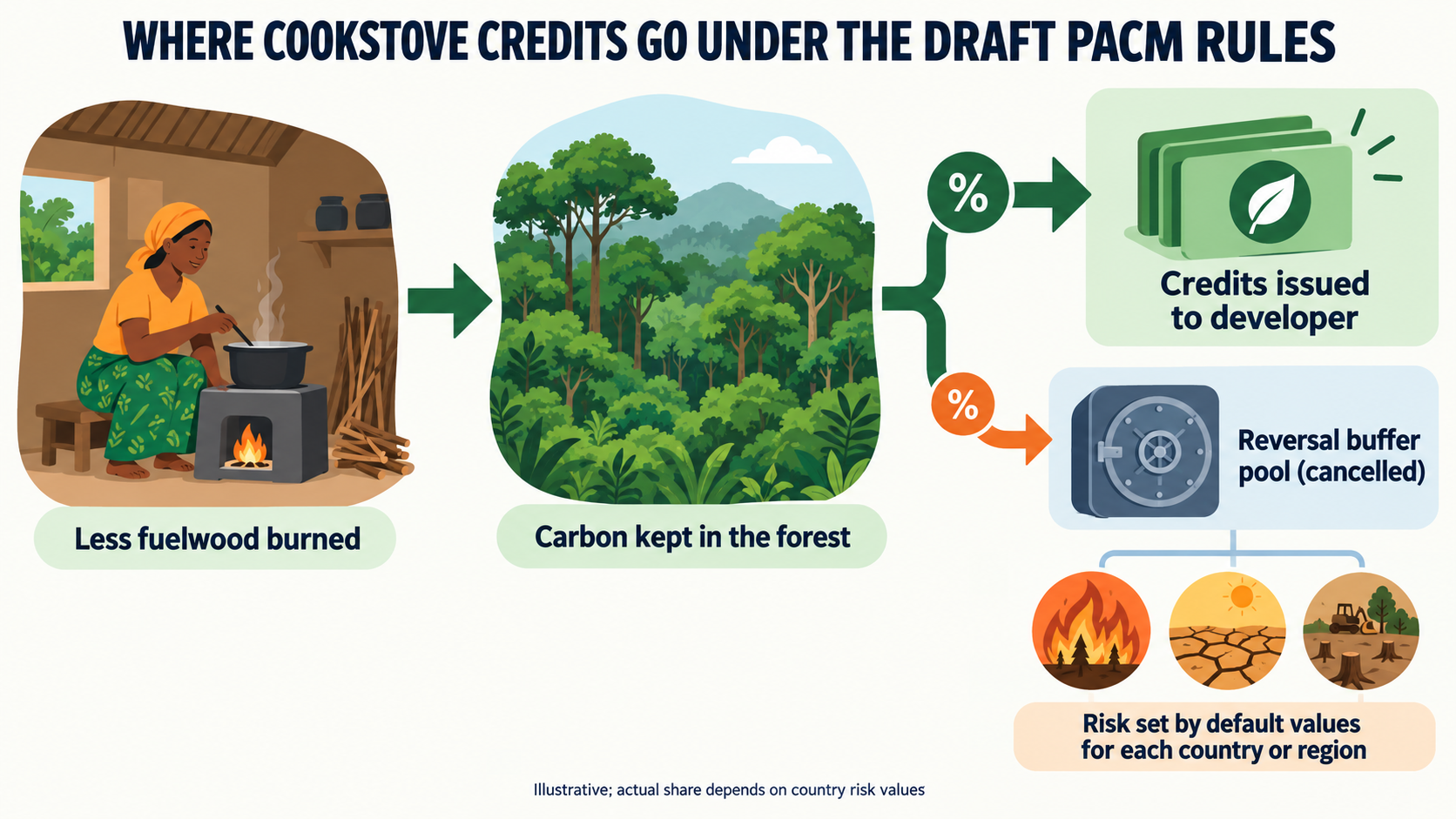
Cookstove reductions are, at heart, about preserving forest carbon stocks. Wood that is not cut keeps its carbon in the forest. Precisely because reductions are converted via fNRB into "how much non-renewable biomass was saved", that preserved carbon could likewise be lost in the future to wildfire, drought or land development.
If it cannot count as a reversal, it cannot count as a reduction. The panel argues that if one claims the carbon stocks affected by cookstoves cannot be identified or attributed, the same reasoning would undermine the reductions themselves.
Over-crediting and permanence are two separate issues. The first is about whether the numbers are accurate, the second about whether the gains last; conservativeness on one should not be used to offset the requirements of the other.
Under the draft design, projects do not have to monitor forests themselves; instead, they apply default risk values set by country or region. Natural risk (wildfire and other natural disturbances) is estimated from satellite data and climate models. For human-induced risk, the panel recommends that the Supervisory Body choose a default value between 20% and 45%, which can be reduced further if the host country's nationally determined contribution covers the land sector, if it has a long-term low-emission development strategy, or if it has met the REDD+ requirements (with combined reductions proposed at 20% to 80%). According to draft figures compiled by Fastmarkets, default natural-risk values in major cookstove markets range from 7.4% in Kenya to 22.3% in Laos.
How big is the impact? The panel worked through hypothetical examples: of the roughly 0.39 tonnes of reductions per household per year from a fuelwood-efficiency stove, about 83% is subject to reversal risk; at a 50% buffer contribution rate, actual issuance falls to about 0.23 tonnes per household. A charcoal-to-electricity example falls from 0.84 to 0.79 tonnes under a 10% contribution scenario. The panel also acknowledges that PACM will issue markedly fewer cookstove credits than comparable projects receive under other crediting standards, so prices would have to be higher to keep projects financially viable.
This is where PACM diverges most from current market practice:
Gold Standard: on the grounds that developers have no control over forest carbon stocks, it classifies cookstoves under a "No Control" exemption and spares them from the buffer pool.
Global Carbon Council: it exempts them because the impact is diffuse and cannot in practice be attributed to individual projects, arguing that conservative fNRB values already cover the risk indirectly.
Verra (VM0050): it applies a fixed 0.95 discount factor that bundles reversals together with other leakage.
ICVCM (Integrity Council for the Voluntary Carbon Market): it considers that there is currently no reliable way to systematically assess reversal risk for cookstoves, and does not require it for now.
Developers and some market participants want the vote postponed. According to Fastmarkets, at a September 29 webinar held by the International Emissions Trading Association (IETA), participants said they had only just received the panel's detailed explanation and needed more time to assess the combined impact of the stacked deductions; Pedro Barata of the Environmental Defense Fund (EDF) said the current approach risked "over-indexing" integrity. Meanwhile, at least 130 civil society groups called, after the meeting opened, for the first A6.4ERs to be suspended and for an independent assessment of the Myanmar cookstove programme, citing verification, human-rights safeguards and whether the reductions were overstated.
A second ledger: squaring buffer-pool credits with national carbon accounts
The Supervisory Body is also due to discuss a concept note: when credits that a host country has "authorized" for use toward other countries' targets or other international purposes are contributed to the buffer pool, how should the host country account for them against its nationally determined contribution (NDC)? Until the Supervisory Body decides, units transferred to the buffer pool are treated as "forwarded", without counting as a first transfer. It may look like a technical detail, but it affects whether host countries are willing to grant authorization, and how many credits cross-border buyers actually receive.
Is there a decision yet?
As of writing (October 9, 2026, the final day of the meeting), the UN has not yet published the decisions of SBM 023. If the vote is postponed, Fastmarkets reports, the next Supervisory Body meeting will not take place until February 2027, and the issue could spill over into COP31, to be held in Türkiye from November 9 to 20. We will update this article once the meeting report is published.
How this connects to our other articles
The CORSIA credit crunch: our article "A 175-Million-Tonne Gap: CORSIA's Carbon Credit Crunch and Where Taiwan's Airlines Stand" noted that eligible credits are in severely short supply and that letters of authorization have become critical. According to Fastmarkets, the Myanmar programme behind the first A6.4ERs has obtained host-country authorization covering use toward other countries' NDCs and other international mitigation purposes (including CORSIA); but the same report noted that, as of March 2026, PACM had not yet been approved by the ICAO Technical Advisory Body, so these credits cannot yet be labelled CORSIA-eligible. If PACM does qualify in the future, the stricter the cookstove rules, the scarcer and pricier this supply will be, which would in turn affect airlines' carbon-credit costs.
Canada's ITMO framework: our article "Canada Develops ITMO Framework to Bring Companies Into Paris Agreement Article 6 Carbon Markets" looked at Article 6.2, under which countries deal with each other directly. Article 6.4, by contrast, is a single UN rulebook, yet both emphasise additionality, avoiding double counting, and permanence; once PACM methodologies are settled, they are likely to become a reference bar for countries negotiating 6.2 agreements.
The ISO 14060 net-zero standard: our article "ISO 14060 Draft Released" noted that corporate transition plans must explain whether and how carbon credits are used. PACM's baseline and permanence requirements give companies a public yardstick for judging "which credits are worth using".
Carbon storage is on the list too: the reversal risk tool currently applies only to cookstove projects, but the panel says it is working on versions for forests, geological storage and biochar. If carbon capture and storage, a focus of this site, is to earn credits under PACM in the future, it will face the same permanence and buffer-pool rules.
Our view: stricter rules mean fewer, pricier credits — and that is the price of "quality"
The reading below is this site's own and does not represent the position of the UN or any other institution.
PACM is drawing an "international quality line" for carbon credits. From a first issuance already 40% smaller than under the CDM method to a possible buffer-pool deduction for cookstoves, PACM's direction is clear: issue less, but make it stand up to scrutiny. This will widen the price gap between PACM credits and conventional voluntary-market credits.
The permanence debate has no textbook answer, only trade-offs. Not deducting would invite criticism that PACM is breaching the requirement in its own rules to address reversals "in full", and would put afforestation and carbon-removal projects that must contribute to the buffer at a cost disadvantage; deducting too much could make clean-cooking projects, which bring real health benefits to low-income households, unviable. Whatever number the Supervisory Body finally picks is, in effect, a policy judgment; the panel itself concedes that the pros and cons depend on each party's perspective and that the net impact is hard to predict.
Baseline downward adjustment is designed to make credits harder to earn every year. For buyers, this means the number of credits the same project can sell will decline year by year, and long-term offtake contracts need to factor that in.
For Taiwan, which is not a Party to the United Nations Framework Convention on Climate Change and so cannot develop projects under PACM as a host country, the more likely role is that of a buyer and a student of the rules:
Corporate procurement: for companies with international customers or aviation carbon-credit needs, PACM's baseline and permanence requirements will be an important reference when assessing credits; price alone should not decide.
Policy alignment: Taiwan's Ministry of Environment says its cooperation with Paraguay is meant to generate internationally transferred mitigation outcomes under Article 6, with corresponding adjustments, as the basis for recognising overseas credits that can offset up to 5% of carbon-fee obligations. Whether, and how, the recognition criteria for overseas credits should draw on PACM's methodology requirements is worth discussing early on the policy side.
Domestic methodologies: whether methodologies for Taiwan's domestic voluntary emission reduction projects also need features such as "baselines that tighten every year" and "permanence risk" is worth reviewing while PACM's rules are taking shape.
Sources
UNFCCC, 23rd meeting of the Article 6.4 Supervisory Body (SBM 023), meeting page
UNFCCC, A6.4-SBM023-AA: Annotated agenda, twenty-third meeting of the Supervisory Body (2026-09-21)
UNFCCC, A6.4-MEP016-A07: Draft methodological tool: Reversal risk assessment (version 02.0)
UNFCCC, A6.4-STAN-METH-004: Standard: Setting the baseline in mechanism methodologies (version 01.0)
UNFCCC, Meetings of the Article 6.4 Supervisory Body (past meetings and adopted documents)