
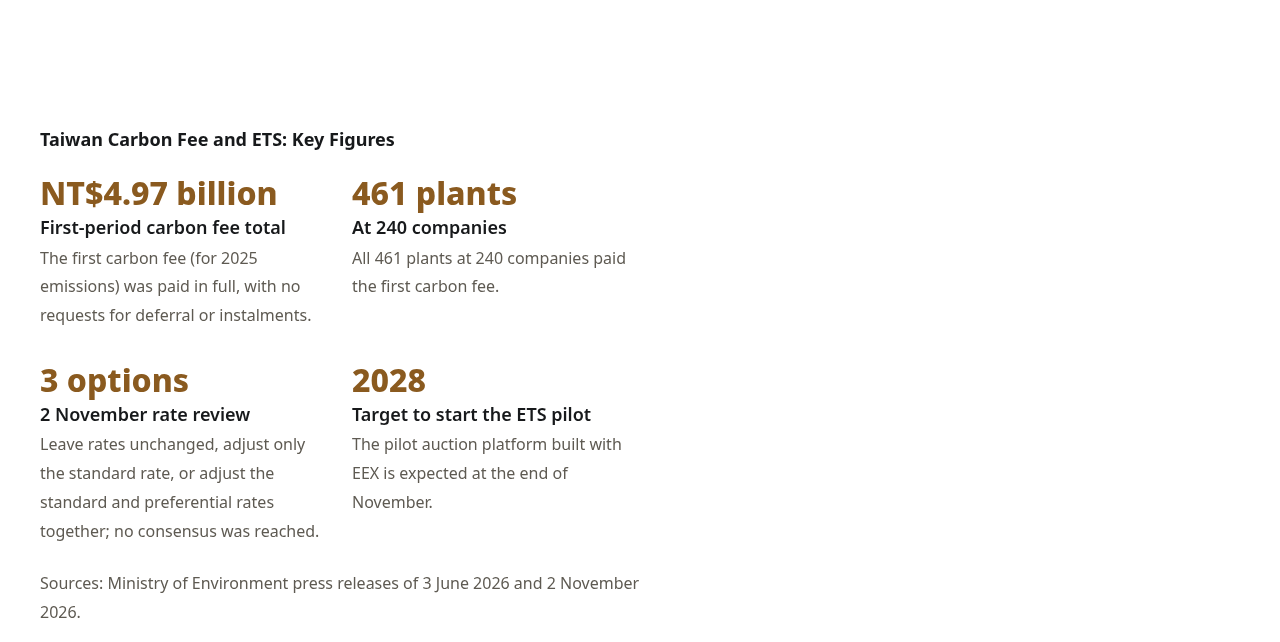
Taiwan's carbon pricing is moving from a single carbon fee to a dual track of the carbon fee plus a cap-and-trade emissions trading system (ETS). The Ministry of Environment announced this direction on September 15, 2026, aiming to start an ETS pilot in 2028. A pilot auction platform built by the Taiwan Carbon Solution Exchange and the European Energy Exchange (EEX) is expected to go live at the end of November. The second carbon-fee rate review committee met on 2 November 2026. The Ministry of Environment put forward three options: leaving rates unchanged, adjusting only the standard rate, or adjusting the standard and preferential rates together. The meeting did not reach a consensus, and the ministry was asked to provide additional material before further review.
Key terms
Carbon fee: under the Climate Change Response Act and the Carbon Fee Collection Regulations, levied on power, gas and manufacturing facilities emitting 25,000 tCO2e or more a year (including indirect emissions from electricity).
Voluntary reduction plans: companies with an approved plan that meet set targets pay preferential rates.
ETS: the government sets a cap and allocates or auctions allowances, and trading sets the price.
Carbon leakage and CBAM: leakage is production and emissions moving to less regulated countries; Taiwan applies adjustment factors to high-leakage-risk businesses. The EU Carbon Border Adjustment Mechanism (CBAM) charges for embedded emissions in imported steel, cement, aluminium, fertilisers, electricity and hydrogen.
1. The dual-track plan
The first carbon fee (for 2025 emissions) was paid in full by 461 plants at 240 companies, totalling NT$4.97 billion, with no requests for deferral or instalments. Minister Peng Chi-ming said on September 15 that the fee offers stable, predictable prices, while an ETS fixes total emissions first and ties more closely to national targets. The pilot plan:
Participants: large emitters with voluntary reduction plans, on a voluntary basis. CNA and the Liberty Times report about 20 companies initially, covering about 80% of regulated emissions.
Timeline: a draft pilot plan by the end of this year, rules completed next year, and a pilot start in 2028.
Platform: the pilot auction platform with EEX is expected at the end of November.

The Economic Daily News reported on October 12 that the pilot will have two phases: the first involves no money, with companies simulating monthly auctions using allocated allowances; real trading comes in the second phase after the fee regulations and cap-and-trade rules are amended. The Climate Change Administration stressed that the same emissions will not be charged twice.
2. Rates and who pays
Rates announced on October 21, 2024 and in effect from January 1, 2025:
| Rate | Per tonne CO2e | Applies to |
|---|---|---|
| General rate | NT$300 | Those not eligible for a preferential rate |
| Preferential rate A | NT$50 | Voluntary reduction plan meets the "sector-specific designated reduction rate" |
| Preferential rate B | NT$100 | Voluntary reduction plan meets the "technology-benchmark designated reduction rate" |

The ministry has approved 402 voluntary reduction plans: 64 plants at Rate A and 338 at Rate B, with estimated reductions of 47.45 million tonnes by 2030 (the Economic Daily News cites 403 plants; we use the ministry's June 3 release).
Under Article 5 of the regulations, chargeable emissions = (annual emissions − K) × adjustment factor. For ordinary businesses K is 25,000 tonnes and the factor is 1; for high-leakage-risk businesses with an approved plan, K is zero and the factor is 0.2, 0.4 and 0.6 over three periods. Our illustration: an ordinary business emitting 100,000 tonnes pays (100,000 − 25,000) × NT$300 = NT$22.5 million at the general rate, or NT$7.5 million at Rate B.
Semiconductors paid about NT$2.2 billion (44.3%), followed by power supply (12.77%), chemical materials (10.97%) and steel (8.06%). Because indirect emissions from electricity count, power-intensive electronics firms are covered.
The first review committee used NT$1,200–1,800 per tonne by 2030 as a reference path. Rates are set for two-year periods, and 2027–2028 emissions fall under the second phase. The Economic Daily News reported that a member noted more than 20 companies chose to pay the general rate rather than apply for preferential rates, suggesting room for a large increase; officials said at least two or three more meetings are needed to reach consensus.
3. Effects on companies
Large emitters: pilot participants will start practising allowance management, auction bidding and internal carbon pricing.
Exporters: whether Taiwan's fee can offset part of the CBAM charge affects export costs.
Credit buyers: domestic reduction credits can cover up to 10% of chargeable emissions and recognized foreign credits up to 5% (not available to high-leakage-risk businesses); domestic voluntary project credits count at a ratio of 1.2. The Taiwan Carbon Solution Exchange is the only body commissioned by the ministry to run domestic credit trading and auctions.
4. The EU CBAM price and the "carbon price paid" rule
On October 5 the European Commission set the Q3 2026 CBAM certificate price at €82.32 per tonne, about 9% above Q2's €75.28, based on weighted EU ETS auction prices; prices are published quarterly in 2026 and weekly from 2027. The definitive period began on January 1, 2026; certificates go on sale on February 1, 2027, and the first declaration and surrender for 2026 imports is due September 30, 2027.
Article 9 of the CBAM Regulation allows deduction of a carbon price actually paid in the country of origin, net of rebates or other compensation; Carbon Pulse reports the Commission is moving to adopt rules on which foreign prices qualify. Taiwan's preferential rates, K values and adjustment factors could therefore affect the amount the EU recognizes. Ministry adviser and German emissions trading expert Jürgen Landgrebe said in September that ETSs with similar caps, MRV and market rules link more easily than fees. On EU–UK linking, see "UK and EU carbon markets are about to "link up"".
5. What it means for companies and CCS
Peng said in September that cutting a tonne of CO2 may cost NT$3,000 to over NT$6,000, above the current fee, and the ETS is expected to bring carbon management into corporate governance and sustainable finance. For CCS, the ministry issued the Regulations for CO2 Storage after Capture on August 25, 2026, covering storage permits and monitoring; the fee regulations allow deductions through reduction credits and offsets, and we found no provision for deducting stored volumes. Voluntary project boundaries also may not include sources liable for the fee.

Companies can start by checking chargeable emissions and factors, reviewing voluntary plan progress (due by April 30 each year), assessing whether to join the ETS pilot and adding carbon price scenarios to investment models.
6. How the first-round carbon-fee revenue may be used, and the “net-zero coin” debate
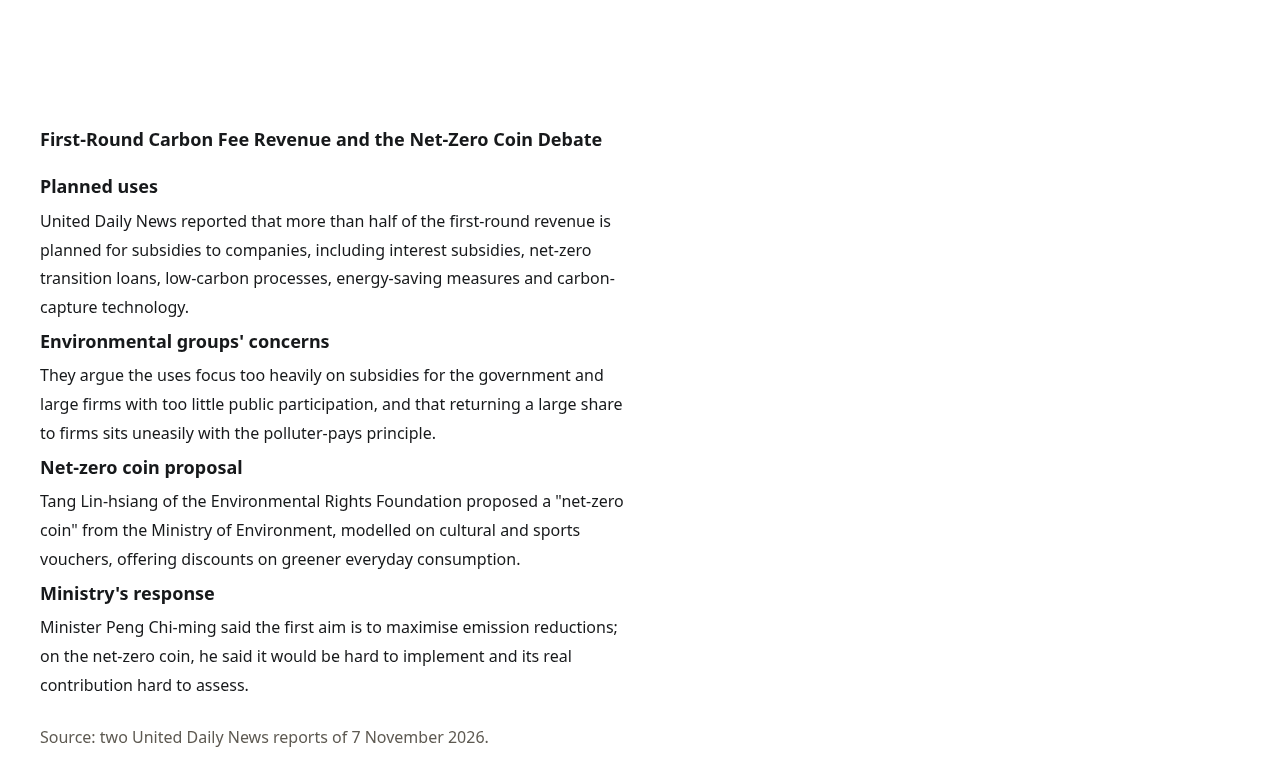
United Daily News reported on 7 November 2026 that more than half of the first-round carbon-fee revenue is planned for subsidies to companies, including interest subsidies, net-zero transition loans, low-carbon processes, energy-saving measures and carbon-capture technology. Environmental groups quoted in the report argued that the uses focus too heavily on subsidies for the government and large firms, with too little public participation, and do not ease concerns that companies will pass the fee on to consumers; they also said that returning a large share of a fee collected from firms back to those firms sits uneasily with the polluter-pays principle and gives too little weight to disadvantaged groups and a just transition.
According to the same report, Tang Lin-hsiang of the Environmental Rights Foundation proposed that the Ministry of Environment launch a “net-zero coin,” modelled on cultural and sports vouchers, offering discounts on greener everyday consumption. In his view, people are more likely to support a higher carbon-fee rate later if they actually receive a dividend from carbon pricing. He cited rebate or investment practices in Canada, Switzerland and California, and suggested that rules on grants to local governments direct some funds to disadvantaged groups. Lin Yen-ting, a senior researcher at the Taiwan Climate Action Network, argued from the transport side that the fee should be integrated with net-zero mobility, citing Seoul’s Climate Card as an example.
Minister of Environment Peng Chi-ming said the first aim in using the revenue is to maximise emission reductions. On the net-zero coin, he said it would be hard to implement and that its real contribution to national reduction targets would also be hard to assess. The spirit of the fee, he said, is whether “one dollar of spending can deliver five dollars of reduction benefit,” so that companies spend their own money and are steered toward process changes. Tsai Ling-yi, director-general of the Ministry’s Climate Change Administration, added that the Climate Change Response Act already sets out the uses of the revenue, with reduction and adaptation as the main items; existing measures already include replacing air-conditioners and installing energy-saving equipment for disadvantaged groups, and interest from long-term care and residential care institutions has been high. The report also noted that the “Green Points” scheme can be redeemed for coffee and small prizes at convenience stores, or used to offset some public-transport fares; a participant interviewed for the story said the material reward is modest.
Still undecided
The second-phase rate and whether two phases will be announced at once; the ETS pilot's cap, allocation, price limits and revenue use (draft plan due at year-end); whether large emitters will all move into the ETS (to be reviewed based on pilot results and legal amendments); how CCS storage will be credited; and the EU's detailed "carbon price paid" rules.
Our view
This is our own reading, not that of the ministry or any agency.
The nature of Taiwan's carbon price is changing: a fee is simply paid, while ETS allowances can be traded and need active management. Because CBAM recognizes only prices actually paid, exporters on preferential domestic rates may need to cover the difference in the EU. With the storage regulations in force, whether stored CO2 can be credited under the fee or ETS will determine whether CCS in Taiwan moves from demonstrations to investments backed by a carbon price.
Sources (22)
Sources
- Ministry of Environment, Taiwan, “Carbon-fee rate review meeting: whether to adjust rates requires further material and another review,” 2 November 2026: https://enews.moenv.gov.tw/moenv-news/zh-tw/News/14412
- Central News Agency, “Ministry of Environment puts forward three carbon-fee options; review committee reaches no consensus,” 2 November 2026: https://www.cna.com.tw/news/ahel/202611020269.aspx
- United Daily News, Li Bo-hao, “Who enjoys the dividend? Over half the carbon fee may subsidise companies; civic groups object,” 7 November 2026: https://udn.com/news/story/7314/9863036
- United Daily News, Li Bo-hao, “Peng Chi-ming: the carbon-reduction benefit of a net-zero coin is hard to assess,” 7 November 2026: https://udn.com/news/story/7314/9862948
Ministry of Environment announcement: Carbon Fee Rates (2024-10-21)
Regulations for the Management of Voluntary Greenhouse Gas Reduction Projects (2023-10-12)
Regulations for the Management of Post-Capture CO2 Storage (2026-08-25)
Climate Change Administration, Carbon Fee Rate Review Committee members (date not stated)
Liberty Times (in Chinese), ETS pilot in 2028 with 20 large emitters first (2026-09-16)
European Commission, Price of CBAM certificates (2026-10-05)
European Commission, CBAM definitive regime (date not stated)
European Commission, CBAM Questions and Answers (date not stated)
Leave a comment
Comments are reviewed before publication. Email is private and used only when contact is necessary. Privacy notice